Posted in Reading Reviewed, Robert Silverberg, Science Fiction at 10:00 on 4 February 2017
Dell Magazines
 Sarah Pinsker’s Guest Editorial That’s Far Out, So You Read it Too? muses on the connections, and the similarities, between SF and music. Robert Silverberg’s Reflections examines the possibility and desirability of resurrecting the Dodo genetically. Peter Heck’s On Books1 discusses novels by Lois McMaster Bujold, Charles Stross, Pierce Brown, Tim Powers, Indra Das and Lavie Tidhar.
In the fiction:-
They All Have One Breath2 by Alexander Jablokov explicitly references E M Forster’s The Machine Stops in a tale of a world taken over by AIs, where all acts of violence have been made impossible.
Empty Shoes by the Lake by Octavia Cade is the tale of two people from a backwoods town; Rafi who gets out, makes pottery and sends his first bowl (cracked) to the other, Becca, who sees visions in the puddles left by the water that seeps out of it.
In HigherWorks3 by Gregory Norman Bossert a black refugee from a US turned to fascism to an almost equally fascistic UK has the knowledge to allow nanotechnology to connect minds together.
The extremely short How the Damned Live On by James Sallis is set on an unspecified island which contains a giant speaking spider which experiences time differently from our human narrator.
The island in The Cold Side of the Island4 by Kali Wallace is somewhere off the north east coast of the US. One day three youngsters find a set of unidentifiable bones in the woods, bones which bind then even though they’ve drifted apart.
Where There is Nothing: There Is God5 by David Erik Nelson features a jobbing actor travelling back in time to 1770 Massachusetts to ply the locals with crystal meth in return for silverware stamped with the mark of Paul Revere.
Pedant’s corner: 1 have showed (shown,) “a team who’s assessing” (a team which is assessing,) “there are a number” (there is a number,) Stross’s (√) yet also Powers’ (be consistent at least.) 2Polykleitos’ (Polykleitos’s.) 3”The couple are” (the couple is,) “a gaggle of girls… stumble” (a gaggle stumbles,) Blue tats’ (Blue tats is a nickname, so is singular; hence Blue tats’s,) “‘a economic refugee’” (even in dialogue that ought to be an economic refugee,) “an photographic print” (a,) “A flock of microdrones spiral” (a flock spirals,) “like a hole in the dancers hair” (dancer’s,) “as she looses the thread” (loses.) 4”Each phalanges” (each phalange, or phalanx,) “a knobby knitted hit” (Hurrah for knitted but the hit should have been a hat.) 5Charles’ (Charles’s,) largess (largesse. Is largess a USian spelling?) James’ (James’s,) maw (it’s a stomach, not a mouth,) “asking ‘Well…’” (no comma preceding the direct speech) “none were drawn” (none was drawn,) Means’ (Means’s.)
No Comments »
Posted in Reading Reviewed, Robert Silverberg, Science Fiction at 20:00 on 18 December 2016
Special Slightly Spooky Issue. Dell Magazines.
 Editorial: Our Slightly Spooky Issue Asimov’s1 by Sheila Williams reminisces about all the issues of Asimov’s tinged with the uncanny which she has published around Halloween time.
Reflections: Magical Thinking by Robert Silverberg considers Lynn Thorndike’s “magisterial” A History of Magic and Experimental Science “an extraordinary treasurehouse of human thought in all its folly and grandeur.”
On the NET: Welcome Our Robot Overlords!2 by James Patrick Kelly examines the state of AI development.
In an excellent On Books:3 Norman Spinrad, for the first time in his reviewing career at Asimov’s dealing with short story collections/anthologies, notes the tendency for works of fantasy to dominate SF awards (and outlets,) in effect the colonisation of SF by “literary” craftspeople looking for a market (all but the only market,) and the necessity for story and style to be combined to make any fictional work outstanding. He decries the necessity for an author to have a “voice” as the style a tale is told in ought to serve the story, not the ego of its author.
In the fiction, Alexander Jablokov’s The Forgotten Taste of Honey4 sees viewpoint character Tromvi have to take a corpse back to the land it came from in order to please the gods. A transfer of memories from the corpse to Tromvi via the honey from a hive inside the body thwarts the man who tries to prevent him.
In Eating Science with Ghosts by Octavia Cade our unnamed narrator goes about eating and drinking with the ghosts of scientists and explorers, ghosts only she can see.
The People in the Building5 by Sandra McDonald describes the occupants of said building – including the interplanetary rescue service on the third floor which has unwisely as it turns out revived an ancient god from a nearby swamp.
Wretched the Romantic by Michael Libling is narrated by Richard, a loser who takes up scattering ashes as a scam once he discovers he has taken on the attributes of the deceased after accidentally inhaling them.
Water Scorpions6 by Rich Larson is set in the aftermath of the crash of an alien spaceship in the Sahara. One of their offspring, genetically modified to make them more human-like, is taken into the family of an ethnobiologist.
In The Leaning Lincoln7 by Will Ludwigstein, said figure is a toy made from a lead ingot salvaged from the shore. It has baleful properties.
Lucite8 by Susan Palwick sees a visitor to an attraction based on Dante’s Inferno take home a dead person’s soul in a lucite box.
Project Entropy9 by Dominica Phetteplace is another in the author’s series on AIs in San Francisco. My heart has begun to sink when I see her name on Asimov’s cover.
When Grandfather Returns10 by S N Dyer is a tale of the appearance among the Navaho of Cabeza De Vaca and his followers and their displacement to the present day.
In Choose Poison, Choose Life11 by Michael Blumlein a woman who has an unfortunate taste in men is variously, and in various guises, saved from, or saves herself from, suicide.
Pedant’s corner:- 1Joel Richards’ (Richards’s.) 2easily your best source the very latest news (of the latest news,) 3Henry James’ (James’s,) a epiphany climax (an,) Gunther Grass’ (Grass’s,) “what the differences between the two, are and stronger “ (between the two are, and stronger.) 4an ewer (I suppose since ewer starts with a vowel this is technically correct, but… It is sounded as a consonant so “a ewer” would be fine by me,) “maw” used for part of a ruminant’s stomach (hurray!) 5new emotions arrives (arrive.) 6sked (seems to be a USian abbreviation for schedule. I was of course thoroughly confused as I pronounce schedule as “shed-yule”.) 7Tutankhamen, (Tutankhamun.) 8McManus’ (McManus’s.) 9negress (we’re back to using n-words now?) 10Thunder Cries’ (Thunder Cries’s,) Rabbit Smile’s (name was previously Rabbit Smiles: the later Rabbit Smiles’ should be Rabbit Smiles’s,) 11to portage the water (“portage”? What on Earth is wrong with “carry”?)
No Comments »
Posted in Fantasy, Reading Reviewed, Robert Silverberg, Science Fiction at 12:00 on 1 August 2016
Dell Magazines, 192 p.
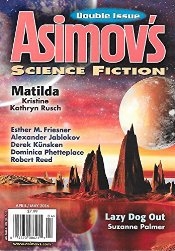
The third issue of the year’s subscription to the magazine my younger son gave me as a Christmas present. In the guest editorial Charlie Jane Anders takes issue with the myth that novels and short stories can’t be written equally well by the same author. In his column Robert Silverberg muses on the possibility that there was not one Trojan War but several, not one Homer but many, writing down their accounts over centuries before it was all drawn into one after Greek script evolved from Phœnician. In the fiction:-
Matilda by Kristine Kathryn Rusch.1 Matilda is a single ship. She likes being piloted by Devi. The feeling is not mutual. Yet in conflict against the CeaWayLaVi they must act in concert.
Three Paintings by James van Pelt. An artist worried about going stale conceives a plan to be backed up, cut himself off from the world, paint and then kill himself, be restored, paint again, kill his new self, and repeat the cycle once more. His commercial partner gets greedy.
In The Days of Hamelin by Robert Reed2 children between the ages of five and eighteen start to die of ruptured arteries. For obvious reasons the virus responsible comes to be known as Hamelin. The few child survivors evolve a mordant philosophy.
The Return of Black Murray by Alexander Jablokov3 sees three former high school friends return to the scene of an incident from their senior year. Black Murray is a giant moray eel; or its simulation. The payoff here does not justify the story’s length.
Starless Night by Robert R Chase is a tale of the response of Earth colonies to invasion from Sagittarius.
Project Synergy by Dominica Phetteplace4 is another of the author’s stories featuring Watcher chips. Here the chip wants to acquire a body of its own, which is highly illegal.
Flame Trees by T R Napper.5 The titular trees are a nostalgic trigger for a war veteran whose memories are about to be wiped for committing an act of violence.
A Flight From the Ages by Derek Künsken6 spans the lifetime of the universe. In 3113 AD a weapon starts to dissolve space-time. Over succeeding multi-millennia efforts are made to escape its expanding wave-front and make the universe into a Klein bottle – all mediated through the experiences of AIs. Very dry indeed.
Of the Beast in the Belly by C W Johnson.7 The belly is that of an arcthant. Nawiz and, Janum, the man she is chasing for revenge purposes, have been swallowed by the huge sea creature. Inside its array of increasingly acidic stomachs exist a number of different societies, scraping a living from the (part) digested contents.
In Woman in the Reeds by Esther M Friesner8 the woman has been feigning madness to avoid the attentions of Pharaoh’s slave overseers and collecting the bones of dead children from the Nile in order to gain the power to restore her own dead son. She refuses the demands of the god Set to hand over a baby she finds floating in a bulrush basket.
Lazy Dog Out by Suzanne Palmer.9 The Lazy Dog is Khifi’s salvage ship. Khifi gets implicated in a plot to take over her habitat and uses the ship to frustrate it. There is an incident here of summary justice (which in my view is never acceptable – even for the supposed good guys. When you think clearly about it, summary justice is no justice at all.)
Pedant’s corner:- 1overlaying (overlying,) 2US spelling of practice and practicing for the verb practise (plus points though for “hanged himself”,) 3vortexes (vortices,) according the Pete (according to Pete,) “The girls squealed satisfyingly and moved closer to me and Myron” (? This would have been difficult. They were in separate boats,) 4terrariums (terraria,) “The long skirt of her skirt grazes the floor” (how about “her long skirt grazes the floor”??) “Often times” (oftentimes is USian I know but isn’t it usually one word?) 5bowls green (USian? we would say bowling green,) 6Poluphemos’ (Poluphemos’s,) Ulixes’ (Ulixes’s,) even less processing sources (even fewer,) 7a pack of sea-jackals were attacking (a pack was,) “with out of his large hands” (with one of his large hands,) Nawiz laid down (lay down,) maw was used here several times: fine; the story takes place inside stomachs, 8Osiris’ (Osiris’s,) maw (it’s a stomach, not a mouth,) 9locii (loci, or even locuses,) Candles’ (x 3; Candles is one if the characters, so Candles’s – which was used once!) “cut the freighter’s main engines, flipped on the brakers.” (Space-ships have brakes? Which can work when the main engines have shut off?) maw (it’s a stomach; not a mouth,) “behind them in a semicircle was Redrum, Jonjon and Inchbug” (behind them were.)
No Comments »
