Archives » Science Fiction

The Start of the End of it All and other stories by Carol Emshwiller

Women’s Press, 1990, 169 p.

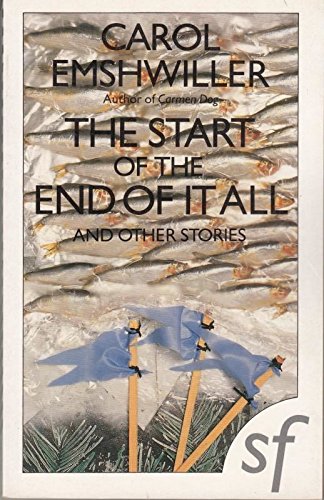
 The Start of the End of it All and other stories cover

In these stories Emshwiller’s style tends to the intellectual and reflective, and always told with a female slant on the world. Very few are straightforward narratives but all of them are intriguing – and well written.

The Start of the End of it All is an alien invasion story. “‘Politics,’ they say, ‘begins at home, and most especially in the kitchen’” – a good place for a revolution to start. But first they have to get rid of the cats. The aliens seem to have targeted divorced, post-menopausal women for their infiltration. A tinge of alarm strikes when one of the aliens says, ‘Time to find lots of little dark, wet places.’ But our narrator isn’t keen on giving up cats.
Looking Down is narrated by a sentient bird (or flying creature at least) who allows himself to be captured by humans to function as an oracle and protector.
In Eclipse a woman stumbles into the wrong party and is taken for either a pianist or flautist. She is neither. But a student of Jung gives her confidence.
The Circular Library of Stones is found by our narrator who collects stones and imagines the circle as a library. Her story can be read as if she has lost some marbles though.
In Fledged a winged woman who looks remarkably like the narrator’s ex-wife comes crashing into his house during a storm.
Vilcabamba finds a man displaced from his people but able to remember gestures they made and bits of their language. He sets out to try to find his way back home.
In Acceptance Speech a man abducted from his own world makes his speech on being made Humble-Master-of-the-Poem.
If the Word Was to the Wise is a story about the importance of the word, and its dangers. In the tallest building in the city are two safes. One contains the law, all that keeps the city secure, the other, all the banned books. A young prince of the library (despite the title, really an underling) falls for the chief librarian’s daughter, Josephine. They begin to plan to open the “banned” safe.
The centre of the universe in Living at the Centre is Omphalo, of whose fabulous beached women the mountain men have heard tell. One old woman goes down there to find out if the tales are true.
In Moon Songs a brother and his older sister encounter an unusual insect which when pricked with a pin “sings” for ten minutes. The sister tries to parlay this discovery into a stage career.
But soft, what light… is a variation on the 100 monkeys eventually typing out Shakespeare thing. Uniq-o-fax, (rather quaintly now in 2019) thirty nine typewriters and a word bank, “all those wires and tubes,” and the female narrator fall in love and write poems to each other.
Pelt is set on Jaxa, an ice planet on which a human has landed, with his dog, to hunt for furs. The viewpoint character is the dog, and the hunter finds more – and less – than he bargained for.
Début could be seen as a variation on Snow White. An apparently blind girl is brought before the Queen only for her mask to be removed before she is banished to the hills. There, the story diverges from that template.
The titular organisation of The Institute is the Old Ladies Institute of Higher Learning (the OLI of HL,) the story one that features an embedded drawing and ends with a piece of musical notation for a song. The narrator’s grandmother, an alumna of the OLI of HL, was quite a gal.
Woman Waiting is the stream of consciousness of a woman waiting for her postponed flight, retreating ever into herself.
In Chicken Icarus a man who is a head and torso but little else (but that little – or not so little – is important,) schemes to have himself displayed more widely.
Sex and/or Mr Morrison features a woman looking for the Others amongst us spying on her upstairs neighbour.
In Glory, Glory a woman on holiday with her husband in a country where they don’t know the language is taken by the locals for a goddess.

Pedant’s corner:- six storey (six storeys,) “bit for the tower, I also, would have done” (either no comma after ‘also’ or an extra comma after ‘I’,) “‘the first snows will be coming’ he says. ‘The tower..” (that ‘he says’ is part of a sentence the character is speaking so it should not be outside the quotation marks,) “in order fit my own ears” in order to fit,) “the forsythia were not in bloom” (either ‘forsythias’, or ‘was not in bloom’, largess (USianism for largesse?) stachel (satchel,) contraposto (contrapposto.)

Terrance Dicks

A name well-known to fans of Doctor Who, Terrance Dicks has died.

His asssociation with the programme began first as script editor (a position he held from from 1968-1974) and then as writer, starting with the last Patrick Troughton serial The War Games, which introduced the Time Lords, in 1969.

Away from the Doctor he wrote the all-but forgotten (some would say rightly) Sf series Moonbase 3.

Perhaps less commendably he contributed scripts for the ITV soap opera Crossroads, famous for its cardboard sets (and equally cardboard characterisation – none of which could be attributed to him.)

He also wrote many of the Doctor Who novelisations and original stories not derived from TV scripts.

Part of many people’s childhoods, his loss will sadden those who look back upon his work with affection.

Terrance William Dicks: 14/4/1935 – 29/8/2019. So it goes.

Interzone 281, May-Jun 2019

TTA Press, 96 p

Interzone 281 cover

Georgina Bruce’s Editorial calls for SF to resist celebrating the beautiful apocalypse and instead to imagine something better. Andy Hedgecock’s Future Interrupted muses on the Golden Age future that didn’t happen and the present day world of work and its intersection with the “stultifying timidity” of business, academia and politics. In Climbing Stories Aliya Whiteleya contemplates stupid questions, obvious questions, the unanswerable Why? and the attempts of film, theatre and fiction to answer it – or not. In Book Zone John Howardb welcomes the “directly and compellingly told” reprints of all-but forgotten 1950s and 1960s writer Charles Eric Maine’s far from cosy catastrophe novels The Tide Went Out and The Darkest of Nights, Duncan Lunan finds A Brilliant Void: a selection of classic Irish Science Fiction novels edited by Jack Fennell a book for the literary historian rather than the SF enthusiast and Temi Oh’s generation starship novel Do You Dream of Terra-Two? not entirely convincing, Ian Hunter lauds Tim Major’s science fantasy Snakeskins as better than good, where good equates to “stays with you”, Stephen Theaker feels the anthology New Suns edited by Nisi Shawl is a missed opportunity to trawl a wider writers’ pool than the editor’s acquaintances, Barbara Melville “cannot fault” the “seamless, gripping and immersive” The Record Keeper by Agnes Gomillion, the best she has ever read for Interzone, Maureen Kincaid Speller says Infinite Detail by Tim Maughan, partly a thought experiment on what happens if the plug is pulled on the internet, is a novel that has been well worth the wait, while finally Andy Hedgecock reviews Georgina Bruce’s “eminently impressive” debut collection This House of Wounds and interviews the author.
In the fiction:
The Realitarians by James Warner1 features, as well as a woman inveigled into luring a physicist to a hotel in Paris, a couple of talking cats. Apart from the cats there is little to this that reads as SF or Fantasy.
In Float by Kai Hudson2 a young woman exiled back to Earth from a space colony struggles with high gravity and the plethora of water.
Harmony by Andy Dudak3 is set in a totalitarian world where the regime uses song as a means of control. A foreign agent tries to resist its siren call.
The city of A Dreamer Arrives in the Occupied City by Malcolm Devlin4 is occupied by lopers who steal dreams, have imposed a curfew and keep the populace subjugated by means of a drug called kurshi. Felicia Fortuna suffered an accident in her youth and so still dreams. She sings her dreams in a nightclub.
The longest story, Scolex by Matt Thomson5, features a drug mule used to smuggling contraband in his blood, who has been given the Scolex of the title, a substance which alters DNA.
The very short Café Corona by Georgina Bruce is illustrated by a background of the recent photograph of the event horizon of a black hole. A woman sits in a café and ponders the malleability of the world, the resemblances between things.
In Our Fathers Find Their Graves in our Shortest Memories by Rebecca Campbell6, the Ossuary, a vast digital database of human images and messages, a repository of human memory, counts down the dwindling number of humans still alive.

Pedant’s corner:- a“to not answer” (not to answer.) b“even if his handling of some of the scientific aspects were not always so sure” (his handling … was not always,) focussing (focusing.) 1Written in USian. 2snuck (sneaked.) 3Written in USian; staunch (stanch.) 4crenelated (crenellated,) “the cream of the city’s middle class were slumming it” (the cream …was slumming it,) “their audience are allowed to dismiss what they say” (their audience is allowed to.) 5“A group of office workers jostle him” (a group jostles.) 6Written in USian, “the species’” (species, singular, so species’s.)

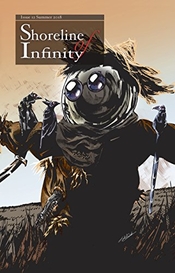
Shoreline of Infinity 12: Summer 2018

The New Curiosity Shop, 134 p

In Pull up a Log Iain Maloney reflects on his time as Shoreline’s reviews editor.

In the fiction we have Do Not Pass GO by Helen Jackson, a light-hearted time-travelling story which tells how the board game “Property Is Best!” became “Monopoly” and conquered the world.
This is followed by Aeaea by Robert Gordon where day by day a man’s consciousness passes between bodies working on a production line of some sort. The workers are overseen by robots. He knows little of his past but occasional dreams let him know he had one. He instigates a revolution but there is still time for an ending which, despite some foreshadowing, is still a deus ex machina.
In Jammers by Anton Rose a young Max is recruited into a gang which remotely hi-jacks self-driving cars in order to rob their passengers. His junkie mother is disgusted by his new-found occupation.
Paradise Bird by J S Richardson features an exotic alien – a male – from an almost forgotten far-flung outpost of humanity come to visit the Habs on the fringe of the asteroid belt and charm one of the hermaphroditic inhabitants.
In Sand and Rust by W G White the entirety of human civilisation wanders through a relentless desert landscape in a caravan guided by a machine called The Chaperone. The caravan’s First Rider has to induct his replacement before entering The Chaperone, never to re-emerge. I did wonder how, in the midst of all this desert, the people in the caravan obtained food.
Sleeping Fire by Elvira Hills is a tale of haves and have nots, the desert people left without regeneration technology, those in Rejensy exploiting them to secure their own longevity. New recruit Resa determines to redress things. The pacing here is a little too breathless at times and the action sequence borders on cliché.
The Beachcomber Presents graphic strip literally depicts people living in social bubbles, escaping their confines to find the richness outside.
SF Caledonia: Crossing the Starfield by Chris Kelsoa relates how he stumbled on a copy of Starfield, the first ever anthology of Scottish Science Fiction, in a Glasgow second-hand bookshopb. He goes on to wonder how it has been so forgotten (not by those of a certain age, mate) and to eulogise the contents.
The Square Fella1 by Duncan Lunan is one of the stories from that collection and describes the first manned rocket mission out of the bowl of the world in which its protagonist lives.

There is a page introducing a flash fiction competition for SoI readers on the subject of the Moonc followed by an interview with Ada Palmer conducted by Eris Young.
Ruth E J Booth’s Noise and Sparks column Who’s Afraid of the Big, Bad Genred discusses the ongoing disparagement of SF by some academics.

Reviews sees Eris Young finding new depth in Ada Palmer’s Terra Incognita trilogy as books 2 and 3 Seven Surrenders and The Will to Battle roll on, Steve Ironsidee confesses to not being armoured enough to cope with the rhythm and narrative of Hal Duncan’s A Scruffian Survival Guide, Katy Lennon delights in the intricacies of M John Harrison’s You Should Come with Me Nowf, Georgina Merryg appreciates the gorgeous writing and unpredictable story line of Sarah Maria Griffin’s Spare and Found Parts, Callum McSorley feels the mix of action thriller and political drama in Null States by Malka Older doesn’t quite mesh, Lucy Powellh describes Eric Brown’s Binary System as a colourful romp.
MultiVerse has poems by Caroline Haker, Ken Poyner and Elizabeth Dulemba (whose three very short pieces are illustrated.) Replacing Parabolic Puzzles we have Spot the Difference by Tsu.

Pedant’s corner:- I proofread the fiction original to this issue before publication so assume there are no remaining errata there. 1“at its comers” (‘corners’ makes sense, ‘comers’ doesn’t,) “on one side that the other” (than,) “but if was less massive” (if it was less massive,) “the last chance to bum him with his knowledge” (burn. This – as with comers above – is a manifestation of the problem in some fonts of distinguishing the letter pairing ‘rn’ from the single letter ‘m’.)
a“There is a notable contributions” (contribution,) David Crooks’ (Crooks’s,) “of it’s achievements” (its.) bSaid in the introduction to be in Glasgow’s Merchant City but it’s in the West end. c“on the the theme of the Moon” (only one ‘the’ needed.) d“the kind of the impact” (the kind of impact,) “startling out of depth” (startlingly.) e“but the challenges I faced in getting to grips with Duncan’s writing means …” (the challenges mean….) 3272 pags apparently (pages,) clamor (is the reviewer USian?) “twisting the reader’s expectations, forcing them…” (that ‘them’ means its noun antecedent ought to be “readers’”,) maw (it’s a stomach, not a mouth.) g“merely part of the characters’ identity” (characters, plural, therefore ‘identities’.) h“for all intents and purposes” (it’s ‘to all intents and purposes’.)

A Wrinkle in Time by Madeleine L’Engle

Puffin, 2014, 262 p.

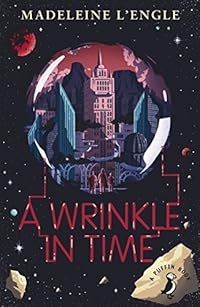
 A Wrinkle in Time cover

Meg lives a more or less normal life with her family of three brothers, twins Sandy and Dennis and the younger Charles Wallace, one of those children who are slow to speak but when they finally do so it is in complete sentences. Normal that is, apart from her mother having a chemistry lab in the back room, and a physicist father who has disappeared (accompanied by all sorts of rumours as to where; and with whom.) Meg, Charles Wallace and her friend Calvin meet three odd women who are secretly inhabiting the local “haunted” house. Mrs Whatsit was once a star in the sky, Mrs Who speaks in quotations (Latin, Greek, French, Italian, Spanish, as well as Shakespearian,) and Mrs Which talks in ddoubblle cconnssonnannttss with the occasional double vvoowweell. Mrs Which can also ‘wrinkle’ space-time and so is able to send Meg, Charles Wallace and Calvin off to battle the forces of evil which have trapped Meg’s father.

On their interstellar journey they encounter a Black Thing in the interstices of space, which almost draws the life from them, strange multi-tentacled creatures who restore them to health, eventually moving on till they reach the planet Camazotz, where Meg’s father is captive and which is home to a large pulsating brain dubbed IT (which nowadays reads slightly differently to how L’Engle would have intended it) bent on total control of the universe.

Meg is disappointed that, once freed, her father can not set the universe right by himself. It is she and her love for Charles Wallace that is the key to overcoming IT’s baleful influence.

Regarded as something of a children’s classic, this was first published in 1962, making the descriptions of card- or tape-fed computing machines, with dot-dash punched print-outs somewhat quaint to modern eyes. Mrs Who’s quotations and Mrs Whatsit’s comparison of the children’s lives to a sonnet, expression within strict constraints, do not talk down to its intended readership. The resolution, though, is a little forced and more in line with early 1960s attitudes than more modern ones.

Pedant’s corner:- Jenkins’ (Jenkins’s,) “in ITs clutches” (IT here is a proper noun not a pronoun, so ‘in IT’s clutches’.)

2019 Hugo Awards

These were announced at the Worldcon in Dublin at the weekend.

As far as fiction goes they were:-

BEST NOVEL: The Calculating Stars by Mary Robinette Kowal (Tor)

BEST NOVELLA: Artificial Condition by Martha Wells (Tor.com Publishing)

BEST NOVELETTE: If at First You Don’t Succeed, Try, Try Again by Zen Cho (B&N Sci-Fi and Fantasy Blog, 29 November 2018)

BEST SHORT STORY: A Witch’s Guide to Escape: A Practical Compendium of Portal Fantasies by Alix E. Harrow (Apex Magazine, February 2018)

BEST SERIES: Wayfarers by Becky Chambers (Hodder & Stoughton/Harper Voyager)

I have read none of these.

That “Best Series” award shows that the Hugos are little more than a popularity contest and not an indicator of merit. I read the first of Becky Chambers’s novels and was put off her writing for life.

Pirate Freedom by Gene Wolfe

Tor, 2017, 439 p, including 12 p Glossary. Illustrated by David Grove.

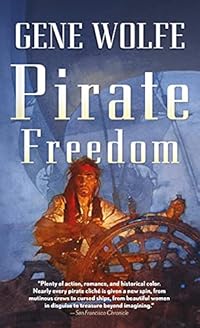
 Pirate Freedom cover

This is a book that probably contains all you ever wanted to know about pirates and then more. Not quite a swashbuckling romp – it is too reflective for that, not shying from depicting the downsides of pirate life – it is always highly readable.

It is also a time travel story. Narrator Chris (Crisofóro) was handed over by his father to be brought up in Our Lady of Bethlehem monastery in a post-Communist Cuba. When he left there he somehow or other found himself back in the heyday of the Spanish Empire, got caught up in the piracy trade, eventually becoming adept at it and in charge of several ships. Interpolations into the narrative of his pirate times relate Chris’s thoughts in later life when he is back in the future but not as far as the time he left it. In these interludes he is an ordained priest, given to musing on his past sins, and on God’s forgiveness.

One of his reflections is that, “money is just another way of saying freedom. If you have money you can do pretty much whatever you want to do. (If you do not believe me. Look at the people who have it.) …That is not exactly how it is for pirates … but it is close. And that is why they do it,” another on the ethics of obedience, “A boy who has been taught to be a sheep will not protect himself or anybody else. If he is molested and does not fight, the people who taught him to be a sheep are at least as much to blame as the molester.” In this he, and Wolfe as author, come dangerously close to condoning abuse.

Then we have, “I remembered that America had fought Spain once and freed Cuba.” Freed Cuba, eh? Swapping one empire for another is hardly freedom. That’ll be why they had a revolution sixty years later.

There are some bons mots. Of a man with whom he had dealings Chris says, “D’Ogeron was an honest politician – when you bought him, he stayed bought.” Another pirate captain says, “‘Not all beautiful things are treasures, but all treasures are beautiful.’”

Pirate Freedom is not one of Wolfe’s major works but it passes the time entertainingly enough and may correct some misconceptions about the pirate life.

Pedant’s corner:- a missing comma before a piece of direct speech (several instances,) formast (foremast.)

Interzone 280, Mar-Apr 2019

TTA Press, 96 p

In the Editorial Shauna O’Meara describes the genesis of her story in this issue in her practice as a vet, seeing the close bond between owners and their animals. Andy Hedgecock’s Future Interrupteda muses on the influence of science and most latterly psychology on literature and SF and wonders what effect the development of neuroscience will have on the stories we tell ourselves. Aliya Whiteley’s Climbing Stories (Books That Smile Back) reflects the endless fascination some people have with books and their rewards. In Book Zone, again relegated to after the film reviews, I say of Helen Coggan’s The Orphanage of Gods that she writes well, with an eye for character and plot, Duncan Lunanb finds quality in the stories in game spin-off The True History of the Strange Brigade edited by David Thomas Moore, but arguing from the first page with The Subjugate by Amanda Bridgeman before eventually finding the author in complete control (though his final paragraph suggests to me the author is not entirely playing fair,) Lawrence Osbornc welcomes the fifth “Invisible Library” book, The Mortal World by Genevieve Cogman, “a detective story that actually works within the parameters set by its fantasy context,” Tim Major is impressed by Helen Marshall’s “eagerly awaited” first novel The Migration,like a parable offering moral guidance, Stephen Theaker thought M T Hill’s Zero Bomb very good indeed despite it switching protagonist halfway through, Val Noland tells us Shadow Captain by Alastair Reynolds succeeds by threading a tonal and thematic discourse between the two extremes of bleakness and optimism exemplified in the author’s previous work and offers a series of satisfying steps on the main characters’ journeys, Maureen Kincaid Speller praises the subtlety and nuance – unusual in a tale of interstellar goings-on – of A Memory Called Empire by Arkady Martine and commends this first novel, Ian Sales finds it a sad state of affairs that Mimi Yu’s The Girl King having two female leads is worthy of note but that the tale is nevertheless an opportunity missed, Andy Hedgecocke lauds the invention, narrative energy and linguistic exuberance of the stories in The Clockworm and other strange stories by Karen Heuler but that there is an emotional flatness at their core.
In the fiction: Cyberstar1 by Val Nolan is narrated by a man whose body is transformed by a religious cult into a cyborg spacecraft in order for him to get close to God in the form of the Sun.
A survivor of a group of humans who were altered to sing in a way that would defeat the bots taking over the world is the viewpoint character of And You Shall Sing to me a Deeper Song by Maria Haskins.
Coriander for the Hidden2 by Nicholas Kaufmann examines the crisis of conscience suffered by Suriel, the angel designated to kill the firstborn of Egypt. This story may be theologically a bit iffy as I believe Judaism has no concept of an afterlife such as the one implied here.
In Everything Rising, Everything Starting Again3 by Sarah Brooks, people’s souls turn into black butterflies, which push themselves out of the body after death.
That Shauna O’Meara story, ‘Scapes Made Diamond4, turns on the desire of a kind of farmed alien animal, which nevertheless has intelligence, to achieve its goals; all mixed in with a human tale of love and sacrifice.

Pedant’s corner:- afocussed (focused; similarly focusses = focuses,) “the period immediately World War II” (the period immediately after World War II,) floatation tanks (flotation.) b“None of them are” (None of them is.) c “This is the fifth volume the very enjoyable” (of the very enjoyable,) Borges’ (Borges’s,) 1930s’ (1930s,) “a number … are being held hostage” (a number is singular,) d“no one is whom they seem to be” (while I welcome the use of whom in its context, the verb ‘to be’ does not take an object; therefore, ‘no one is who they seem to be,) “the work of an author enjoying their material” (Reynolds is male, ‘enjoying his material’.) efocussed (focused,) “critique of humanities tendency” (humanity’s.)
1“of the solar system’s brightest stars” (last I heard the solar system had only one star,) “the populace on Mars were forced to endure” (the populace on Mars was forced to endure,) “off of” (I hate this USianism. It’s just “off”.) 2Written in USian, “None of them were” (None of them was,) “none of the other angels understand the language of flowers” (none … understands the language.) 3“but the pile of black flakes on the chopping board untouched” (is untouched.) 4“the form laying on” (lying on,) clear (I think ‘colourless’ was meant rather than ‘transparent’,) “… would stay close to our charge, stroking them, calming them…” (to our charges,) Bassinos’ (Bassinos’s,) staunching (stanching,) “our species’ vocabulary” (it was ‘species’ singular; so ‘species’s’.)

Clarke Award 2019

I see this year’s winner* of the Arthur C Clarke Award is Rosewater by Tade Thompson.

I’ve not read it but I’ll put it on my to seek list.

*At least it wasn’t the Yoon Ha Lee.

Close Your Eyes by Paul Jessup

Apex Book Company, 2018, 230 p. Reviewed for Interzone 276, Jul-Aug 2018.

Close your Eyes cover

This certainly starts with a bang; to be precise a supernova, in which the star in its death throes somehow impregnates a woman called Ekhi, apparently by means of light. Thereafter she is forced to pilot her own ship after shutting down its AI heart since it goes insane due to entropic breakdown of its programmes. She is found floating, naked, in the ship’s control centre – throughout the book these are named egia – by Mari, Hodei and Sugoi, scavengers from The Good Ship Lollipop. At this early point the text displayed an uncomfortably voyeuristic attitude towards Ekhi, embodied in the character of Hodei, who is also fascinated by a nude model in a stache of magazines he keeps. (Magazines? These digital days?) This fascination is later revealed to be because he has the essence of a woman, Iuski, hidden inside him.

Sugoi is Mari’s (very jealous) lover and resents, to the point of violence, any hint of interest in her by Hodei. Sugoi is a lumbering, almost inarticulate creature. With his propensity for violence it is difficult to see what, for Mari, his attraction might be. Then too, there seems to be little jeopardy. Biological repair organisms named thalna can restore to health a body damaged to a high degree. In a similar way robot-like mozorro keep the egias running “smooth and perfect”. Moreover each character contains within itself systems called patuek which “have the ability to store a mind in stasis and be transplanted into a healed, cloned body”.

The ship’s captain, Itsasu, has a frail withered body tethered to the ship’s control heart near the Ortzadar engine (found on the ruins of a moon) and its “bizarre wisdom culled from centuries of intelligence algorithms evolving and learning and storing information into complex data matrices”. She is on a long, 435 year, quest to find her husband but has kept this from the crew, never explaining “exactly why they wandered the stars, stealing from dead cities and spun-down relics of starships”.

None of these are sympathetic characters, not even Ekhi, who seems to be present only to kick-start the story and incubate the supernova’s child. This problem of empathy is exacerbated by Jessup’s use of short, sometimes one word sentences. This is a technique best used sparingly, rather than being endemic.

Jeopardy does come; in the shape of pirates of a sort whose main weapon seems to be language; “‘We would whisper the word once, just once, and your mind would become a slave to this foreign tongue, this alien thought device.’” “That language is a giant looming inside of my mind. Hunting me.” “With the new language came a new being, a hive mind that commanded each and every one of them.” This enemy is connected with the sakre, which can drive human minds to destruction.

The novel is divided into two “books” titled “Open Your Eyes” and “Close Your Mouth” both with five Acts and separated by an Intermission. The birth of the child of the supernova (“I am Arigia. I am the dreams of humanity, the lands of the stars. I am the coupling between all and everything. I float, I am free. And I sing this ship to life. The port to life. I sing the sorrow song at the end of the universe, at the end of time,”) ends the first section. This seems to presage Arigia’s subsequent importance but she is all but totally absent from Book II wherein a wheelchair bound Isatsu, accompanied by Mari (now turned into a bird,) and Isatsu’s husband Ortzi – or, rather his consciousness contained within a skull – wander a labyrinth loosely drawn from the minotaur legend through a landscape of severed heads, while trying to escape the clutches of a bear-like creature called Basa and his diminutive controller La whose driving force seems to be, “Cover them in words. Take their heads. Fill with eggs.”

It all presents as just a little bonkers. Add in some purple-skinned, elephant-headed creatures for seasoning.

Bonkers is fine, but a human story to hang on to while we’re at it, characters whose fates the reader might care about, would help the medicine go down. If SF ideas for the sake of SF ideas do it for you then give this a go. Those who prefer their senses and sensibilities to be engaged should look elsewhere.

The following did not appear in the published review.

Pedant’s corner:- Written in USian, eg “inside of” (for inside) is littered throughout the text, as is outside of, though there was at least one plain “inside”, shined (shone,) gasses (gases.) Otherwise; sung (sang,) pixilated (pixelated; “pixilated” means drunk, not “blocky in appearance”,) madamoiselle (mademoiselle,) “the sound of the engine became a thundering rush of sounds” (sound….. became …. sounds,) “recording each movement and sending it back” (sending them back,) “and he doesn’t expect me too, either” (expect me to, either,) “kept trying on the shape of names” (shapes,) “had climbed into … and stole away” (stolen away is more natural.) “The only thing preserving his being … were his patuek” (The only thing …was.) “She felt a smile, somehow, hung in her mind” (hang in her mind?) “The eyes were not orbs, but instead flashlights, letting out hot white halos from LED eyes.” (The eyes …. eyes,) “[you] will be discarded of properly” (discarded properly; or, disposed of properly; not “discarded of properly”,) “the heart and the AI where the only things” (were the only things. How on Earth does this “where” for “were” substitution get past i] the writer, ii] any agent involved, iii] a publisher’s reader, iv] the editor?) “her remembered his mother” (he remembered,) “tried to push his cheek back and out its washcloth caress” (and out of,) “with the tip of his toes” (tips.) “His life readings show that his still alive” (he’s still alive,) “near were we need to be” (and now we get the reverse; “were” for “where”,) “a white milky, substance” (a white, milky substance,) ganeeshas(ganeshas,) “with doors along the every facet of the interior” (along every facet,) “Hodei opened door” (opened the door,) “a craggy old fishermen” (fisherman,) “and horded them for itself” (hoarded,) “of the most importance” (utmost?) “it heard a voice sing a solitary voice sing” (take out either ‘a voice’ or ‘a solitary voice’,) “on one the lesser pods” (one of the lesser,) batadur (previously betadur,) crow’s feet (crows’ feet,) “all of her wonderful machines she’d been building” (all of the wonderful machines she’d been building.) “The tenor of the words were true” (The tenor … was true.) Patuek (patuek.) “Sword to help each other” (Sworn makes more sense,) “She saw that flicker of flame tattoos on each of the foreheads” (that flicker of flame tattoo,) shrunk (shrank.) “The profound of absurdity of our very existence” (The profound absurdity of our,) “we watched thirteen suns float through and endless sea of night” (an endless sea,) encoves ….. “on a raised dais where the reprogrammed dolls” (Here it is again; were the reprogrammed dolls,) “all I found where your doubles” (and again: were,) a missing question mark (x3,) Mozorro (elsewhere mozorro,) their epidermis (their; therefore epidermises,) super nova (supernova,) “a room that was on large tank” (one large tank,) “waiting to be woke into” (woken,) “It always changed when they go on the hunt” (when they went on the hunt,) “And where they more her than she was?” (once more; were,) “through the infinite of space and time” (infinity,) sat (seated; or, sitting,) “The pain one’s experiences” (the pain of one’s experiences; or, the pain one experiences,) “This ship was filled with the most flammable object known to humankind. Oxygen.” (That “object” ought to be “substance”. And oxygen isn’t flammable. It’s the agent that causes flame,) damnit (elsewhere dammit,) “a thought eeked out” (eked? Leaked?) “with these cluster of doubles” (this cluster; or, these clusters,) ‘Can you use to revive him?’ (use it,) “full of explosive oxygen” (oxygen isn’t explosive; in its presence other substances may be.)

free hit counter script