Archives » Reviews published in Interzone

The Peacock Cloak by Chris Beckett

NewCon Press, 2013, 239p. Reviewed for Interzone 247, Jul-Aug 2013.
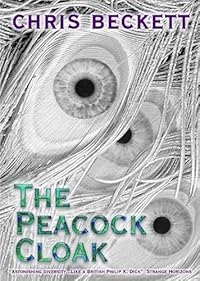
This is Beckett’s second collection, containing twelve short stories – with a few commonalities in background – that have been published during the past five years. Four are from the pages of Interzone. They span a wide range of perennial SF concerns – social or technological extrapolation, global warming, enigmatic aliens, their strange worlds, parallel universes, stargates, altered histories – plus a genuflection to Arthur Clarke’s The Nine Billion Names of God.

Atomic Truth contrasts the seeming connectedness of the digital world with the distancing it carries along with it. Everyone wears bugeyes, interactive goggles that form an interface between the real and virtual worlds and display emails, ads etc. Everyone, that is, except Richard, who has no need of goggles to see visions. His encounter with Jenny provides a small moment of humanity in his disorientated world.

The style of Two Thieves is reminiscent of a fairy tale – a form which has less than cosy attributes. The thieves, exiled to a remote and totally secure penal colony, start work on an archæological site, where they uncover a relic of the Old Empire. It’s a spatial gateway, which of course they jump through. There is some nice foreshadowing here that is both blatant and subtle at the same time.

Johnny’s New Job is set in an Orwellian society with a Stakhanovite labour force and a justice system to gladden a tabloid newspaper proprietor’s heart. Offenders against the public good (who all seem to work in Welfare) are demonised by the authorities. These unfortunates are named and worse than shamed, guilt by association is afflicted on their families. Johnny goes along with the general mood, then gets an unrefusable job offer.

On the planet Lutania lies The Caramel Forest, a malodorous place of grey, brown and pink vegetation contrasted by the bright green of settlers’ lawns. The Lutanian indigenes nicknamed goblins can project settlers’ thoughts back into human minds. The Agency running the planet tries to protect them but the original human settlers have their own way of dealing with them. Cassie, the child of a constantly arguing Agency couple on a tour of duty, is influenced to escape the rows by running off into the forest.

Greenland. Juan Fernandez is a refugee from Spain scraping an ever more insecure living in a slowly submerging south-east of England flooded both by global warming and the so-called beachrats, illegal immigrants lucky to escape the machine-gunners on the shores. He loses his crap job but his future is determined by a lucrative offer to copy him in a hazardous matter-replicating machine.

The Famous Cave Paintings on Isolus 9 depict a God fashioned, as all gods are, in the image of the locals. He is imprisoned and can only dream of escape. The narrator’s Uncle Clancy, a famous womaniser who has finally fallen in love, sees them, and is terrified.

Rat Island is a take on our reckless consumption of fossil fuels. A child whose civil servant father confides to him the inevitability of the consequent crash and likens us to introduced rats on an isolated island eventually eating all the seabirds’ eggs, finds his only consolation is the taking of photographs.

Day 29. Lutania again. Stephen Kohl is coming to the end of his tour of duty for the Agency and is frustrated and worried by the thought of the memories of 29 days he will lose when he undergoes Transmission back to civilisation.

England is occupied, taken over by Brythonic Celts expelled from Britain by the Romans into France, Iberia and the Americas. They have come back to the land they claim that God gave them. The scenario has implicit and explicit parallels to the Israeli/Palestinian conflict and, in common with that, isn’t resolved. Beckett’s framing device lets its story, Our Land, off that hook, though.

Jacob Stone is The Desiccated Man, transporting cargoes over the solitary spaceways, accumulating money till he can retire to a life of indulgence. But old habits die hard.

In Poppyfields, a brownfield site subject to a development delay, waif-like Tammy Pendant – who has taken slip, a drug which pierces the membranes between universes – materialises in front of bird-watching Angus Wendering. Angus is easily led.

The creator of a fabricated world called Esperine finally enters it. The copy of himself he installed there comes to confront him wearing The Peacock Cloak, a shimmering all powerful device he has used to rebel against Esperine’s tameness.

Some of these tales have an overly conversational tone, parts have a tendency to be told rather than unfold, info dumping can be intrusive and there are occasional disjunctions where story elements seem to clash but, in all of them, Beckett never loses sight of the humans he is writing about. Here we are in all our folly – and occasional glory.

Interzone 249

I assume I was sent this as a contributor’s copy (my review of We See a Different Frontier appears within) but it’s uncommon for me to receive one.

Interzone 249 cover

Unknown Cities of America by Tim Lees
The fantastical element of this story concerns parts of the US which do not appear on maps and which you stumble into by accident while travelling. The unnamed narrator meets and forms a relationship with a woman from one of these towns who fears she will be taken back there by a man known as the Turk.

Paprika by Jason Sandford
Paprika is a time angel, built to access people’s memories and store them in her pocket universe. Satori the toy maker manufactures toys from the recovered memories of the olds who are all that is left of humanity after rejuvenation treatments mean there is no room for children any more. But the olds are dying off and the memories of time angels are all that is left.

Filaments by Lavie Tidhar
R. Patch-it is an old priest/rabbi of the Church of Robot, wearing out, parts no longer available, reflecting on its legacy and on faith. The story is replete with references, SF and otherwise, – to God’s nine billion names, the sands of Mars, Louis Wu, the Merchant of Venice.

Haunts by Clare Humphrey
Alekra is an ex-duellist, the last of her duelling school to survive, though she is hamstrung due to her one defeat. She is reduced to selling off her fingers one by one to survive. Her former (dead) schoolmates remain in her garden as haunts. A new patron enters her life.

The Kindest Man in Stormland
by John Shirley
Eight hundred miles of the North American coast is a perpetual stormland due to the sudden effects of global warming. A serial killer is on the loose in the flooded remains of Charleston, South Carolina. A detective from Search in Person, of Washington DC, is called in to find him. The setting is atmospheric, but the story is resolved perfunctorily.

Trans-Siberia – an account of a journey by Sarah Brooks
An orphan who has just become a man makes the dangerous journey on the railway from Beijing to Moscow. He encounters an enigmatic woman around whom strange things happen.

Planesrunner by Ian McDonald

Everness Book 1. Jo Fletcher Books, 2013, 373p. Reviewed for Interzone 246, May-Jun 2013.

Tottenham Hotspur supporter, school team goalkeeper and fine Indian cook, Everett Singh witnesses the kidnap of his physicist father, Tejendra, just before they were due to meet on an access visit. He provides the police with mobile phone photos of the kidnap. When his dad’s boss, McCabe, turns up asking if Tejendra had left Everett anything, Everett knows something more profound is afoot. Moreover, when his pictures are returned they have been altered. And he is being followed to school and back. As we are immersed in Everett’s world his mistrust of the police and the strained relationship with Everett’s mother these encounters engender are portrayed well, though like all young protagonists Everett is perhaps just a touch too knowing.

Soon a mysterious folder marked “Infundibulum” and obviously left by his father appears on Dr Quantum, Everett’s laptop. Everett knows infundibulum means “bigger inside than out” – references to Doctor Who follow – and recognises the contents as a representation of the multiverse. His father named him after the creator of many worlds theory and he has always been able to think in up to seven dimensions. This facility allows Everett to tie the Infundibulum topologically into a map of the many worlds. Another of his father’s colleagues has given him clandestine information about the success of the many worlds project and footage of other universes from beyond the Heisenberg Gates. Ours is E10 in the Plenitude of Worlds but none of the others has a map, only Everett. This scenario may have been too much for most writers to pull off but McDonald’s exposition of the arcane details is lucid and he uses all this only as a jumping off point. The necessity for plot to rumble on, though, for action, marks this out as a YA novel. Indeed there are echoes of The Northern Lights – not the least of which is the increasing presence of a powerful villainess, Charlotte Villiers – which, given the target audience, is no bad comparison. Echoes of this kind are almost inevitable when the necessity of holding a young audience’s attention is taken into account. There is plenty to keep the adult reader going too, though.

Armed with his knowledge Everett contacts McCabe and is transported to where the many worlds project has its base near the Channel Tunnel. Diplomats from the Plenitude are present as Everett demonstrates the ability of his map to target contact with other worlds. One of them threatens him with a strange gun and he jumps through an open gate into E3, a world with no oil-based technology, where rugby is the main spectator sport – and where Everett only has himself to rely on. This is one of the (arguably necessary) perennial features of “children’s” fiction: the adventure can only begin if no parents are around to prevent it. The stories are usually the better for it.

Everett finds a library and researches his new environment, quickly working out that the Plenitude is probably keeping his dad in the Tyrone Tower.

Later, on the underground, Everett meets the wielder of a strange tarot deck, a young girl called Sen Sixsmyth, who tries to filch Dr Quantum, but Everett decides to befriend her. Sen turns out to be an Airish – crew of the airships which ply the skies of E3. Her home is the Everness, whose captain is her adoptive mother and whose crew includes a “Southern” gentleman addicted to quotations and a Scottish accented guy in charge of the engines. “Captain, I canna get full power when there’s no engine…” Due to his culinary skills Everett is accepted as a crew member and the real fun starts.

To communicate with each other the Airish use a version of Polari, in our world an argot of gay subculture. (This reference would surely go over the heads of most YA readers were an explanation and glossary not supplied at the end.) The Airish have their own customs and loyalties and not a few colourfully named individuals. Any discrimination Everett experiences on E3 is not due to his skin colour but that he is now Airish.

The details of this other world feel right even if they are a touch old-fashioned but it is a kind of steampunk scenario after all. Moreover it is one which McDonald clearly has enjoyed creating. Set pieces including Sen penetrating the Tyrone Tower, the inevitable pursuit by Charlotte Villiers and a battle between airships for arcane Airish reasons keep things moving nicely.

Being part 1 of the Everness series nothing is truly resolved by the end of Planesrunner but the dénouement and the setting up of the sequel have a logic of their own, consistent with what has led up to them.

Planesrunner is bona stuff. One might even say fantabulosa.

Latest Reviews

Interzone 248 (Sep-Oct 2013) with my review of Catherynne M Valente’s Deathless has been out for a few weeks now.

My review of We See a Different Frontier: A Post-colonial Speculative Fiction Anthology for Interzone 249 (Nov-Dec 2013) has been submitted.

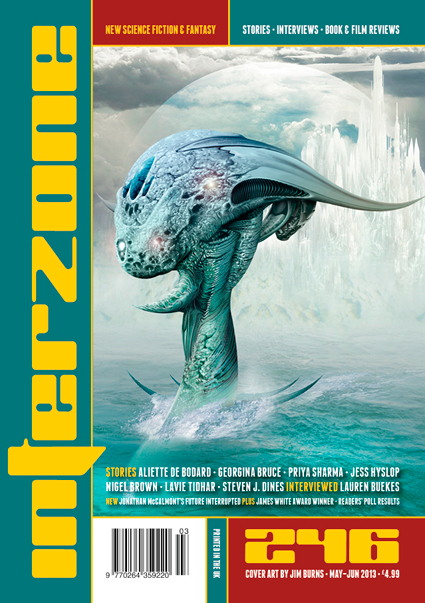
Interzone 246 and the James White Award

TTA Press, May-Jun, 2013.

Interzone 246

This accompanied Nina Allan’s Spin, a TTA novella which I have promised to review here. My review of Ian McDonald’s Planesrunner appears in this issue, which I assume I received as a contributor’s copy.

The Machinehouse Worker’s Song by Steven J Dines
Men work stoically at their shifts in a machinehouse which they cannot leave until they succumb to an apparently psychological sickness, or death. The story is set at a time when only two of them remain.

Triolet by Jess Hyslop
Mrs Entwistle grows poems (which seem to be exactly like flowering plants but speak their verses when touched.) One day she gives James and Lisa a triolet. Its repetition presages alteration.

Sentry Duty by Nigel Brown
An alien stands guard for her Sisterhood and interacts with the human whose skycart has landed in their territory. This story would not have been out of place in a 60s SF magazine.

The Angel at the Heart of the Rain by Aliette de Bodard
An immigrant from a war torn country comes to terms with her new existence.

Thesea and Astaurius by Priya Sharma
A reworking of the Minotaur story featuring the woman Thesea. Minos is a blood-crazed madman and Deadalus wields modern technology.

The Core by Lavie Tidhar
Achimwene follows his lover Carmel through Central Station. She is a strigoi, a data vampire to whom the Station’s children are attracted. A strange piece, undermined for me
by the use of the word “faint” once each in the first two lines, describing respectively the light and a glow.

Cat World by Georgina Bruce
Narrated by an eight year old girl, an orphan who lives on the streets with her sister. Flavoured chewing gum takes their minds into Cat World. Her sister disappears and she has to fend for herself.

The James White Award is a short story competition open to non-professional writers and judged by a panel of professional authors and editors. The winner receives a cash prize, a trophy and publication in Interzone. This year’s winner, selected by Aliette de Bodard and Ian McDonald, was:-

You First Meet the Devil at a Church Fete by Shannon Fay
A well written tale narrated by one Stuart Sutcliffe, who is tempted by the devil with promises of the band he’s in with John and Paul – and George – becoming big. Stuart turns him down. The rest is history.

Redshirts by John Scalzi

Gollancz, 2012, 309 p. Reviewed for Interzone 245, Mar-Apr 2013.

For the first two-thirds of Redshirts the thought recurs that it’€™s either the most intriguing piece of SF you have read in a long time or else a sad waste of dead tree. The set-up has replacement crew-members on a starship slowly noticing strange events occurring – especially to those who attract the attention of senior officers and are as a result assigned to accompany them on away missions, where, invariably, one of the minions is at best badly injured, at worst killed. So far, so interesting.

The trouble is that the main characters are barely worthy of the name, being more or less indistinguishable. Moreover we are treated to various mundanities of their lives normally omitted in fiction. Yes, they are supposed to be walk-on parts in a different narrative, a bad Science Fiction TV series from our time, and hence might be expected not to be fully fleshed – but they are the main characters in ours and doesn’€™t the reader always deserves more? Moreover, dialogue is rendered as “Dahl said,”€ “€Duvall said,”€€ “€€œHester said”€€ etc making it feel like a shopping list. In addition the prose rarely rises above the leaden and workmanlike.

And yet the text plays games with narrative and with the reader, features characters who become aware of themselves as players in a story and who take steps to alter their fate. There is even a false ending, allowing Scalzi to address the reader directly.

Viewers of a certain 1960s US TV SF series – which bears a superficial resemblance to the scenario here – may have noticed certain …. illogicalities. Scalzi clearly enjoys laying out the faults, the playing fast and loose with the laws of Physics, the lack of internal consistency, the black box resolutions, which can plague such an enterprise. It is generally not regarded as a good idea for a Science Fiction novel explicitly to refer to SF, yet given the subject matter here it would be remiss not to. Indeed the plot of Redshirts depends on it.

After the amended ending – and making up the last third of the novel Redshirts as an entity – we have no less than three codas, subtitled first person, second person, third person, each narrated in its subtitular mode, respectively by the writer of, and two of the actors in, the TV series. These comment on, illuminate and extend what has gone before. The writer is not cheered by criticism distinguishing between bad writing and being a bad writer, the two actors find their destiny in life. While the codas’€™ styles are disparate, and thus a welcome relief, the last still has dialogue framed like a shopping list. Crucially though, the characters in them feel real.

In the main narrative Scalzi shows he can do bad writing very well. (Now there’s a back-handed compliment.) If you don’€™t know what’s to come in the codas, though; if you’€™re not, say, reading Redshirts for review, that could be a fairly large hurdle to overcome.

Interzone 246

This issue should be out now. It contains my review of Ian McDonald’s Planesrunner.

I’ll shortly be publishing here my review from Interzone 245 of John Scalzi’s Redshirts. It was ….. interesting.

Edited to add. I see Jim Steel has informed us the issue will be out in the next few days.

Interzone 245

This edition is out now (news via Jim Steel’s blog.)

This is the one where my review of John Scalzi’s Redshirts can be found.

I’ll be posting that here after a decent interval.

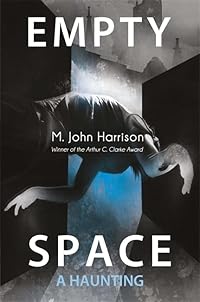
Empty Space by M John Harrison

Gollancz, 2012, 302 p. Reviewed for Interzone 243, Nov-Dec 2012.

Empty Space cover

Sub-titled on the cover and the main title page as “€œA Haunting,” Empty Space follows on and amplifies the universe Harrison constructed with his novel Light and continued in Nova Swing.

In early twenty first century London, Anna Waterman, obsessed by the memory of her first husband Mike Kearney, shuttles in an affectless way between her psychologist Helen Alpert, her daughter Marnie and other rather shiftless denizens of her world. Every so often on her night strolls she imagines her summerhouse is on fire.

In Saudade City, on the planet Saudade, overshadowed by the lurking strangeness of the astronomical anomaly called the Kefahuchi Tract, riddled by its impossible physics, Enka Mercury and Toni Reno are bizarrely murdered to the sound of a disembodied voice saying, “My name is Pearlant and I come from the future.” Their bodies hang suspended, rotating and slowly disappearing. An unnamed police assistant with data scrolling down her arm helps investigate the crimes.

R I Gaines is struggling to make sense of the mysterious apparition known as the Aleph, the figure of a woman contorted in an awkward way (and mysteriously accompanied by a cat) and who may bear some sort of relation to the Tract.

Meanwhile Fat Antoyne, who is no longer fat, and Liv Hula, undertake a commission from the elusive M P Renoko to transport odd containers called mortsafes in their spaceship “€œNova Swing.”€

Many of these characters are familiar from Light and Nova Swing but here Harrison extends and refines their relationships.

The Waterman sections of Empty Space, at least in the early stages, are related in what seems a straightforward mainstream prose and are at odds with the SF elements – which are as jargon-filled as any devotee could wish. But this highlights a problem.

The trouble with “€˜six impossible things before breakfast”€™ scenarios, with impossible physics, is that if nothing is explicable, if things just happen, then nothing means anything – or everything. When chains of causation are lost narrative becomes problematic and the trust between writer and reader can be undermined.

While considering the Aleph one of Harrison’€™s characters muses that the universe is “€œa useless analogy for an unrepresentative state.”€ This could, though, be a description of the novel Empty Space itself as Harrison is attempting a literary description of that unrepresentativeness, with all the cognitive dissonance that implies.

What redeems the book is Harrison’€™s prose; which sweeps grandly along, his descriptive powers manifest, the Waterman sections being the most flowing, apparently effortless.

Nevertheless; that Harrison in the end brings all the strands together – thus also resolving the whole of his Kefahuchi Tract trilogy – comes as something of a release – and relief. The connections between the various types of haunting are finally made; though they are more than a little strained. Maybe even impossible: for the strangenesses around Saudade and the wrongness of the Tract physics remain pretty much unresolved.

Still, Harrison devotees and those who loved Light and Nova Swing will find Empty Space a notable conclusion.

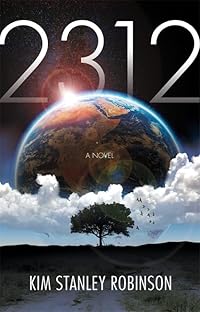
2312 by Kim Stanley Robinson

Orbit, 2012, 561p. Reviewed for Interzone 242, Sep-Oct 2012.

Note: this is not how the review appeared in Interzone. The post below is 650 words or so long. Due to a mix-up over Interzone’s move to a new page size their reviews editor had to cut 150 of these.

 The Intrusion cover

The Solar System has long been colonised; from asteroids inside the orbit of Mercury out to the mining of the Oort cloud. Earth is garlanded with space elevators and its billions of mainly impoverished inhabitants are resentful of the easier life they imagine spacers enjoy. The planet has succumbed to global warming – there is a nice vignette of an inundated New York as a kind of stalagmitic Venice (though I would have thought storms would have ravaged the skyscrapers quite quickly.) Terraformed asteroids – either hollowed out and spun up “innies” or tented over “outies” – provide habitats for the growth of food (much of which helps to supply Earth,) the preservation of animals now extinct on the home planet, or as spaceships for fast inter-system travel. Politically the structure is Balkanised with habitats jealously guarding their own interests and playing each against other. Humanity too is splintering as a proto-speciation of humans with different statures has developed as a result of the different living environments that abound. Medical advances mean limbs can be regrown, life span has increased, gender become more plastic. Quantum computer AIs known as qubes control many processes, some are utilised as wrist aids or even via head implants. 2312 has no lack, then, of Science-fictional ideas with which to tickle the sense of wonder. The characters’ longevity is almost incidental, though, as apart from not seeming to worry about their children they do not behave very differently from at present. Despite being well over one hundred they act as if they’re in their twenties or younger. This may be how long life spans affect us, of course.

The narrative follows four viewpoint characters; Swan Er Hong, a gynandromorph who lives on Mercury and whose grandmother’s death leads off the story; police Inspector Jean Genette, a so-called small; Fitz Wahram, an androgyn, and Kiran, a young earthman who rescues Swan from possible kidnapping on one of her visits to Earth. The – plot such as it is – hinges on whether or not the qubes are developing consciousness and designs of their own; even manifesting themselves as androids, possibly as terrorists. It is a feature of the narrative that we see the characters caught up in events, variously imperilled, but never quite at the centre of things; which is like life. This is not the usual mode in SF but none the less welcome for it.

Since his Mars trilogy Robinson has rarely borne his research lightly. Here the “story” chapters are variously separated by descriptions of eight (sub)planetary bodies/habitats, fifteen lists, eighteen extracts from an apparent history written well after the events of the novel and three “quantum walks.” It is a style which largely circumvents the crudities of information dumping by parading them as a strength. It is not an entirely new approach to the problem. Robinson credits John Dos Passos in his acknowledgements and, within SF, John Brunner employed a similar technique in Stand on Zanzibar.

In pursuit of this the novel ranges all over the solar system from Terminator, a city constantly on the move over the surface of Mercury, out to Io, back and forth to Earth, taking in Venus, Saturn’s cloud tops, Titan, Pluto and various interplanetary terraria, surfing the gravity wave on Saturn’s F ring along the way. The main fault with all this is that it can seem the narrative has been designed to show off the research. At one point Swan says, “All right. I will. But I’m going to take the long way there.” But she is, in our terms, old, and she has time.

Without these interpolations between the chapters, though, the book would have been much less impressive.

In 2312 plot and characterisation are not Robinson’s primary concern. It is the solar system – to which, as one of the interludes reminds us, humanity is bound by the vastness of interstellar space – that is his hero.

free hit counter script