Archives » Football

Sons’ Achievement Equalled

I see that Celtic’s failure to win today means that Rangers are now Scottish Football Champions.

So Dumbarton’s achievement of winning champioships at the top four levels of Scottish football (the last being in 2009 when we won the then Third Division of the SFL) has been matched.

Rangers fans will no doubt say they did this in 2016 when they won the second tier for the first time having previously won tiers 3 and 4 in 2014 and 2013 respectively.

However those three lower league wins all came subsequent to their administration and reformation as a new club and some would consider they do not add to the 54 championships Rangers FC won prior to their financial melt-down but that this is in fact their first as overall champions of Scotland.

There is no doubt now, though, that they have equalled Dumbarton’s record.

Congratulations to them.

Ian St John

So now it’s Ian St John who has died.

Having made his name at Motherwell he became an integral part of the first great Liverpool team of my lifetime, the first Shankly-managed one, and also played what now seems a paltry 21 games for Scotland, scoring nine goals for the national side, including two in that great sliding-doors match, the play-off with Czechoslovakia for the right to go to the World Cup in Chile in 1962. Scotland were ahead with a few minutes to go but lost a goal before the final whistle then two more in extra-time. Czechoslovakia went on to reach the World Cup final. What if indeed.

St John’s great years as a player were a bit before my time but I do remember the possibly apocryphal story of a Church billboard in Liverpool asking, “What would you do if Jesus came to Liverpool?” to which some wag had added below, “Move St John to inside-left.”

After his retirement I remember a TV competition to find a new commentator for televised football matches in the run-up to the 1970 World Cup. The competitors were anonymous before the voting. However I knew I recognised one of the voices but couldn’t place it. Then came the reveal of the runner-up (who I now see but hadn’t remembered till looking it up actually tied with the winner) – Ian St John. The winner was a Welshman named Idwal Robling who apparently did go on to commentate on games for Match of the Day (never broadcast at the time in Scotland so I never heard any of them) and later mostly for Welsh games.

But it was as co-presenter of Saint and Greavsie, an ITV equivalent of the Football Focus of today but with a more light-hearted approach (and which was broadcast in Scotland) that St John was more familiar to my generation. The banter between St John and the other presenter Jimmy Greaves was always good-natured and entertaining.

John (Ian) St John: 7/6/1938 – 1/3/2021. So it goes.

Dumbarton Rock and The Rock

On our visit to the town last March we also had a look in Dumbarton town centre. The Artizan Shopping Centre has seen better days. That day many of its premises did not have tenants. Covid can only have made that worse.

Some of the empty units had been brightened up though by having huge photographs of Dumbarton Rock pasted onto their frontages. These are crops of the photos I took of those huge photos.

Dumbarton  Rock, west Dunbartonshire, Scotland

Dumbarton  Rock, west Dunbartonshire, Scotland

The Rock is a beautiful sight, isn’t it?. And that’s a lovely sky.

This cracking shot of Dumbarton Rock and Dumbarton Football Stadium (aka The Rock) was posted in 2020 in a blog I follow:-

Dumbarton Rock and The Rock

And this view was in a newsletter from Dumbarton FC:-

The Rock and the Rock

An Away Trip

I remember football.

(Just.)

I remember away games.

(Dimly.)

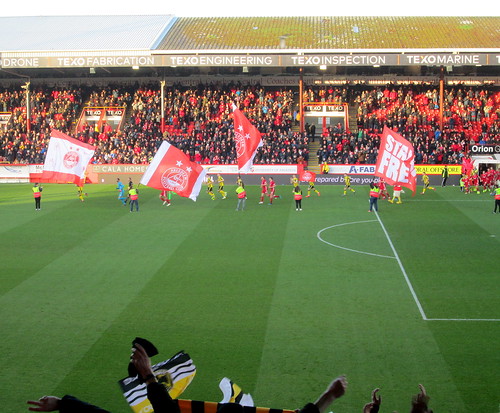
The reason for our visit up north via Dunnottar Castle, Stonehaven and finally Aberdeen last January was for one such away game; Sons’ 4th Round Scottish Cup tie at Pittodrie on 18/1/20.

Ticket to Aberdeen - Dumbarton Scottish Cup Tie, January 2020

Before the game we met up with my younger son and his wife, who were making a day of it, in a pub in Aberdeen city centre for some lunch. The pub had also attracted other Sons fans:-

Dumbarton F C Fans in Aberdeen Pub

They don’t half make a fuss before a game at Pittodrie.

Razzmattazz prior to Scottish Cup tie, Aberdeen v Dumbarton, 18/1/20:-

Razzmattazz at Pittodrie, 18/1/20

More Razzmattazz, Pittodrie, 18/1/20

Teams coming out:-

Dumbarton F C at Pittodrie, 18/1/20

Sons players:-

Pittodrie, 18/1/20, Dumbarton F C Before Game

Teams line up, Pittodrie, 18/1/20

Apart from the result it was a good day out.

I wonder when I’ll be able to have another away day.

Snapshot by Daniel Gray and Alan McCredie

Scenes and stories from the heartlands of Scottish football, Nutmeg, 2020, 208 p.

The introduction claims this book to be “a love letter to the charms of football …. a portal into a different kind of Scotland.” Well, maybe; but it’s a portal through which many people have travelled.

As an aside I notice on the cover photo (of a pitch on Eriskay) there are flags marking the halfway line. I thought those had been done away with years ago.

For each “chapter” we have a page or three of narrative. These describe in turn the unsung background people, the beating heart of every club, “ensuring our Saturdays have purpose, comfort and melancholy;” the return to normality and focus of a new season’s start; the contrasting fortunes of the two “wee” Rangers, of Berwick and of Cove; the bright promise of a ground you’ve never been to before; the “gentle pleasures” of football in the Borders (notwithstanding the brutalist concrete splendour of Gala Fairydean’s main stand;) the rigours and dangers of blaes pitches; the magic of a floodlit game, forever enchanting; the glory and misery of away trips; the local team as the heart of a community, embodied in its social club especially in Junior football; the joys of park football; the content the writer senses in the Highland League.

The match day experience of attending a midweek floodlit game in a minor league is highlighted by a photograph of a neglected bottle of orange juice and a mug with the word “Twat” printed on it sitting on top of a dugout.

Football’s past is given its due with photos of an iron fence and gate before where the main stand stood at The Gymnasium; trees striding down the terraces of Cathkin Park; a single Art Deco style wall still bearing the name Shawfield; the sole survivor of Brockville, a turnstile acting as a memorial in the car park of the town’s Morrisons; the overgrown terraces of Tinto Park, Benburb; Meadowbank stadium’s “oddly alluring air of otherness …. a little pocket of Leningrad tucked behind Arthur’s Seat.”

An even more melancholy note is struck by the mention of two Hibs supporters, one photographed on an away trip, who succumbed to Covid-19, with the final paragraphs devoted to the loss the average fan has experienced as a result of the pandemic’s suspension of the Saturday ritual.

Pedant’s corner:- “a 1,000” (either ‘a thousand’ or ‘1,000’. 1,000 does not stand for ‘thousand’, it is specifically ‘one thousand’; no one ever says, ‘a one thousand’,) “their 54 years of league football had ceased” (Berwick Rangers joined the Scottish League proper in 1955; 64 years, then; 68 if you count the Division C years,) Berwick fans in August “singing ‘Back to school tomorrow’ to visiting young fans of Scottish clubs” (unless it was a midweek game more likely ‘Back to school on Monday’,) Rangers’ (Rangers’s,) Rovers’ (Rovers’s,) “the club … are familiar” (the club … is familiar,) “the first senior league game at Cove’s Balmoral Stadium.” (Okay, the writer used a lower case ‘s’, but…. Cove have been Senior ever since they joined the Highland League, so, ‘their first game in a nationwide league,’) “Galashiels Fairydean Rovers FC” (the club’s name is Gala Fairydean Rovers FC.)

Suspended

I was looking forward to actually seeing a Sons game again tomorrow.

However today’s suspension of Scottish football below its top two tiers means that it will now not be until February 13th when the home game against Montrose is due – or just possibly the 9th if the Cup game against Huntly is scheduled for then – that I will have that pleasure.

With the coronavirus now spreading at a higher rate than ever I suppose this was an inevitable decision. People’s safety must be the main priority.

It’s still a blow to morale, though.

Dumbarton Football Stadium

I’ve posted Footy Adventures’s video of Dumbarton Football Stadium from Dumbarton Rock elsewhere.

Now, in another video (posted on 7/1/21) he took advantage of the club granting him access to the ground (well there was no-one else around) and he’s very enthusiastic about the place.

He waxes lyrical about the surroundings but bemoans the fact the fans can’t see the Rock when they’re seated in the stand.

However from the stand there is a very good view of the range of hills known locally as the Long Crags but whose formal name is I think the Kilpatrick Hills, which also overlook the town and are scenic in themselves.

Posting this means I probably don’t need to inflict my own photos of the Rock on you all.

The First Kings of Scotland:

Colin Bell

Manchester City’s best team may have been the one of the very recent past. Certainly in terms of trophies won it is the most successful. However City’s last great side, the one of the late 60s and early 70s, is worth mentioning in the same breath.

That side’s outstanding performer, one of the greatest players Manchester City ever had, if not the greatest, Colin Bell, has died. The only one of City’s players ever to be dubbed ‘the King’, in his case ‘King of the Kippax’, after the Kippax Street Stand at City’s old Maine Road Ground. He was also nicknamed Nijinsky after a famous race-horse of the time due to the seemingly effortless way he covered the ground. The team was an attacking force to be reckoned with and Bell was its driving creative hub.

His stature at the club was such that one of the stands at City’s new ground, the Manchester City Stadium, aka the Etihad, was named for him.

There was a fine appreciation by Simon Hattenstone of what the man meant to City supporters in yesterday’s Guardian.

By all accounts he was a decent man as well as a great footballer.

Colin Bell: 26/2/1946 – 5/1/2021. So it goes.

The Doc

So 2020 continued to be a miserable sod right till the end, when it took Tommy Docherty away from us.

The Doc was probably most famous for being manager of Manchester Uinted though he had previous spells at Chelsea and other clubs, plus as Scotland manager. After Man U he managed seven more clubs.

His senior playing career began at Celtic but he could not displace Parkhead legend Bobby Evans from the team and moved south to Preston North End and later Chelsea.

He played for Scotland 25 times including in the 1954 World Cup (but we’ll swiftly draw a veil over the 7-0 defeat to Uruguay – I read once of a player’s recollection that the Scotland team were in heavy woollen jerseys as if playing in winter rather than the heat of a Swiss summer and were shod in big old-fashioned boots – with the Uruguayans in more modern footwear he described as like slippers in comparison. We were lucky it was only seven was the verdict.)

It was as a manager that The Doc made the most impact, taking over a very declined Man United and not able to turn the club’s fortunes round till after a relegation but leading them to a swift – one season – return to the top flight and then to an FA Cup win against Liverpool (denying that club what would have been a first ever treble by any English side.) Who knows what might have transpired if The Doc had not had an affair with the wife of the club’s physio Laurie Brown and as a consequence got the sack? (I note from the obituaries that Docherty was still married to Mary Brown when he died.)

Despite plying his trade mostly in England Docherty, like most of his ilk, remained a proud Scot.

There was a tale told – I think it was of Joe Donnelly, Dumbarton’s perennial substitute in the 1971-1972 season (only one sub allowed in those days and that for injury) that the player had once been involved in an altercation with an English team mate who had called him a “Scottish b*****d.” Docherty, as their manager, took them into his office, got them to settle the matter reasonably amicably then let the Englishman leave the room. Whereon he immediately turned to Donnelly and said, “You didn’t hit him hard enough.”

A character, then.

Thomas Henderson (Tommy) Docherty (The Doc): 24/4/1928 – 31/12/2020. So it goes.

Jim McLean

I’ve just seen a report of the death of Jim McLean, the man who led Dundee United to the greatest successes in their history (bar a Scottish Cup win.)

Following two earlier League Cup wins (themselves the club’s first major trophies,) in 1983 his stewardship found them winning the League and becoming champions of Scotland. With hindsight that seems even more remarkable than it did at the time. As I recall (but don’t quote me) they achieved that using no more than 15 players in total over the whole season.

The next season saw an even more incredible achievement, a European Cup semi-final (matching the effort of their city rivals, Dundee, from 1963.) Then there was a UEFA Cup final appearance (thereby eclipsing their neighbours) in 1987. The most astonishing statistic of the club’s European games under McLean’s leadership is their two wins against Barcelona (OK, they were not the force at the that time they were to become but it was still a huge scalp) in that EUFA Cup run. Curiously the club had also beaten Barcelona home and away in the equivalent competition, the Inter Cities Fairs Cup, in 1966.

Some controversy surrounded McLena’s treatment of players, especially as regards the details of their contracts, but he nurtured many who went on to forge big careers in the game. His relationships with members of the press were not always rosy though. He was a personality, no doubt.

As a pure manager, though, his record is nothing short of amazing.

James Yuille (Jim) McLean: 2/12/1937 – 26/12/2020. So it goes.

free hit counter script