Shalimar The Clown by Salman Rushdie
Posted in Fantasy, Other fiction, Reading Reviewed at 17:00 on 24 December 2011
QPD, 2005, 398p
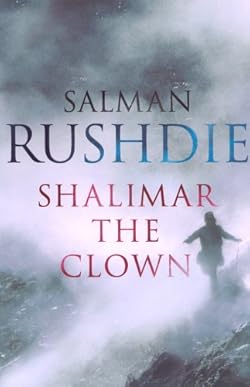
After the relatively disappointing aberration of Fury this novel sees Rushdie return for his setting to the locales and interests from which he made his name. He treated with Indira Ghandi’s India in Midnight’s Children, Pakistan in Shame and Islam in The Satanic Verses, before returning to (modern) India with The Ground Beneath Her Feet. In Shalimar The Clown it is Kashmir on which he focuses. In this sense the novel’s start is misleading as it begins in California with the daughter of a former ambassador in the days leading up to his assassination by his chauffeur/factotum, the titular Shalimar the Clown.
The book ranges far and wide with many digressions. In a strange resonance with the previous book that I read the ambassador, Maximilian Ophuls, [why Rushdie chose for his character the name of a film director is somewhat obscure; to me at any rate] was a (Jewish) native of Alsace forced to flee, leaving the family printing business behind, after the Germans took over in 1940. He became a leading member of the French Resistance, was involved in US-French relations, emigrating to the US at the end of the war, and was appointed ambassador to India in the 1960s. This novel is not without incident.
The story arc of the book deals, though, with the relationship between Noman Sher Noman and Boonyi Kaul (both of whom, along with Max and his daughter are given sections of the book – I was going to say to themselves, but other characters pop up all the time all over the book, in typically Rushdiean profusion) and the two villages in Kashmir, Pachigam and Shirmal, where they grew up. It seems all of life is here; the picture of a community, a way of life, is detailed. The plot of the novel is almost buried at times – yet this is true of every section. And is the placid, comradely, nature of existence there before the tensions between India and Pakistan led to strife in the region a touch overplayed? Whatever, the growth of Islamic fundamentalist influence, the deterioration in the situation and the horror of communal conflict is well depicted. Neither the Pakistan backed Muslim terrorists nor the Indian Army are spared implicit criticism.
When Ophuls visits the villages Boonyi seizes her chance to escape, only to end up in a different kind of entrapment. Noman meanwhile burns for revenge. He is recruited as a terrorist and suppresses his character while training. In this context the use of his name (no man) as a signifier seemed perhaps a little trite.
A short review can only touch the surface of the myriad elements which go into a novel which, like this, tries to deal with a big issue. There has to be some kind of story on which to hang the subject matter but at times, here, the human dimension is lost in a surfeit of detail. Do we really, for example, need to know the history of the main characters’ parents? This is a trope which Rushdie has employed in previous books. (A similar trait annoyed me in Norman Mailer’s The Naked and the Dead where, every time the author switched to a new viewpoint, we were treated to the character’s whole life story to that point, fatally interrupting the novel’s flow.) In Shalimar The Clown moreover, many passages are told rather in the style of a historical narration than a novel. I shall not reveal the true identity of Shalimar, even though it’s not hard to guess.
While I could have done without the ascent into fantasy in the final section, Rushdie’s sympathies are always in the right place and, despite the various horrors the book describes, overall it is, as perhaps all fiction should be, life-enhancing. After Fury, it represents a return to form.
 Set mostly in New York Fury is perhaps the fruit of Rushdie’s move to the US after the restrictions necessitated by the