Posted in Reading Reviewed, Robert Silverberg, Science Fiction at 12:00 on 13 August 2016
Dell Magazines.
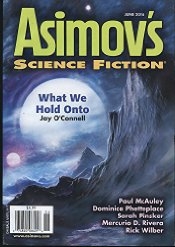
The fourth issue of this year’s subscription. In the editorial Sheila Williams introduces the magazine’s background staff. Robert Silverberg’s column describes his discovery of the utility of a smartphone. (He still doesn’t own one though.) In On the NET James Patrick Kelly discusses the back and present catalogue of stories set on Mars in the light of encouraging real space missions. Norman Spinrad’s excellent Book Review essay reflects on the difficulties of representing quantum reality (his preferred term for quantum mechanics) in fictional form and the necessity to treat the reader fairly vis-à-vis recent developments in astronomy.
As for the fiction:-
Clearance by Sarah Pinsker sees a tooth gel saleswoman discover the delights of holidays in different realities.
In Unreeled by Mercurio D Rivera the husband of a streamer (people whose consciousnesses are beamed across the universe then brought back again) finds his wife’s behaviour has altered as a result of a trip to a black hole. The denouement seemed a trifle rushed.
Rambunctious by Rick Wilber is a tale of an overly-gifted young girl whose family harbours a secret. I was reminded (a bit) of Zenna Henderson’s stories of The People.
Project Symmetry by Dominica Phetteplace sees a woman’s Watcher chip help her to come to terms with her life. This story didn’t really add much to what we already knew about the author’s fictional universe.
In Rats Dream of the Future by Paul McAuley a researcher tries to get rats to predict the future in order to make stock market killings.
What We Hold Onto by Jay O’Connell is set in a climate changed world where some cities have been inundated. A woman enlists a Nomad (a group of stateless licensed helpers) to deal with her dying mother’s estate. In essence an extended love story.
Pedant’s corner:- phase (I prefer faze for this sense, though apparently phase is an acceptable US usage,) laying down with (lying down with,) flack (flak,) patinaed (patinated,) Chthulu (Cthulhu,) sat (sitting; or seated,) Nils Bor (Nils Bohr,) a “neither…. or” rather than neither … nor, “summarizing .. for or readers” (omit “or”,) daring-do (this is the first time I have seen this formulation but it is indeed the original which was mistaken as a noun in itself and so has long been rendered as derring-do,) charactarogical (characterogical, surely?)
No Comments »
Posted in Reading Reviewed, Robert Silverberg, Science Fiction at 12:00 on 15 August 2015
Dell Magazines.

This magazine is more weighted to fiction than Analog though there are non-fiction pieces. Kathleen Ann Goonan’s guest editorial describes SF as a literature that asks Where do we come from? What are we? Where are we going? – thus adding two additional questions to the one most literature addresses – Robert Silverberg’s Reflections goes over the history of predictions of the end of the world and of apocalyptic SF while James Patrick Kelly’s On The Net: an Optimist’s Tale argues that modern day SF is not as pessimistic as some in Project Hieroglyph present.
As to the fiction, there is less cleaving of the paper light years in Asimov’s than there was in Analog, notwithstanding the first story The End of the War by Django Wexler, wherein two remnants of humanity called Minoans and Circeans fight a proxy war on derelict spaceships left over from the main battles by means of pilot-controlled salvage/manufactory devices. The opposing pilots have conversations as they fight over the remains.1 Henry Lien’s The Ladies’ Aquatic Gardening Society has two society ladies in what seems the nineteenth century trying to find the favour of Mrs Ava Vanderbilt by means of elaborate gardens. They take it too far.2 Mutability by Ray Nayler sees a couple meet for the first time in a café – four hundred years after being photographed together. Indrapramit Das’s The Muses of Shuyedan-18 features two human women who are witnessed having sex by the huge alien of the title which reproduces them in a carving on its back.3 The titular characters in M Bennardo’s Ghosts of the Savannah are two prehistoric women hunters who don’t want to settle to a life of domesticity and child-bearing. Our Lady of the Open Road by Sarah Pinsker is the tour bus for the band Cassis Fire, who are rare hold-outs still playing real gigs in a world where entertainment has been cornered by the corporate might of StageHolo.4
Pedant’s corner:-
1 the compute power (twice!! “computing power” is so much less ugly,) to go to particular place (a particular place,) “slingshot” as the preterite of the verb (slungshot? slingshotted? But then I suppose USians use fit as a past tense,) the maze of room and corridors (this ship had corridors but only one room?)
2 hostess’ (hostess’s,) the USianism “dove” for “dived”, plus the story jumps from Chapter VII to IX with no sign of VIII.
3 chord (cord,) in a way the human brain will remind of our own architectures (will be reminded of.)
4 in the cards (on the cards.)
No Comments »