Posted in Reading Reviewed, Science Fiction at 12:00 on 24 July 2012
Corgi, 1966, 157p.
This book was first published in 1962, and it shows. Structured as a series of tales noted down long after the events they describe by Pacific islanders who are among the few remnants of human civilisation – perhaps the only civilised remnants – following a devastating nuclear war which occurred in or around the year 2000 it relates the adventures of a man called Joenes in the run-up to, and the unfolding of, the apocalypse. Sheckley does not waste the opportunity to lampoon early 1960s attitudes, particularly slyly in the portrayal of a McCarthyite Senatorial inquisitor. At one point Joenes is sent to a military headquarters whose official map is false in order to confuse spies. Written when it was, it is not a surprise that the book has the USSR and the USA as adversaries and an unintended nuclear war brought on by automated systems as a plot point.
Other segments can turn our usual notions on their heads. Joenes is incarcerated for a time in a prison which people fight to get into.
The book is a series of incidents, though, not really a coherent whole and none of the characters rises above the mundane – nor to Sheckleyâs need to have them explain things to his naïf main character. Names such as Arthur Pendragon, Bill Launcelot, Richard Galahad and Austin Mordred are something of a hostage to fortune, as is the plundering of the Theseus and the Minotaur story.
I suppose, though, that most fiction that is fifty years old would not stand much scrutiny.
No Comments »
Posted in Reading Reviewed, Science Fiction at 20:00 on 17 May 2012
Methuen, 1986, 185p. (Also known as Crompton Divided.)
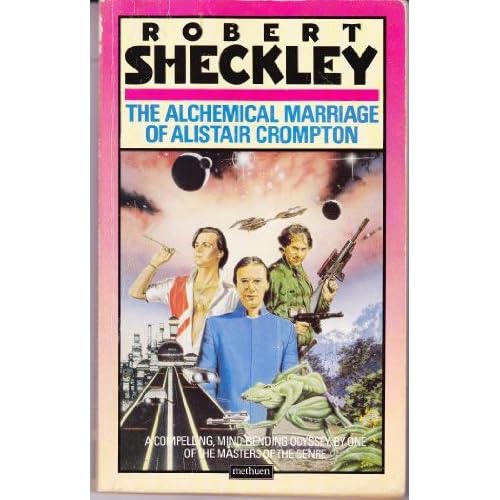
Due to âvirus schizophreniaâ Alistair Crompton has had his personality divided. Two of his alter egos have been decanted into Durier bodies and sent to far-flung parts of the galaxy. Crompton himself, an abstemious prude, has developed a fine nose and concocts subtle perfumes for Psychosmells Inc. After trying to steal a highly expensive essence he seeks out his alter egos to attain âReintegration.â The first, Loomis, who lives on the planet Aaia, is a prodigious womaniser, likes his life and so does not want to re-merge. Crompton manipulates things so that he will. They move on to the planet Yggia where after a long search they discover the third personality, Dan Stack, is homicidal. They come to him as he is about to be hanged for murder (though the victim hasnât quite died yet.) The merge takes place just as the hanging reaches its culmination. It then turns out the victim is a fourth alter ego.
The absurdities do not stop there as the Reintegration is not straightforward and in a search to achieve it the united but unintegrated personalities travel to the Intersentient Therapeutics Centre where all sorts of weird things happen.
In all of this the characterisation never rises above the stereotypical, not to say sketchy. In addition the book is riddled with info dumping and overloaded with science-fictional neologisms. There are frequent typos – but one was magnificent, âhis sanity was undermindedâ – and, among the poor jokes, an OK one when Crompton says, âIâm a paranoid schiz,â and his interlocutor replies, âThereâs quite a few of you lads here.â
Character names such as Al Dente and firms called Harbinger&Omen clearly signal the book is meant to be light-hearted. Whether it may have been funny in 1978 when it was first published is moot. It certainly isnât now.
No Comments »

