Archives » Philip Reeve

A Darkling Plain by Philip Reeve

Scholastic, 2006, 580 p, plus i p Acknowledgements and vii p Timeline of the Traction Era.
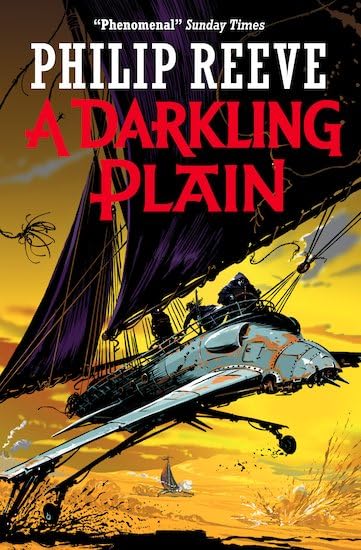
A Darkling Plain cover

This is the last in Reeve’s Predator Cities series of novels, continuing on from where we left off in Infernal Devices.

Tom Natsworthy now with a dicky heart after his shooting by Professor Nimrod Pennyroyal, and his daughter, Wren, are trying to pick up the pieces of their lives since their estrangement from Hester Shaw (respectively his wife and her mother.) In Wren’s case this is made easier by her attachment to Theo Ngoni. The plot kicks off when Tom thinks he recognises a woman, Clytie Potts, from his days in the now destroyed London, but she disclaims all knowledge of him. However an encounter with Wolf Kobold, the son of the ruler of the traction city Murnau leads to them going on his “suburb” Harrrowbarrow through the lines of the anti-traction army the Green Storm to where the remains of London lie in its surrounding debris fields. London turns out to be not quite the derelict it appears. Its surviving inhabitants have taken great care to keep themselves secret as they build a new city capable of magnetic levitation on the Earth’s Magnetic field.

Things haven’t gone entirely smoothly, though, as Wren and Theo have been separated by his enslavement – from which he is rescued by Hester. Other characters to reappear from the earlier books are the aforementioned Professor and the machine-like Shrike and Anna Fang. The latter of these drives part of the plot as she is able to control an orbiting WMD called ODIN using it against both sides of the traction city wars to undo a peace initiative.

As usual in YA fiction there is an abundance of action and incident, though a degree of coyness with matters of attraction between the sexes. Reeve lards his text with extratextural references (some of which may go over the heads of a YA audience.) We have characters named Lurpak, Nutella, Lego and Duplo, a street in Murnau called Über-den-Linden, a traction city named Peripatetiopolis, stories of awful salvage-stealing Wombles, a tunnel-like street called Holloway Road – heavy-handedly re-stated as Hollow-Way Road – mistakes about old-time usages (contract lenses,) and mention of a statue of Thatcher, the all-devouring goddess of unfettered Municipal Darwinism. I did wonder whether Cynthia Twite was possibly a nod to Joan Aitken’s Black Hearts in Battersea.

All great fun if you like that sort of thing and not entirely without jeopardy but one caveat.

I know the concept of predatory cities roaming the plains aiming to devour each other is an extrapolation ad absurdum but is the emphasis on violence not perhaps an unsuitable way to socialise the young?

Pedant’s corner:- burgermeister (burgomeister, but presumably Reeve didn’t want to alienate his YA audience,) “the Green Storm were” (the Green Storm was,) “than the old-fashioned jigs and reels than Wren had learned” (that Wren had leatned,) off-of (off,) “the old brake-blocks which supports Crouch End’s roof” (brake-blocks which support.) “Was that was this was all about?” (Was that what this was all about?) “Stories which she had had scoffed at” (only one “had” required,) “wondering where he had sprung him” (sprung from.) “A group of Green Storm aviators were running” (a group was running,) “one less regret” (one fewer.) “A party of his men were herding ..” (a party was herding,) “a saucer-shaped antennae” (antennae is the plural, one of them is an antenna.)
Infernal Devices by Philip Reeve

Scholastic, 2012, 388 p. Returned to a threatened library.

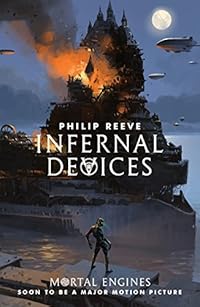
 Infernal Devices cover

The action in this novel takes place sixteen years on from the events in Predator’s Gold the previous (and second) of Reeve’s YA “Predator Cities” books. Tom Natsworthy and Hester Shaw have been living in the safety of Anchorage-in-Vineland for all that time. Their teenage daughter, Wren, however, has known no other life and is bored. As a consequence, when one of the burgling “Lost Boys” comes secretly to Anchorage in search of a relic from before the Sixty Minute War which led to the rise of the traction cities she is beguiled into helping him. This results in her abduction. Hester wades in rather heavy-handedly to try to prevent her kidnap but fails. The book follows Wren’s (mis)adventures and her parents’ search for her. Along the way we remake acquaintance with Professor Nimrod Pennyroyal, the anti-tractionist Green Storm and the Stalkers Anna Fang and Shrike.

The book is full of neat touches which may pass its YA readers by. Aeroplanes called Visible Panty Line or JMW Turner Overdrive or Itsy Bitsy Teeny Weeny Yellow Polka-Dot Machiney? An aviatrix calls to her sidekicks, “Algy? Ginger?” The slave-dealing Shkin corporation is “An Investor in People.” Hester seems more hard-bitten here than she did in the earlier books though it could be she is merely demonstrating she is her father’s daughter. Wren’s naivety can be a bit wearing but she has led a sheltered life. As is usual with YA there is plenty of action but also recognisable characterisation (even if its portrayal can be a bit over the top at times.)

Pedant’s corner:- into t he night (the night,) “I’ll pop the book back in my safe” (on the previous page the speaker had said “It’s in the safe in my office.”) Nabisco Shin (Nabisco Shkin,) casters (castors,) inside of (inside,) a missing end quote. In the publisher’s puff at the end (before extracts from Reeve’s GUIDE TO THE TRACTION ERA):- “The quartet are all available” (the quartet is.) In those extracts:- “with all both the” (no all, I think.)
But… plus points again for the diæresis used in aërobatics and aërodrome.

Predator’s Gold by Philip Reeve

Scholastic, 2004, 316 p.

Predator's Gold cover

I spotted this in one of the local libraries that’s within a few miles of Son of the Rock Acres (there are actually six – only one of which the good lady has not yet checked out – plus several more within ten miles) and since I felt like a relatively undemanding read while still cogitating on my review of Beta-Life for Interzone and Bring up the Bodies I borrowed it.

It contains more adventures of Tom Natsworthy and Hester Shaw in the world of Municipal Darwinism familiar from Mortal Engines. Here Tom and Hester are forced to flee the Green Storm, a militant offshoot of the Anti-Traction League, and land on the city of Anchorage whose margravine Freya, a teenage girl forced into rule by the untimely death of her parents in a plague, takes a fancy to Tom. Hester flies off in a fit of jealousy and betrays Anchorage’s location to the predator city Arkangel before being kidnapped by agents of the Green Storm. Tom is also kidnapped: by some Lost Boys, experts in burgling the wandering cities. Adventures ensue before our heros are reunited and return to try to save Anchorage from its fate.

This being a “young adult” book the subsidiary characters are drawn with broad brush strokes but are still recognisable people for all that. Not that Reeve is a slouch in the characterisation department. In the course of Predator’s Gold Freya and Hester undergo a fair degree of development.

The concept of Municipal Darwinism doesn’t withstand a moment’s scrutiny, of course. It isn’t meant to, but is a glorious device to allow the playing out of Tom’s and Hester’s relationship and the examination of issues of morality against a backdrop of jeopardy. The Lost Boys – under the direction of the nefarious “Uncle” – are a clever conflation of situations from Oliver Twist and Peter Pan.

The book is a delight throughout. (But does the cover not bring to mind Tintin books?)

Pedant’s corner:- One instance each of quick and slow being used as adverbs rather than adjectives, one opened set of brackets which wasn’t ever closed and a solitary typo, desciptions for descriptions. Reeve gets plus marks though for the word gowk and the diæresis in “Aëro engines.”

free hit counter script