Archives » Maureen F McHugh

Mission Child by Maureen F McHugh

Orbit, 1999, 385p.

On a planet whose name we don’t learn until the seventh last line of the novel (“What a foolish thing, to name a world”) there are three kinds of things: “onworld that will fill you up but not feed you, in-between things like renndeer and potatoes that we can eat but can live on onworld things; and offworld things like dogs and people.” (In its first appearance onworld was rendered as aunworld.) The onworld life, then, can variously be eaten for sustenance, for bulk with no sustenance, or is poisonous. Its amino acids are right handed – the opposite chirality to Earth’s.

Janna of Harma clan is the titular Mission child, brought up in an appropriate technology mission in a polar area where the main source of food is herded renndeer. To trade, her clan makes whisky (spelled whiskey.) Another clan called Tekse is becoming over powerful. Tekse outrunners arrive at the Mission as the novel starts. They have rifles whereas Harma do not. The inevitable destruction of the Mission and the clan follows. In the meantime Janna has been given implants by former offworlder Wanji. These help her survive the trek to other clan grounds and her subsequent adventures wherein she manages to roam far over her home world. Early on she has to put on a dead man’s clothes as hers are ragged. To protect herself in an offworlder run refugee camp, where she subsequently takes up with a shaman, she decides to stay dressed as a man, calling herself Jan.

The novel is episodic and as a result does not feel like one story but a fix-up. For example the shaman is only present for the middle portion and may as well not have appeared in Jan’s life as far as the last chapters of the book are concerned – except in so far as Jan tries to help people affected by a plague. What stays with Jan is hir background in the clans of the north, hir middling sense of gender and hir mistrust of offworlders, though these are almost always a benign influence on hir life. (My use of the indeterminate pronoun hir.)

It did seem strange that humans would bother to travel so far that it is all but impossible to return to Earth and then display the same sorts of follies they had left behind, in many ways living worse lives in this new world. Then again that may simply be an allegory of the European migration to the Americas. We are told, though, Earth still has many problems such as pollution.

The societies Jan lives in are observed only obliquely, the only one which is fully fleshed out is the Lapp-like existence of the renndeer herding clans. McHugh’s interest in Earth’s oriental cultures (as in China Mountain Zhang) comes through, though.

Pedant’s corner:- I spotted only one typo (abut for about) but there was a “lay” for “laid”, and (twice on one page) “shined” for “shone” where shoes were not concerned.
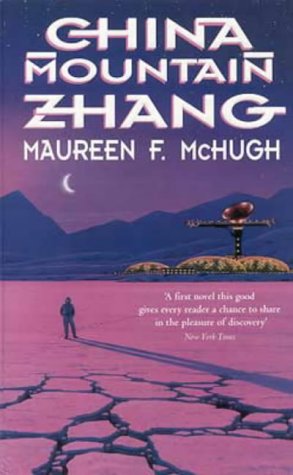
China Mountain Zhang by Maureen F McHugh

Orbit, 1995

China Mountain Zhang cover

This is another multi stranded narrative mostly dealing with the life of Zhang Zhong Shan,* an ABC (American Born Chinese) in a world where China is the major power. There was a major depression in the early part of the 21st century, bankrupting all the “€œWestern” powers barring Japan, Canada and Australia. (Does this sound faintly familiar? It was a bit bizarre reading stuff like this after the events of the past few months.) However, here the US underwent a proletarian revolution, a Second Civil War and, with some aid from China, became a socialist republic. Not a likely outcome in the real world, where socialism appears to be a swear word in the US.

Zhang’s mother has lumbered him with an embarrassing name (Sun Yat Sen in English transliteration.) She was Hispanic, a decided drawback in Zhang’€™s world, but he has been gene-spliced to make him appear more Chinese, though his genetic background is available to anyone who can access the records. This is possible by the process of “jacking-in” to a system, as are other activities legal and illegal. Such systems are extremely important in this world.

To make Zhang’€™s life even more problematic he is gay, a proclivity which requires to be hidden in the US and which could see him shot in the China he travels to in the fifth section of the novel.

Each strand is written in the first person, present tense. There are five sections narrated by Zhang but the other four narrators, Angel, Martine, Alexi, and San Xiang, have only one episode each and they all have at best only a tangential relationship to Zhang. It is therefore difficult to see what purpose these sections serve apart from to pad the novel out or else to illuminate Zhang’€™s world a little more fully than he can on his own – a flaw to my mind.

Still, the prose, being eminently readable, rolls along easily and the characters are well enough drawn. However, one does strike a cord in another at one point. (I had always thought it was a chord that was struck in such circumstances.)

Martine’€™s and Alexi’s strands are connected to each other (they marry) but are set on Mars where Zhang never sets foot! (He does communicate -€“ via a fifteen or so minute delay – with Alexi, by vid.) Martine’€™s and Alexi’€™s story is left hanging somewhat, though. The other two non-Zhang strands are quite divorced from the rest of the book.

Its episodic nature and the unrelated aspects of the strands made the book read more as a collection of short stories rather than a coherent novel and made me think this was actually a fix-up. A quick check reveals this to be at least partly the case since sections two, “Kites,”€ and three, “€œBaffin Island,”€ appeared in Asimov’s in 1989. As a result I am at a loss as to why this “novel” was nominated for the Hugo and Nebula awards in that category for 1993. It can only be for its unusual setting which almost seems designed to conclude that “€œMarx was wrong”€ – as Zhang intimates to a class he teaches in the last section.

The read here is undemanding; the prose is transparent and the characters are mostly engaging. Good enough; but, for me, not an award nominee.

*Zhong Shan can also mean China Mountain -€“ hence the title.

free hit counter script