Archives » Kathleen Ann Goonan

Asimov’s Science Fiction Jun 2015

Dell Magazines.

Asimov's Jun 2015 cover

This magazine is more weighted to fiction than Analog though there are non-fiction pieces. Kathleen Ann Goonan’s guest editorial describes SF as a literature that asks Where do we come from? What are we? Where are we going? – thus adding two additional questions to the one most literature addresses – Robert Silverberg’s Reflections goes over the history of predictions of the end of the world and of apocalyptic SF while James Patrick Kelly’s On The Net: an Optimist’s Tale argues that modern day SF is not as pessimistic as some in Project Hieroglyph present.
As to the fiction, there is less cleaving of the paper light years in Asimov’s than there was in Analog, notwithstanding the first story The End of the War by Django Wexler, wherein two remnants of humanity called Minoans and Circeans fight a proxy war on derelict spaceships left over from the main battles by means of pilot-controlled salvage/manufactory devices. The opposing pilots have conversations as they fight over the remains.1 Henry Lien’s The Ladies’ Aquatic Gardening Society has two society ladies in what seems the nineteenth century trying to find the favour of Mrs Ava Vanderbilt by means of elaborate gardens. They take it too far.2 Mutability by Ray Nayler sees a couple meet for the first time in a café – four hundred years after being photographed together. Indrapramit Das’s The Muses of Shuyedan-18 features two human women who are witnessed having sex by the huge alien of the title which reproduces them in a carving on its back.3 The titular characters in M Bennardo’s Ghosts of the Savannah are two prehistoric women hunters who don’t want to settle to a life of domesticity and child-bearing. Our Lady of the Open Road by Sarah Pinsker is the tour bus for the band Cassis Fire, who are rare hold-outs still playing real gigs in a world where entertainment has been cornered by the corporate might of StageHolo.4

Pedant’s corner:-
1 the compute power (twice!! “computing power” is so much less ugly,) to go to particular place (a particular place,) “slingshot” as the preterite of the verb (slungshot? slingshotted? But then I suppose USians use fit as a past tense,) the maze of room and corridors (this ship had corridors but only one room?)
2 hostess’ (hostess’s,) the USianism “dove” for “dived”, plus the story jumps from Chapter VII to IX with no sign of VIII.
3 chord (cord,) in a way the human brain will remind of our own architectures (will be reminded of.)
4 in the cards (on the cards.)
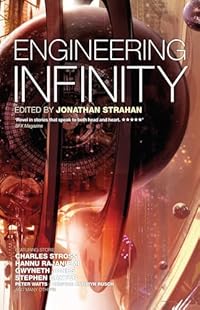
Engineering Infinity edited by Jonathan Strahan. (Solaris, 2010.)

Reviewed for Interzone issue 233, Mar-Apr 2011.

Engineering Infinity cover

According to Strahan’s introduction this anthology is a collection of stories roughly categorisable as hard SF, adding the disclaimer that the term is now a slippery concept hence the stories are inevitably broader in scope than might once have been implied. Whatever his claim that they all invoke the sense of wonder, most exhibit a tendency to be didactic in their narrative styles.

The tone is set early with “Malak” by Peter Watts, the tale of an unmanned airborne war drone that learns from its experiences.

Kristine Kathryn Rusch’s “Watching the Music Dance” deals with the effect of enhanced abilities for children on their dependency and psychological development.

The ghosts of the Soviet space programme are being made real in “Laika’s Ghost” by Karl Schroeder, mainly set in the former cosmodrome in Kazakhstan.

Stephen Baxter’s “The Invasion of Venus” is peculiar in that everything that happens, including the disappearance of the planet Neptune, occurs off stage. Apt, in that humans, and Earth, are of no consequence to the eponymous invaders.

Hannu Rajaniemi’s “The Server and the Dragon” has an intergalactic AI on some inscrutable purpose creating a baby universe as its plaything before being suborned and consumed by a message packet it receives. Extremely dry in the telling, a knowledge of quantum physics and cosmology might be advantageous here.

Charles Stross’s “Bit Rot” is a generation starship type story where the ship is “manned” by cyborgs who are suffering the deleterious aftermath of a gamma and cosmic ray burst. Stross references Tom Godwin’s “The Cold Equations” but overall the story is more reminiscent of John Wyndham’s “Survival.”

In “Creatures with Wings” by Kathleen Ann Goonan the remnants of humanity eke out their lives in what could almost be a zoo which the protagonist leaves to achieve enlightenment. Though Goonan tries to finesse it the story has too large a disjunction when these survivors are taken from Earth by the creatures of wings of the title.

“Walls of Flesh, Bars of Bone” by Damien Broderick & Barbara Lamar is the story from which the collection’s title may have sprung. A man sees himself on a film shot in 1931. The story moves on swiftly to become a concoction of quantum entanglement, self-interference of particles, Bayesian probability, spatial displacements and time travel.

Robert Reed’s “Mantis” concerns the realness (or otherwise) of our experiences and how to tell whether or not we live in stories. The SF gloss involves two way CCTV type screens called infinity windows.

The title of John C Wright’s “Judgement Eve” evokes Edgar Pangborn but unfortunately Wright is no Pangborn. The story, involving angels and Last Judgement, aspires to the condition of myth or Biblicality. As a result the “characters” become cyphers, the prose overblown, the dialogue bombastic and syntactically archaic.

In “A Soldier of the City” by David Moles the eponymous soldier volunteers for the revenge attack on the habitat of the terrorists who attacked his city and killed the goddess whom he loved.

The somewhat loopy protagonist of “Mercies” by Gregory Benford, made rich by inventing a logic for constructing unbreakable codes, invests in and then uses quantum flux technology to “jogg” to nearby timelines in order to execute serial killers before they set out on their sprees; thus becoming himself the object of the same fascination.

In Gwyneth Jones’s ”The Ki-Anna” a man travels to a distant planet to discover the circumstances surrounding his sister’s death and encounters the obligatory strange and disturbing ritual practices.

John Barnes’s “The Birds and the Bees and the Gasoline Trees” features a humaniform who has swum Europa’s oceans and stridden the beds of Titan’s methane seas unravelling the unforeseen consequences of humans trying to offset climate deterioration by seeding Earth’s Southern Ocean with iron from meteorites.

Hard SF? Sense of wonder? In an uneven collection a few stories fail to hit these marks. Enough do, though.

free hit counter script