Archives » Other fiction

What you are looking for is in the library by Michiko Aoyama

Penguin, 2024, 249 p. Translated from the Japanese お探し物は図書室まで (O-sagashi mono wa toshoshitsu made, literally “Please go to the library for what you are looking for,”) POPLAR Publishing Company, 2020, by Alison Watts. Illustrations by Rohan Easson.

This book’s title is surely designed to appeal to book lovers. Yet, in a sense, it must be preaching to the converted. Book lovers will all have used libraries and, crucially, already read books and thus need no encouragement to pick one up.

There are five stories within, all with a similar trajectory. Each of the lead characters has a reason to visit the Hatori Community House situated by a local school and gets drawn to its library where the librarian, Sayuri Komachi, recommends books to them and at the same time proffers a gift of a felted toy from the many she spends her time making.

The viewpoint characters are:-

Tomaka, a sales assistant in womenswear at Eden, a Department Store.

Ryo, who works in accounts for a furniture manufacturer but yearns to start an antiques business.

Natsumi, a former magazine editor moved sideways to a less fulfilling role on having had a child.

Hiroya, a thirty-year-old NEET who has neglected his talent for drawing.

Masao, recently retired and feeling a lack of direction.

Unfortunately, this all involves a lot of repetition of information as each character relates the details of their first visit to the Community House in very similar terms. There are also some instances of the relaying of characters’ internal thoughts or reactions which are rendered far too colloquially thus breaking readers’ suspension of disbelief.

There is discussion of the content of the borrowed books (in one case it’s not borrowed, since it’s too heavy to carry far, but rather consulted,) publishing details of which are appended in the Bibliography.

Special pleading for the utility of reading occurs when one of the narrators tells us “Books belong to everybody: the creators, the sellers and the readers.” Similarly, Ms Komachi says to another, “Readers make their own personal connections to words, irrespective of the writer’s intentions, and each reader gains something unique.”

It’s all very easy to read and undemanding but somehow feels inconsequential.

Pedant’s corner:- Uses British spellings but has the occasional USianism – sidewalk, sneakers, schoolyard, some schoolchildren are said to be in third or fourth grade. Otherwise; “inside in my stockings” (either ‘in my stockings’ or ‘inside my stockings’,) “I did use to talk with him” (did used to.)
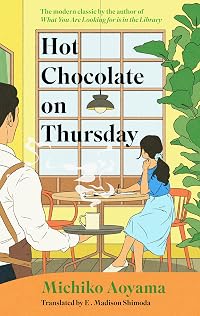
Hot Chocolate on Thursday by Michiko Aoyama

Doubleday, 2026, 193 p. Translated from the Japanese 木曜日にはココアを (Mokuyōbi ni wa kokoa, literally Thursday Cocoa,) Takarijamasha Inc, Tokyo, 2017, by E Madison Shimoda.

This is not so much a novel as a series of linked short pieces (calling them stories is not quite accurate) each with some sort of connection to the Marble Café in Tokyo.

The server in the café, who one day simply asked the owner for a job, has a yen for the woman who comes in on Thursday and always has a hot chocolate. The owner is known as Maestro, has a mole in the centre of his forehead and another business selling/promoting art.

After the first, each chapter then proceeds with one of the characters from the previous one carrying on with their own story. Every chapter has its own title and a (different) colour designation.

The scenes range as far as Sydney in Australia, though. In one of these a character tastes Vegemite and reflects it “looks sweet but is actually salty – isn’t that what life is like?”

Another character thinks “We’re all intertwined in each other’s lives without even knowing it” which corresponds a bit too much to what the structure of Hot Chocolate on Thursday is like.

An unusual feature of the publication is that at the top right-hand corner of each odd-numbered page is an illustration of a cup and what looks like a teapot (but may be supposed to contain hot chocolate) at first poised to pour but, as the chapters progress, pouring liquid into the cup until it is full and giving off condensed vapour. (I refuse to call this steam. Steam, pure steam, is a colourless gas, not white.)

The book has an addendum titled Matcha on Monday (月曜日の抹茶カフェ, Getsuyōbi no matcha kafe, literally Monday Matcha Café) on which the café, normally closed on a Monday, is open – but only to sell matcha.

Aoyama’s writing is fine enough but overall Hot Chocolate on Thursday feels a little inconsequential.

Pedant’s corner:- octopi (the English plural is ‘octopuses’, the Greek ‘octopodes’.)


A Wild Sheep Chase by Haruki Murakami

Vintage, 2003, 301 p. Translated from the Japanese 羊をめぐる冒険 (Hitsuji o meguru bōken, literally An Adventure Concerning Sheep,) Kodansha Ltd, Tokyo, 1982, by Alfred Birnbaum.

This is a strange concoction. It starts off as a kind of boy (okay man) meets girl (ie woman) story where our unnamed divorced narrator notices a model’s ears in a photograph his advertising agency has used and develops a penchant for them. When they meet he discovers she habitually keeps her ears hidden except when modelling (or having sex.)

Then it morphs into a quasi-noir type tale when the agency publishes a pamphlet for a life insurance company containing a photograph of grazing sheep against a mountain background which attracts the attention of a representative of “The Boss,” a power in Japan’s political and economic circles. Our narrator is tasked with withdrawing the publication and then finding a distinctive sheep shown in the photograph on pain of his business being dissolved. A turn to the unusual occurs when the chauffeur taking him to a meeting with the Boss says he has a telephone hotline to God given him by his employer.

Along with his now girlfriend, whose ears have a semi-supernatural sensitivity, our narrator travels to Hokkaido to try to find the sheep. Hence the book’s title in English.

All this is linked in with his acquaintance with a character called the Rat whose whereabouts are unknown but with whom the narrator has held an intermittent correspondence. (I note from Murakami’s Wiki page that A Wild Sheep Chase is in fact the third in a trilogy featuring the Rat. Unfortunately, I have not read the previous two books.)

The novel becomes a travelogue, a part history of the area of Hokkaido where the distinctive sheep is to be found, and a fantasy of possession whereby sheep take up residence inside a person. (This once happened to the Boss.)

Along the way the narrator muses, “Russians have a way with aphorisms. They probably spend all winter thinking them up.”

A crucial encounter with a hotel owner’s father known as the Sheep Professor, who once also had the sheep inside him, leads them to an isolated house in a backwater beyond even remote, where the narrator assumes the Rat has been living. Then there is the Sheep Man dressed in a sheep costume (an illustration of whom appears on its own page) who may or may not be the Rat.

If all this sounds as if it might be confusing it actually isn’t when reading. On the page it all makes sense – of a sort.

Pedant’s corner:- Translated into USian. Otherwise; “which may have been reason why” (been the reason why,) “the herringbone lay of the oak floorboards” (the herringbone lie of.) Chapters starting with dialogue are missing the opening quotation mark (this may be publishing convention but I hate it,) “why she treated me special” (‘why she treated me as special’,) snowslide(s) (x 4. Has the translator never heard the word ‘avalanche’? Is ‘snowslide’ a USian usage?) “if worse comes to worse” (if the worst comes to the worst,) “the lay of the grass” (the lie of the grass.) “‘It is special sheep’” (a special sheep.) “Only the the cicadas” (has one ‘the’ too many,) pull-ring (x 4. USian for ring-pull I assume,) “the overture to the The Magnificent Seven” (the overture to The Magnificent Seven.) “October laid heavy on the town” (October lay heavy,) buildiing (building,) “the lay of the land” (it was not a song: ‘the lie of the land’,) “the rotary” (I assume USian. To me ‘rotary’ is an adjective, not a noun. The appropriate word for this piece of road architecture is ‘roundabout’,) “corrogated iron” (corrugated,) “the rest the wine” (the rest of the wine,) “the lay of the house” (the lie,) “the word ‘free will’” (‘free will’ is two words; the one word would be ‘freewill’.) “The cords come out of four holes” (the rest of the passage is in past tense; ‘the cords came out of’.)

An Experiment in Love by Hilary Mantel

Penguin, 1996, 254 p.

This evocation of the late 1960s and early 1970s is narrated from the perspective of her later life by Carmel McBain and charts the relationships between herself, her childhood companion Karina, and later school and college friend Julia(nne) Lipcott over those years.

Every weekday Carmel accompanied to school her close neighbour Karina, the kind of good girl other mothers held up as an example, but whose parents had a tragic background in the then relatively recent Second World War in Europe. Karina may not be quite what they think, though, as Carmel observed her hanging round with rough boys at the bus station.

Carmel’s mother, prompted by a teacher at Carmel’s school, became fixated on her daughter gaining a place at the Holy Redeemer, a school no-one from her neighbourhood has yet attended. However, Karina also sits the entrance exam – and sails through.

Carmel’s Catholic background is always a nagging influence. At the Holy Redeemer she imbibes the thought that “bodies are encumbrance, a necessary evil.” Of Bonfire Night, she tells us, “If you’re a Catholic you don’t burn Guy Fawkes; the Pope says you mustn’t.”

Most of the story, however, is set at Tonbridge Hall, the college the three girls attend after leaving the Holy Redeemer, and an institution plagued with dire, unappetising food. This is an intense environment where the young women converse about who is engaged, who is on the pill, or pregnant, or thinks they might be pregnant, or has just discovered that she isn’t pregnant. This aspect of the novel did remind me of the May of Teck Club in Muriel Spark’s The Girls of Slender Means. The climax of An Experiment in Love also bears some comparison with that book. Mantel is a much more lucid writer than Spark, though.

However, being of their time, most of the students are preparing for life with a husband.

Partway through the novel Carmel says this is a story about appetite – “in its many aspects and dimensions” and that women carry the faculty for love into later life. “Men will never understand it until till they stop confusing love with sex, which will be never.” Carmel tells us she loves multiple women, but not in a sexual sense.

The whole is infused with a forthright feminism. “There are people who find life hard and those who find it easy. There are those who have a natural, inbuilt, expectation of happiness, and there are those who feel that happiness is not to be expected: that it is not, in fact, one of the rights of man. Nor, God knows, one of the rights of women.”

“When men decided women could be educated, they educated them on the male plan” (schools with mottoes and school songs, muddy team games, collars, ties) but always inferior. “Women were forced to imitate men, and bound not to succeed at it…… Our schools kept from us, for as long as they could, the dangerous, disruptive, upsetting knowledge of our own female nature.”

The Secretary of State for Education visits the college – and the food suddenly becomes palatable. The lady “leant forward and smiled, and her hair moved with her, as if it were not just hair but a hat made of hair,” a feature not uncommon among women politicians at the time. But, “She turned her head in my direction; she opened her lips to speak, and shards of glass fell out.” No need to mention the Secretary’s name.

Carmel’s reaction to a southerner’s comment is waspish. “I wasn’t used to Londoners then. I’m still not. They talk so much. I always want to smash their jaws shut; I realize the reaction may be excessive.”

Mantel’s literary skill, which was manifested so magnificently in her Wolf Hall trilogy, is in evidence here, fully formed.

Pedant’s corner:- “thorn in Jesus’ crown” (Jesus’s,) “was now sewed with a name-tape” (was now sewn,) sunk (x 2, sank,) swum (swam.)

The Great Gatsby by F Scott Fitzgerald

Everyman’s Library, 1991, 150 p, plus 22p Introduction by Malcolm Bradbury, 2 p Select Bibliography and 9 p Chronology. First published 1925.

I had had this on my tbr pile for years without ever getting round to it. I might still not have had it not been on both the Guardian’s list of 100 Best Novels, where it was no 11, and also in the readers’ list (16 [equal]).

It’s a bit of an odd experience to read a book held in such regard: especially if you’ve seen a film made from it (in my case the one starring Robert Redford.) In this instance it was also dispiriting. Few, if any, of the characters have any redeeming features.

Gatsby, born Jimmy Gatz, is blinded to just about all else – especially caution – by his obsession with Daisy Buchanan, who is herself narcissistic, superficial and, strange as that may seem given his bootlegging activities, actually unworthy of him. Her diffidence makes her more of an absence in the book than an active participant. Even her crucial contribution to the story, the driving of the car whose fatal encounter precipitates the denouement, occurs outwith the direct narrative. Her husband Tom is nothing but a bully, a racist and white supremacist, subscriber to the great replacement theory (yes in the 1920s,) who sees racial intermarriage as the end of civilisation and treats his mistress Myrtle Wilson with casual violence. Myrtle’s husband George is merely a catspaw.

Daisy’s friend Jordan Baker, and our narrator Nick Carraway’s sometime girlfriend (a relationship always somewhat tenuous,) seems to be present only for purposes of information dumping.

Nothing much is revealed of Carraway himself, a very un-USian protagonist in that he affects little in the story and only reacts to what is around him. (That last is not a criticism, by the way; they also serve.)

There is a curious statement in, “Americans, while willing, even eager, to be serfs, have always been obstinate about being peasantry.”

I note that a door marked, ‘The Swastika Holding Company’ reads now a little differently than it would have done in 1925.

I wouldn’t rate this anywhere near my top 100 reads. It may be it is as much – perhaps more – to be noted for its highlighting of the vacuousness and indifference bordering on callousness of the monied during what was called the Jazz Age as for any literary merit. But then the monied are vacuous and indifferent in any age, you only have to witness our own, where callousness seems endemic.

Sensitivity note: ‘kike’, ‘three modish negroes, two bucks and a girl’, ‘a small flat-nosed Jew’, ‘a lovely Jewess’.

Pedant’s corner:- “‘you’d of thought,’ ‘he’d of got me’ and ‘appendicitus’” (spoken by Mrs Wilson or her sister, so possibly an attempt to render a lack of education: ‘you’d’ve thought,’ he’d’ve got me,’ ‘appendicitis’,) “had reached a crescendo” (a crescendo is the rise, not its peak,) caravansary (caravanserai.)

Wise Children by Angela Carter

Vintage, 1992, 236 p.

I suspect that Carter actually enjoyed writing this book, which fizzes with energy and sly humour and at times tips into magical realism. Its title is based on the old saw that a wise child knows its father. Narrated by Dora, one of the twin sister dance act known as the Chance Girls. She and twin (Leo)Nora are daughters, on the wrong side of the blanket, of theatrical great Melchior Hazard, who unfortunately did not acknowledge them as his. That burden was taken on, though, by his nomadic brother Peregrine.

The convoluted nature of the family relationships here – the girls were brought up by the woman they know as Grandma (even though she wasn’t) and told their mother died shortly after their birth in Grandma’s house – is further complicated by the fact that living with them is the disabled former wife of Melchior, Lady (in her own right) Atalanta Hazard, known to the now 75 year-old twins as Wheelchair.

There is a measure of smoke and mirrors to proceedings, reflecting theatrical illusion. The novel is steeped in theatrical and stage lore, with Shakespearian references abounding. A trip to Hollywood illustrates the excess of the early film industry with a climactic scene perhaps owing a little something to slapstick comedy. The contrast between Melchior’s status as a grand old man of legitimate theatre and the lower brow nature of the sisters’ dance career highlights the disparity between their own legal status and that of their half-sisters,  acknowledged by Melchior, born in wedlock, though possibly not sired by him.

At its core, though, is Dora’s longing to belong, her search for a figure to fill in for the father who disowned her.

Dora’s vice may be irritating to some what with all the theatrical allusions, irreverent asides and references to lost cultural staples.

But along the way she has some more serious thoughts. “Let’s not call it a tragedy. A broken heart is never a tragedy. Only untimely death is a tragedy. And war.”

Much later we have this exchange with her sister.

“‘It’s every woman’s tragedy,’ said Nora, ‘that, after a certain age, she looks like a female impersonator.’”

‘What’s every man’s tragedy, then?’ I wanted to know.

‘That he doesn’t, Oscar,’ she said.”

She also tells us that, in story telling, “If you get little details right, people will believe anything,” (true in life as well perhaps?) and vouchsafes that, “Comedy is tragedy that happens to other people.”

This was Carter’s last novel, written after her diagnosis of lung cancer. In the circumstances it is something to be wondered at that, while touching on seriousness, overall it has such a consistent lightness of tone.

Pedant’s corner:- “she’s showed her all” (intended I’ve no doubt – the book’s background is show business after all – but it ought to be ‘shown’,) “to whit” (it’s ‘to wit’,) forbad (forbade,) “Nora said, he was young enough” (that comma alters the sense,) “Epps’ cocoa” (was that a proprietary brand. Whatever it ought to be ‘Epps’s’,) a musical revue called What You Will, later rendered variously as “What? You Will?”, “What! You Will?”, “What! You Will!” and “What You Will!”, “than sang” (then sang,) “oblivious of” (it’s oblivious to,) “legs akimbo” (how you can put your feet on your hips is beyond me,) slax (slacks, spelled so to indicate lack of care or attention,) “never forgave a grudge” (a malapropism for forgot?) “Peter Jones’ store” (Jones’s.) “Nora sunk in thought” (sank.)

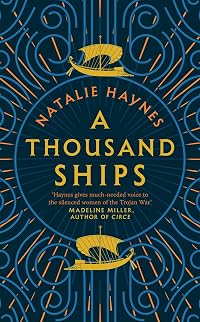
A Thousand Ships by Natalie Haynes

Mantle, 2019, 348 p plus 5 p List of characters, 5p Afterword and 2 p Acknowledgements.

This novel’s title is not particularly apposite – though it does allude to its subject, those Greek tales of the Trojan War – as it barely mentions the legendary ships at all. Instead, its focus is on the women caught up in that conflict and more or less sidelined in all the years since they were first written about. And not simply, like Pat Barker’s Women of Troy sequence, on the Trojan women, but also on the those the Greeks left behind and the Muses and Goddesses said to have influenced affairs.

Thus we have the muse Calliope irritated by the importunings of “the poet” for her to sing for him of the events he wishes to describe (Haynes thereby echoing the usual translation of the Iliad’s opening line, “Sing, Muse, of the wrath of Achilles.”) Creusa, woken by the tumult of the city’s fall, fearing for her five-year-old son and wondering where her husband Aeneas has got to. The captured Trojan women on the shore by the Greek camp, their travails only beginning but intermittently returned to through the narrative. Penthesilea the Amazon, fighting for Troy against the Greeks to atone for being responsible for the death of her sister. Penelope, writing increasingly tetchy letters to her husband Odysseus as his long absence is exacerbated by failure to return promptly on the war’s end and then prolonged on – and on and on – (the poet’s missives suggesting he will use any excuse not to come home.) Chryseis, the daughter of Apollo’s priest, who is befriended by Briseis in shared adversity. The sea-nymph Thetis, mother of Achilles, bemoaning her forced marriage to a mortal and her son’s own mortality. Laodamia begging her husband Protesilaus not to be the first onto the beach at Troy, though she knew he would be. Iphigenia, tricked by her father Agamemnon’s promise of marriage to Achilles into being sacrificed for a favourable wind to set sail for Troy. Aphrodite, Hera and Athene using wiles and false promises to trick Paris into his famous judgement. Oenone, who rescued Paris as a baby after he was abandoned due to the prophecy that he would cause Troy’s downfall. Eris, goddess of strife, setting up the business with the golden apple. Hecabe, Queen of Troy, struggling to accept her new diminished status but still able to revenge at least one of her dead sons. Her daughter Polyxena, accepting her fate with stoic dignity. Cassandra, cursed to see the future as the present and not to have her visions believed. The goddess Gaia resenting the ravages humans wreak on the Earth. Clytemnestra nursing her fury at Iphigenia’s death and preparing her vengeance for it for ten long years. The three Fates spinning the threads of mortals’ lives. Andromache slowly coming to terms with her new life as a slave.

Not a straightforward linear narrative, then, and the many viewpoints and scenes mean the whole thing comes across as fractured and a bit scattershot. This stands in contrast to Haynes’s previous novel The Children of Jocasta which was more tightly focused. The lack of linearity of the storyline works, though, and Haynes clearly has a deep knowledge of her source material.

Her main point, that the sufferings and endurance of the women of these wars (and by extension the women of any war) are as – or even more – heroic than any acts carried out by warriors is certainly worth considering.

Pedant’s corner:- “Odysseus’ nurse” (Odysseus’s,) “Aeneas’ heart” (Aeneas’s,) Briseis’ back” (Briseis’s,) Chryses’ character (Chryses’s,) all names ending in ‘s’ are given s’ rather than s’s for their possessives, “to staunch your bleeding” (stanch,) “each head will open its gaping maw” (stomachs are not usually located on heads,) “‘that Hector deserved to die.’ she said” (‘that Hector deserved to die,’ she said’,) “not known to have expressed regret for any cruelty he had perpetuated against anyone” (he had perpetrated against anyone.)

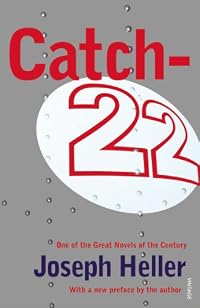
Catch-22 by Joseph Heller

Vintage, 2000? 568 p. First published 1961. (The publishing information page gave this edition’s date as 1994, but the author information page states he died in 1999 so it must have been some time later.)

How to approach a novel whose title has contributed a concept to the world’s lexicon of phrases? Indeed, a novel whose cover describes it as “One of the great novels of the century” and was no 99 in the recent Guardian list of 100 greatest novels ever, thus spurring me on to retrieve it from my tbr pile. That makes it 34 of those 100 I have now read. (It made no 8 in the readers’ list.)

And how will it conform to the great novelistic concerns of love, sex and death?

Well, Catch-22 is a war novel, so that’s death ticked off – though not often directly. Fear of death, yes, (the background to the eponymous catch,) but not death itself. Sex is certainly alluded to, but in a perfunctory way, and there is precious little love displayed in its pages. Some of the characters say they’re in love but the reader may beg to doubt it.

War novels have a head start in the importance stakes. They do tend to be taken seriously, as Kate Atkinson noted.

War is, of course, a deadly serious business; but it is also at its root utterly absurd and non-sensical. In Catch-22, Heller has chosen to lean into that absurdity. Heavily. At times so heavily it tips over into farce.

The text is full of digressions, repetitions and conversations which circle back on themselves or have characters repeating to each other what each has just said. It is decidedly non-linear with the narrative sometimes jumping from one scene to another mid-sentence. Scenes from main character Yossarian’s training and the island of Pianosa where he is based in the ‘now’ of the novel slide into each other without demarcation. Character descriptions tend to the grotesque and few of them impress as real people. The treatment of women is perfunctory and off-hand. The overall impression is of a surrealistic collage which goes thoroughly overboard at times with such character names such as Major Major and A Fortiori.

But it is not really so much a novel of war as of the US military mindset. Colonel Cathcart’s desire for promotion (or publicity,) the rivalries between senior officers more important to them than the war itself. Cathcart’s continual raising of the number of missions his charges must fly before their tour ends and they can be sent home is the proximate cause of bomb-aimer Yossarian’s refusal to fly any more, his natural fear of being killed not then being evidence of the insanity which would ensure his withdrawal from combat. Quartermaster Milo Minderbinder’s black market activities – supposedly to benefit all the soldiers on the base – with his fingers in every pie imaginable plus a few more, extend even to dealing with the Germans and undermine the war effort in other ways.

The novel does undergo a mood change halfway through chapter 39 (out of 42) when the narrative becomes more sombre and it is from here on that Cathcart and Colonel Korn suddenly show more perspicacity and cunning than up to that point.

I can’t decide whether this is a heartbreaking work of staggering genius (a phrase I have purloined in a bid for comic effect) or the most annoying novel I’ve ever read.

I think I lean towards the latter.

Sensitivity note: the word ‘nigger’ appears – as do ‘kike’, ‘wop’ and ‘spic’.

Pedant’s corner:- “the educate Texan from Texas” (that’s where Texans usually come from,) “a bus depot blazing with red and yellow lights” (wouldn’t they have a blackout?) “clefted chin” (cleft chin,) receptable (receptacle,) german (x 1, elsewhere, as is proper, German,) “threw this arms about” (his arms,) “and order him” (and ordered him.) “Now She sat” (she,)  “how many times she’s packed his bags” (he’s packed his bags,) “like most of all” (Liked most of all,) mispronounciations (mispronunciations,) “Dr Stubbs’ fault” (Stubbs’s.) “‘Another country heard from’”  (elsewhere this phrase is rendered as another county heard from.)

The Guardian Readers’ 100 Best Novels List

In response to its 100 best novels list I posted about here, on Saturday last the Guardian published its readers’ list of their 100 best novels.

I must admit I did not send in my contribution so have no grounds for complaint but again I note the absence of Sunset Song.

I did better with these, 44 (47 if the Neapolitan Quartet counts as 4; or 43⅓ if the Tolkien is taken as a whole.)

Since I copied and pasted from the Guardian website the links are theirs.

93=  Animal Farm by George Orwell

Love in the Time of Cholera  by Gabriel García Márquez

Mrs Dalloway by Virginia Woolf

80= Dune by Frank Herbert

Jonathan Strange & Mr Norrell by Susanna Clarke

The Name of the Rose by Umberto Eco

75= Brave New World by Aldous Huxley

Brideshead Revisited  by Evelyn Waugh

Tinker Tailor Soldier Spy  by John le Carré

73= The Unbearable Lightness of Being  by Milan Kundera

70= Piranesi by Susanna Clarke

The Dispossessed by Ursula K Le Guin

To the Lighthouse  by Virginia Woolf

63= Neapolitan Quartet by Elena Ferrante  (Isn’t this actually four books?)

Rebecca by Daphne du Maurier

The Tin Drum by Günter Grass

62 Midnight’s Children by Salman Rushdie

60 Possession by AS Byatt

57 Cloud Atlas by David Mitchell

52= Birdsong by Sebastian Faulks

Emma  by Jane Austen

49 David Copperfield by Charles Dickens

46  Watership Down  by Richard Adams

41 Heart of Darkness by Joseph Conrad

The Handmaid’s Tale by Margaret Atwood

39= Frankenstein by Mary Shelley

Stoner by John Williams

37 The Catcher in the Rye by JD Salinger

31 The Master and Margarita by Mikhail Bulgakov

29 Great Expectations by Charles Dickens  (Also at 29 was Huckleberry Finn which I may have read when very young but can’t actually remember doing so.)

26 Jane Eyre by Charlotte Brontë

21 Slaughterhouse-Five by Kurt Vonnegut

20 Beloved by Toni Morrison

19 Gravity’s Rainbow by Thomas Pynchon

16 Persuasion by Jane Austen

14= Wolf Hall by Hilary Mantel

Wuthering Heights by Emily Brontë

8= Catch-22 by Joseph Heller (I’ve now started this.)

One Hundred Years of Solitude by Gabriel García Márquez

7 Nineteen Eighty-Four by George Orwell

6 War and Peace by Leo Tolstoy

5 To Kill a Mockingbird by Harper Lee

3 Pride and Prejudice by Jane Austen

1 The Lord of the Rings by JRR Tolkien (I’ve only read The Fellowship of the Ring, the first in the trilogy.)

The Temple of Dawn by Yukio Mishima

In The Sea of Fertility, Penguin, 1987, 196 p. Translated from the Japanese 曉の寺 (Akatsuki no Tera) by E Dale Saunders and Cecilia Segawa Seigle.  First published 1970.

This instalment of Mishima’s tetralogy starts in 1940 and follows on from Runaway Horses by featuring now retired judge Shikeguni Honda, still convinced that Isao Iinuma was a reincarnation of Kiyaoki Matsugae, the doomed lover in Spring Snow; a belief mainly due to the presence of three moles on their left sides.

As part of his legal consultancy work protecting Japanese exporters’ interests Honda travels to India via Thailand. He meets a six-year-old Thai princess, Ying Chan, who is convinced she is Japanese but her assertions are, of course, treated by her family and attendants as mental aberrations. Honda believes her and tries unsuccessfully to see if she also has three moles.

On to Benares in India where Honda has an epiphany while Mishima takes the opportunity to impart to us a lengthy treatise on various ideas of reincarnation from around the world. At a waterfall in the Antaji caves Honda also recognises a scene which Matsugae had predicted he would encounter.

The Second World War comes and goes off-stage and the story undergoes a shift in tone when it restarts in occupied Japan where Ying Chan has come to study. Honda becomes obsessed by the idea of seeing her naked to confirm his reincarnation belief. He invites her to his house (but several times she does not turn up on time.) He tries to get the nephew of his neighbour to seduce Ying Chan, on whose intended room he can spy via a peephole, but this plan fails. (I note the recurrence of this peephole scenario in Mishima’s later novel The Sailor Who Fell From Grace with the Sea.)

Honda becomes even more of a voyeur before the novel’s climax during one of his houseparties and there is an odd, almost detached, final chapter set in 1967 where he discovers Ying Chan’s destiny.

Mishima’s unease at Japan’s loss of identity under Western influence is less to the fore here than in the previous two volumes. It is almost as if this instalment is from a different story sequence, despite the reincarnation connection.

Pedant’s corner:- “voices chanting a sutra rose rapidly to a crescendo” (No. The crescendo is the rise, not its culmination,) “plusses and minuses” (pluses and minuses?) “the aureoles around the nipples” (the areolae.)


free hit counter script