Archives » Japanese Fiction

What you are looking for is in the library by Michiko Aoyama

Penguin, 2024, 249 p. Translated from the Japanese お探し物は図書室まで (O-sagashi mono wa toshoshitsu made, literally “Please go to the library for what you are looking for,”) POPLAR Publishing Company, 2020, by Alison Watts. Illustrations by Rohan Easson.

This book’s title is surely designed to appeal to book lovers. Yet, in a sense, it must be preaching to the converted. Book lovers will all have used libraries and, crucially, already read books and thus need no encouragement to pick one up.

There are five stories within, all with a similar trajectory. Each of the lead characters has a reason to visit the Hatori Community House situated by a local school and gets drawn to its library where the librarian, Sayuri Komachi, recommends books to them and at the same time proffers a gift of a felted toy from the many she spends her time making.

The viewpoint characters are:-

Tomaka, a sales assistant in womenswear at Eden, a Department Store.

Ryo, who works in accounts for a furniture manufacturer but yearns to start an antiques business.

Natsumi, a former magazine editor moved sideways to a less fulfilling role on having had a child.

Hiroya, a thirty-year-old NEET who has neglected his talent for drawing.

Masao, recently retired and feeling a lack of direction.

Unfortunately, this all involves a lot of repetition of information as each character relates the details of their first visit to the Community House in very similar terms. There are also some instances of the relaying of characters’ internal thoughts or reactions which are rendered far too colloquially thus breaking readers’ suspension of disbelief.

There is discussion of the content of the borrowed books (in one case it’s not borrowed, since it’s too heavy to carry far, but rather consulted,) publishing details of which are appended in the Bibliography.

Special pleading for the utility of reading occurs when one of the narrators tells us “Books belong to everybody: the creators, the sellers and the readers.” Similarly, Ms Komachi says to another, “Readers make their own personal connections to words, irrespective of the writer’s intentions, and each reader gains something unique.”

It’s all very easy to read and undemanding but somehow feels inconsequential.

Pedant’s corner:- Uses British spellings but has the occasional USianism – sidewalk, sneakers, schoolyard, some schoolchildren are said to be in third or fourth grade. Otherwise; “inside in my stockings” (either ‘in my stockings’ or ‘inside my stockings’,) “I did use to talk with him” (did used to.)

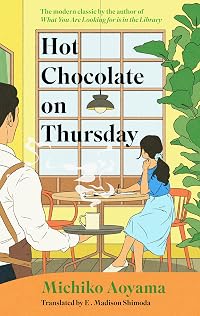
Hot Chocolate on Thursday by Michiko Aoyama

Doubleday, 2026, 193 p. Translated from the Japanese 木曜日にはココアを (Mokuyōbi ni wa kokoa, literally Thursday Cocoa,) Takarijamasha Inc, Tokyo, 2017, by E Madison Shimoda.

This is not so much a novel as a series of linked short pieces (calling them stories is not quite accurate) each with some sort of connection to the Marble Café in Tokyo.

The server in the café, who one day simply asked the owner for a job, has a yen for the woman who comes in on Thursday and always has a hot chocolate. The owner is known as Maestro, has a mole in the centre of his forehead and another business selling/promoting art.

After the first, each chapter then proceeds with one of the characters from the previous one carrying on with their own story. Every chapter has its own title and a (different) colour designation.

The scenes range as far as Sydney in Australia, though. In one of these a character tastes Vegemite and reflects it “looks sweet but is actually salty – isn’t that what life is like?”

Another character thinks “We’re all intertwined in each other’s lives without even knowing it” which corresponds a bit too much to what the structure of Hot Chocolate on Thursday is like.

An unusual feature of the publication is that at the top right-hand corner of each odd-numbered page is an illustration of a cup and what looks like a teapot (but may be supposed to contain hot chocolate) at first poised to pour but, as the chapters progress, pouring liquid into the cup until it is full and giving off condensed vapour. (I refuse to call this steam. Steam, pure steam, is a colourless gas, not white.)

The book has an addendum titled Matcha on Monday (月曜日の抹茶カフェ, Getsuyōbi no matcha kafe, literally Monday Matcha Café) on which the café, normally closed on a Monday, is open – but only to sell matcha.

Aoyama’s writing is fine enough but overall Hot Chocolate on Thursday feels a little inconsequential.

Pedant’s corner:- octopi (the English plural is ‘octopuses’, the Greek ‘octopodes’.)


A Wild Sheep Chase by Haruki Murakami

Vintage, 2003, 301 p. Translated from the Japanese 羊をめぐる冒険 (Hitsuji o meguru bōken, literally An Adventure Concerning Sheep,) Kodansha Ltd, Tokyo, 1982, by Alfred Birnbaum.

This is a strange concoction. It starts off as a kind of boy (okay man) meets girl (ie woman) story where our unnamed divorced narrator notices a model’s ears in a photograph his advertising agency has used and develops a penchant for them. When they meet he discovers she habitually keeps her ears hidden except when modelling (or having sex.)

Then it morphs into a quasi-noir type tale when the agency publishes a pamphlet for a life insurance company containing a photograph of grazing sheep against a mountain background which attracts the attention of a representative of “The Boss,” a power in Japan’s political and economic circles. Our narrator is tasked with withdrawing the publication and then finding a distinctive sheep shown in the photograph on pain of his business being dissolved. A turn to the unusual occurs when the chauffeur taking him to a meeting with the Boss says he has a telephone hotline to God given him by his employer.

Along with his now girlfriend, whose ears have a semi-supernatural sensitivity, our narrator travels to Hokkaido to try to find the sheep. Hence the book’s title in English.

All this is linked in with his acquaintance with a character called the Rat whose whereabouts are unknown but with whom the narrator has held an intermittent correspondence. (I note from Murakami’s Wiki page that A Wild Sheep Chase is in fact the third in a trilogy featuring the Rat. Unfortunately, I have not read the previous two books.)

The novel becomes a travelogue, a part history of the area of Hokkaido where the distinctive sheep is to be found, and a fantasy of possession whereby sheep take up residence inside a person. (This once happened to the Boss.)

Along the way the narrator muses, “Russians have a way with aphorisms. They probably spend all winter thinking them up.”

A crucial encounter with a hotel owner’s father known as the Sheep Professor, who once also had the sheep inside him, leads them to an isolated house in a backwater beyond even remote, where the narrator assumes the Rat has been living. Then there is the Sheep Man dressed in a sheep costume (an illustration of whom appears on its own page) who may or may not be the Rat.

If all this sounds as if it might be confusing it actually isn’t when reading. On the page it all makes sense – of a sort.

Pedant’s corner:- Translated into USian. Otherwise; “which may have been reason why” (been the reason why,) “the herringbone lay of the oak floorboards” (the herringbone lie of.) Chapters starting with dialogue are missing the opening quotation mark (this may be publishing convention but I hate it,) “why she treated me special” (‘why she treated me as special’,) snowslide(s) (x 4. Has the translator never heard the word ‘avalanche’? Is ‘snowslide’ a USian usage?) “if worse comes to worse” (if the worst comes to the worst,) “the lay of the grass” (the lie of the grass.) “‘It is special sheep’” (a special sheep.) “Only the the cicadas” (has one ‘the’ too many,) pull-ring (x 4. USian for ring-pull I assume,) “the overture to the The Magnificent Seven” (the overture to The Magnificent Seven.) “October laid heavy on the town” (October lay heavy,) buildiing (building,) “the lay of the land” (it was not a song: ‘the lie of the land’,) “the rotary” (I assume USian. To me ‘rotary’ is an adjective, not a noun. The appropriate word for this piece of road architecture is ‘roundabout’,) “corrogated iron” (corrugated,) “the rest the wine” (the rest of the wine,) “the lay of the house” (the lie,) “the word ‘free will’” (‘free will’ is two words; the one word would be ‘freewill’.) “The cords come out of four holes” (the rest of the passage is in past tense; ‘the cords came out of’.)

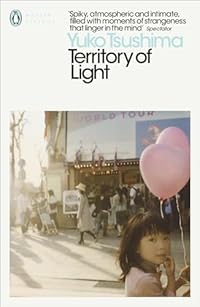
Territory of Light by Yūko Tsushima 

Penguin, 2019, 126 p. Translated from the Japanese 光の領分 (Hikari no ryōbun,) by Geraldine Harcourt. First published in 1978-1979 as a series in the literary monthly Gunzō.

The book outlines in first person narration the life of an unnamed woman recently separated from her husband, Fujino, in the year following his leaving. They have a two-year-old daughter, also unnamed, who begins to react badly to her new life after mother and daughter move into an apartment on the fourth floor of a building which has mostly offices below. Its large windows flood the interior with light, hence the book’s title.

Over the course of the year we see the daughter’s behaviour deteriorate; she throws objects out of the window onto a roof below and gets into trouble at her daycare centre.

This is paralleled by her mother’s increasingly difficulty to cope with her life, turning up late for her job in a library, having a one-night stand with the father of another child at daycare.

There are parallels here with the other of Tsushima’s novels I have read, Child of Fortune.  whose protagonist is also separated from her husband (but in her case divorced.) The absence of Fujino, like that of Hatanaka in Child of Fortune, is core to the narrator’s sense of drift. This is an indictment of the men involved, though, not of the women they have left.

The book’s origins as a series of twelve monthly instalments in the magazine Gunzō (群像) lead to some repetitions in later chapters of information the reader already knows and which would have been unnecessary to include in a novel per se.

I note as an aside that the living space in Japanese dwellings is described in terms of how many tatami mats the rooms can accommodate.

Pedant’s corner:- a missing comma before a piece of direct speech embedded in a larger sentence (x 2,) a similar missing comma at the end of a piece of direct speech embedded in a larger sentence.


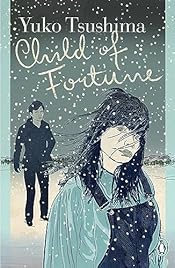
Child of Fortune by Yūko Tsushima

Penguin, 2023, 182 p. Translated from the Japanese, 寵児, (Choji,) Kawada Shobo Shinsha, 1978, by Geraldine Harcourt

Kōko is a divorced mother of eleven-year-old daughter Kayako. She is struggling with her life and her job giving piano lessons is not really enough to sustain them both. For this and other reasons Kayako has moved in with her Aunt Shōko, Kōko’s sister, who thinks of herself as the responsible sibling. Kōko’s memories of her handicapped brother who died when he was twelve colour her feelings towards both Kayako and Shōko. Since her relationship with Kayako’s father, Hatanaka, ended, she has had a long-standing (but now finished) affair with Doi, with whom she also became pregnant but aborted the child. She now feels she would have liked a child to Doi but has embarked on an on-off liaison with Hatanaka’s friend Osada, who acted as intermediary between him and her.

Child of Fortune is a portrait of a woman pulled and pushed between her past and present, and the future she devoutly wishes but is somehow unable to grasp, acutely conscious of the way in which society views women like her. The signs of pregnancy she notices precipitate her crisis.

The novel, though unmistakably Japanese, is not specific to Japan. Kōko’s troubles could be those of a woman anywhere in a judgemental world.

Pedant’s corner:- Dialogue which Kōko remembers is indicated by dashes, in the novel’s “present” (written in the past tense) it is rendered in the usual way. There was also a missing comma before one piece of direct speech.

Spring Snow by Yukio Mishima

Pocket, 1973, 376 p. Translated from the Japanese, 春の雪 (Haru no Yuki,) by Michael Gallagher.

I suppose any tale of star-cross’d lovers invites comparisons to Romeo and Juliet. I doubt, though, that most of them will contain references to the Russo-Japanese War, which is still in the recent memory of this novel’s protagonist, Kiyoaki Matsugae. That the book starts with his recollection of a photograph of the memorial services for the war dead is an indicator that the outcome of the novel is not likely to be joyful.

Kiyoaki had been entrusted by his father Marquis Matsugae to be raised in the noble but now relatively impoverished Ayakura family so as to acquire a touch of elegance and hope of advancement. The Ayakuras’ daughter, Satoko, had lavished affection on him and at the book’s start Kiyoaki knows she is in love with him but he is for the most part indifferent  hence it takes a while for the love story to gather momentum. Early parts of the book deal with Kiyoaki’s relationship with his friend Shikeguni Honda and two Siamese princes who are on a diplomatic visit of sorts and attend their school.

An exchange of letters between Satoko and Kiyoaki in which she reveals her feelings for him become central to the plot but his request for Satoko not to read his last one (where he eventually acknowledges his for her) comes too late. At first he does not know this and when he finds out she did read it he is angered and cuts off contact.

In the meantime Satoko, at twenty years old getting close to being on the shelf, is all but forced by her family into a betrothal to Prince Harunori of the Imperial family. Kiyoaki expresses to his father indifference to the engagement but, threatening to expose Satoko’s last letter to him, demands a meeting with her through the agency of her maid Tadeshina. This leads to the consummation of their relationship and further clandestine meetings. An odd aspect of the story is that Count Ayakura had years before instructed Tadeshina that Satoko should lose her virginity before any bridegroom chosen by the Marquis should touch her. Revelation of the affair would therefore reflect badly on him. Satoko’s resultant pregnancy presages disaster. Drastic attempts to avert it are not entirely availing.

While not absolutely following the template of Romeo and Juliet the parallels are unavoidable. Star-cross’d love is a universal theme, in Japan as elsewhere.

Pedant’s corner:- “wracked with sobs” (racked,) “cyprus wood” (cypress wood,) “wracked by her feelings” (racked,) “his amusement was tingled with disgust” (tinged is the usual verb here,) “the lay of the land” (the lie of the land.) “Count Ayakura was a hopeless coward in the face to the Countess at once, and when she in turn handed it quite a disturbance on the morning that Tadeshina did not get up.” (Make of those two sentences what you will. I confess I couldn’t.) There was over to her husband, he opened it at fingertips’ length, as if it were germ-ridden” (needs clarifying,) “from lack to sleep” (lack of sleep,) “the Masugaes” (Matsugaes.)

Snow Country; and, Thousand Cranes by Yasunari Kawabata

Penguin, 1971, 204 p. Translated from the Japanese 雪国 (Yukinugi) and 雪国 (Senbazuru) by Edward G Seidenstecker. First published in English in 1956 and 1958, respectively.

This book contains two of the author’s novels, Snow Country and Thousand Cranes. Kawabata is also known as a poet and some of his sentences here are short and enigmatic, as in haiku. The nuances of Japanese culture can perhaps never be properly illuminated by a translation; there is though something ineluctably Japanese about the two tales – at least to someone brought up with no contact with the country – a sort of understanding not fully expressed by the prose.

Snow Country is the story of the relationship between Shimamura, who goes on a trip from the city to the hot springs of the snow country of Western Japan, and Komako, a local part-time geisha. On the train there Shimamura observes the ministrations of a young woman named Yoko to a young man who is obviously ill, returning to his home to die. Yoko is an off-screen presence for most of the novel, though her importance to Shimamura, perhaps as some sort of ideal, is not in doubt. It is his dealings with Komako that take up most of the story though, a liaison never completely spelled out but indicated by implication, yet most likely utterly transparent to a Japanese reader.

Thousand Cranes is a bit more straightforward. As a boy, Kikuji was once brought by his father to a meeting with his mistress, Chikako, when he glimpsed the birthmark on her left breast. Years later, after his father’s death, his mother also being dead, Chikako unwarrantedly assumes loco parentis and tries to inveigle him into marrying Yokiko Inamura, who on introduction to him wore a dress decorated with pictures of cranes. He is not interested. Instead, he becomes briefly involved with Mrs Ota, who had replaced Chikako as his father’s mistress, and friendly with her daughter Fumiko. A lot of their interactions are mediated through the rituals of the tea ceremony and of gifts and usage of various kinds of Japanese pottery.

These two short novels were interesting reading, if a little opaque to my anglophone sensibilities.

Despite this being in translation (albeit into USian) amazingly I found not a single typo or any other possible entrant for Pedant’s corner in this book.

Scandal by Shūsaku Endō

Penguin, 1989, 235 p. Translated from the Japanese (スキャンダル) by Van C Gessel

At an award ceremony, famous writer Suguro, known for his Christianity and clean living, is accosted by a woman who claims to recognise him from his sojourns in Sakura Street in Shinjuku – an area known for its peep-shows and porn shops. Suguro indignantly denies such behaviour, any wider revelation of which would undoubtedly lead to a scandal.

A reporter named Kobari, who was present at the accusation, instinctively believes the woman and, shocked at Suguro’s apparent double standards (at one time frequenting vice dens, at the other portraying the exact opposite in his fiction,) makes it his mission to uncover what he sees as Suguro’s duplicity. The discovery of a portrait apparently of Suguro, painted by one of the women of Sakura Street, confirms Kobari in his pursuit. In one of Kubari’s interviews there a sex-worker tells him, “Sex is awfully deep, sir. All kinds of sensations come bubbling up from the bottom-most part of your body. It’s like a strange new music.” She reveals to him the bizarre enthusiasms and fetishes of the clients of the establishments in Sakura Street, by which Kobari is appalled.

In the meantime Suguro engages a young girl, Mitsu, whose family is in straitened circumstances, to help his (like Suguro himself, ageing) wife with the housework. Mitsu eventually turns out to be untrustworthy but Suguro has by this time, in a first intimation that he may have a darker side, dreamt of her half-naked.

As an exploration of the dark recesses of sexuality the novel is heightened when Suguro strikes up a conversational relationship with Madame Naruse. Her stories of her late husband’s complicity in, indeed instigation of, a wartime atrocity and the erotic charge it gave her trouble Suguro in its contrast with his own staid (it is strongly implied now non-existent) sex life.

The book’s emphasis on human frailty is at times tempered by reflections on writing. In a conversation Suguro is told writers can be divided into two groups, the biophilous (life-loving) and the necrophilous (self-destructive, degenerate, decadent.) Suguro’s work lies in the former category.

Suguro’s certainty that he must be being impersonated (even though he reflects that “Deep in the hearts of men lay a blackness they themselves knew nothing about”) leads him to try to confront his double.

Madame Naruse sets up a meeting in Sakura Street so that Suguro might meet the impostor, during which she tells him people delight in inflicting pain, that perhaps Jesus was murdered because he was too innocent. As he carried his cross the crowd reviled him and threw stones because of the pleasure it gave them. She adds, “… all you’ve written about are men who have betrayed Jesus but then weep tears of regret after the cock crows three times. You’ve always avoided writing about the mob, intoxicated with pleasure as they hurled stones at him.” The only other person present in the love hotel, however, is a comatose Mitsu, upon whom Suguro spies through a peep-hole.

The döppelganger/split personality has long been a wellspring of Scottish fiction. To see the dichotomy examined in a Japanese context was unusual but Endō treats it subtly and convincingly.

Pedant’s corner:- “A magazine reported named Kubari” (reporter.) “He was assigned to a regiment in Chiba” (China, I assume,) a missing comma before a piece of direct speech, “a silver rhinestone broach” (brooch,) “Madame Nearuse” (Naruse.)

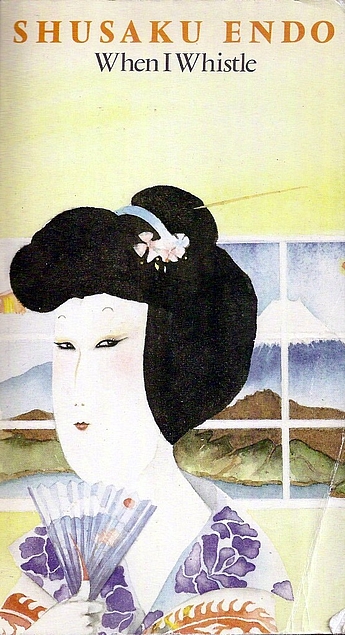
When I Whistle by Shūsaku Endō

Quartet, 1979, 275 p, including iv p Preface. Translated from the Japanese, 口笛をふく時, (Kuchibue wo Fuku Toki,) by Van C Gessel.

 When I Whistle cover

A chance encounter on a train with a former schoolmate forces a man called Ozu (I can’t remember being told his first name) to think about a boy at school who was dubbed Flatfish. Flatfish, a new arrival in Ozu’s class (not the top set by any means,) unfortunately had an odour but, because he was seated next to Ozu, by default became his best friend. Ozu had to explain to him all the unwritten rules but Flatfish continually managed to get himself in trouble both by accident and by being himself. The defining moment of Flatfish’s life was an encounter the pair had with two girls from the local girls’ school – with whom they ought not to have had any contact by the strict rules of the time – on the way home one day. Flatfish formed a lasting but doomed attraction to Aiko, the girl who, in an act of compassion, bandaged his injured hand. These schooldays were in the 1930s, Japan was embroiled in China and militaristic attitudes abounded but the nature of schooling (harsh) and the trials of dealing with the opposite sex come over as being not too dissimilar to Western experiences of the time.

In the novel’s present day, Ozu’s son Eiichi is a practitioner at the dispensary of the local hospital and eager to climb the greasy pole of the medical profession so does not demur from the outmoded prescribing and treatment practices of his superiors. He notes, in particular, the habit of telling soothing platitudes to patients. Despite his liaison with a nurse, Keiko, he sets his designs on his boss’s daughter, but has a rival in Doctor Kurihara who also has a nurse on a string. Relations between the sexes in Japan had clearly also undergone a more liberal change post-war. Eiichi then is complicit in administering a new, otherwise untried, cancer treatment devised by a firm owned by Kurihara’s father.

Flatfish not being academic quit school and got a poorly paid job but when war with the Western powers came (the feeling was that Japan would easily defeat them, of course, and at first it seemed so) was swiftly drafted into the miltary and sent to Korea. Nevertheless, he inveigled Ozu to seek out Aiko and give her a pen as a token of his esteem. She in the meantime had married a young naval officer. The reader suspects, rightly, that none of this will come out well. This thread between Aiko, Flatfish and Ozu is what binds the book together.

When I Whistle isn’t one of Endo’s better novels even if it is one of his later ones. There is something about the writing that is sketchy or ill-considered (which doesn’t seem to be because of translation) and more than once information or characters’ thoughts are repeated that have no need to be.

Still, the reflection, “People often wonder when they will die but they rarely wonder where they will die,” is original but, “Now, when all was lost, he felt he understood the meaning they had given to his life,” is a novelistic thought if there ever was one.

The Preface tells us that the author was himself in hospital for a considerable time with various complaints and during one operation his heart stopped. But he survived and continued smoking. It is noticeable that the doctors in this novel all smoke. Then again, it was first published in 1974.

Pedant’s corner:- “if worse came to worst” (if the worst came to the worst,) “None … were” (several times. ‘None …was’.) Opthamology (x 3, Ophthalmology,) knit (knitted, please. Okay the translation is into USian, but still,) “his voice rising to a crescendo” (to a climax; the crescendo is the rise.)

Automatic Eve by Rokurō Inui

Haikasoru, 2019, 315 p. Translated from the Japanese Jidō ibu (自動イブ,) by Matt Treyvaud. Published in Interzone 284, Nov-Dec 2019.

 Automatic Eve cover

How necessary is it to suspend disbelief in order to appreciate, or perhaps persevere with, a work of fiction? Conventional wisdom suggests it is at least a necessary condition. Automatic Eve suggests that might not be the case.

The plot of Inui’s novel hinges on the existence of elaborate automata. Not toys, not merely small things like crickets, but better than android–like simulacra of human beings. Things of convincing, warm, outer human appearance but internally consisting of metal, cogs, gears, wires – each with a pendulum for a heart. Yet the automata here are effectively so realistic that they appear to be completely human to everyone involved, even to the extent of being able to have sex convincingly, to inspire love and devotion, and to experience these things for themselves. Even capable of being convinced that they themselves are human – until, perhaps, they find otherwise. And that’s a leap that’s a big requirement to ask of a reader. (This one always had nagging doubts.) Yet, to carry on, to keep faith with the story, said reader has to take this on trust. (And, maybe, later, write a review.)

It is a mark of Inui’s writing, and his translator’s ability to convey it, that the necessary perseverance isn’t a problem. The story here is engaging enough to keep you turning the pages. It helps that the central concept is introduced fairly gradually.

The setting is a little odd though. The characters know of Chemistry, electricity and clockwork, yet the society in which they are embedded has a mediæval feel. It is obviously closely based on Japan, but not a Japan which ever existed. Yes, we have sake, bathhouses, sumo, cricket fights, meticulous gardening (albeit also a cover for spying,) a certain pleasure in fine objects, finely wrought – not to mention the goings-on in the building known as the Thirteen Floors. There is, too, intrigue between an Imperial court and a shogunate, but the divine figure is an Empress, and the succession goes through the female line, to a female. It is a Japan tweaked just so, to enable the story. A fantasy, then.

Would-be Sumo wrestler, Geiemon Tentoku, has fallen in love with the Eve of the title and selflessly seeks to release her from her indenture in the Thirteen Floors to restore her to the man he thinks she loves. Kyuzo Kugimiya learned all he knows about the construction of automata from Keian Higa, who had plotted the overthrow of the system before being executed after his plans were betrayed to the authorities. Under the instructions of the Imperial Gardener (really a spymaster) Kihachi Umekawa, the shogun’s spy, Jinnai, is investigating Kigimiya’s activities. All these are actors in the overall plot, which concerns the contents of the Sacred Vessel, a sealed container within the Imperial Palace.

The existence of convincing automata leads a couple of characters to question the nature of humanity. Kyuzo thinks, “A pregnant woman’s body was home to not one soul but two. Where did the life in her womb come from, and when? If souls came from elsewhere to reside in the human body, was it not possible that one might take up residence in the infant automaton they were building?” Later, Jinnai wonders, “Where did the soul come from? Where, in the body or brain, did it conceal itself while a human still lived? …. Automata like Eve showed human behavior [sic] as a response to the care and love they received from humans.”

Such metaphysical considerations are invited by the subject matter – and are arguably the raison d’être of literary fiction – but Inui doesn’t let them bother the thrust of his story for too long.

There is a slight flaw to the book’s structure, however. Rather than a novel it is a succession of seven shortish novellas, albeit featuring ongoing characters. That the narrative viewpoint changes between these sections is not a problem but certain repetitions of information suggest that they may not have been conceived or written as a whole but subject to a later fix-up. And Automatic Eve herself is more like an absence than a protagonist. Though she does appear in them all she is neither the focus nor viewpoint character in any of the seven segments.

None of that, however, takes away from the overall effect. It may lack innovation in its central idea but Automatic Eve is still a well-written, solid piece of fiction.

The following did not appear in the published review:-

Pedant’s corner:- “none were too explicit” (none was too explicit.) “The master of accounts were responsible for” (the master … was responsible.) “None of these new revelations were the answers Kakita sought..” (None of these new revelations was the answer ..) “none of them understand the situation” (none of them understands the situation.) “None of the spies were supposed to know” (None … was supposed to know.) “The attendant’s quarters” (attendants’ quarters.) “The group made their way…” (The group made its way,) “‘I gather that neither of those fates await those who are careless?’” (neither of those fates awaits those, plus the sentence isn’t really a question.) “Mounts of leftover soil and worktools ..” (‘Mounds’ makes more sense.) “‘The palace has decided to keep the news to themselves for now’” (to itself is more grammatical,) “for this automata” (for this automaton.) “These question had always bothered Jinnai.” (These questions.)

free hit counter script