Hope Island by Tim Major
Posted in My Interzone Reviews, Reviews published in Interzone, Science Fiction at 12:00 on 8 July 2021
Titan Books, 2020, 389 p. Published in Interzone 288, Jul-Aug 2020.
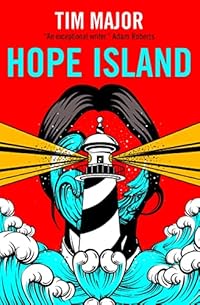
Workaholic Nina Scaife has not taken a break from her job as a producer on a north of England TV news programme for five years. Now, her partner Rob Fisher having left her for another woman (and the two kids they’ve had,) she is accompanying her young teenaged daughter, Laurie, to Hope Island off the coast of Maine – where Nina has been too busy to travel to before – to visit Tammy and Abram Fisher, Rob’s parents, to break the news to them – and Laurie. The island is isolated, with bad communications to the outside world, and internet and mobile phone coverage barely even patchy.
On the way from the ferry terminal to the Fishers’ house Nina has to brake suddenly to avoid hitting a young girl on the road. This disorienting experience sets a tone of mild unease for the narrative, which, however, hovers below the edge of manifesting into something greater for well over half the book before it finally tips over into the weird.
Nina feels unsettled by Tammy who she thinks disapproves of her because of her atheism and also for never marrying Rob. Abram seems a detached presence, possibly descending into dementia. The Fishers’ bond with Laurie is strong though, but that between Laurie and Nina is fraught. Laurie’s teenage discontents, her wrong-footings of Nina, are well portrayed.
Tammy introduces Nina to a sort of commune known as the Sanctuary, run by a group known as the Siblings at the other end of the island. One of its members, Clay, is carrying out experiments into sound but also into silence using noise dampening headphones and a recorder. As part of his demonstration he takes Nina into a shell midden, a cavern inside a hill where no shells should be, where she has a strange experience with a sound that at first she perceives as the wind through the entrance passage but then feels as if it comes from everywhere. After this she tends to carry the headphones around with her but also experiences dreams of floating.
Due to her previous visits to the island with Rob, Laurie has an affinity with the local children – especially the oldest, Thomas, whose mother Marie has a young baby who wails incessantly and claws at his mother’s neck constantly, drawing blood, but, to Nina, Thomas can appear distant, as if his awareness is elsewhere. He also manifests a tic of rubbing at his ears, something Abram too does in his absent-minded moments.
Gradually, sound becomes a recurring motif. In what seems an innocent exchange Tammy tells Nina, “‘Everybody’s got a voice inside them,’” a voice telling them what’s going on in the outside world and also what’s inside themselves. Nina begins to feel everyone is shouting.
When a man called Si Michaud finds the body of Lukas Weber on the beach, skull caved in, the novel seems as if it might change tack into the crime investigation genre as Nina tries to find out who the murderer was. Nina takes Abram to the cliff above where the body was found, where he lets out a wordless howl to shut out the voices in his ear. Later Abram too becomes a murder victim and the islanders behave oddly at the gathering to mourn him.
Nina’s suspicions soon fall on the children. To this end she alienates the islands’ parents after she reasons some of the children have tried to kill her. Tracking down May and Noah Hutchinson she finds them almost feral and apparently terrorising their mother and father. All this gets trammelled up in Nina’s mind along with the implications of Tammy’s paintings of a man falling off a cliff. She wonders if she can trust anyone, even Laurie.
It is to Major’s credit that, despite the nagging familiarity of the situation, the necessity of isolation, the lack of communications, to the story, there is still an impetus to keep turning the pages, but how it all hangs together, the importance of sound and of the shell midden, are revealed in something of a rush. Suffice to say the explanation is not down to Earth but it does come as a bit of a deus ex machina.
Nevertheless, Major writes well, character and relationships are handled deftly, but the realistic register of the parts of the book which deal with these aspects feel as if they come from another novel entirely compared to the fantastical flourishes which are in store in its climax.
The following did not appear in the published review:-
There is overuse of a metaphor relating to white blood cells.
Pedant’s corner:- English coins (that would be British coins.) “At the crescendo of their performance” (At the climax of their performance,) fit (fitted,) “the fishmongers” (I’ve read that they don’t have such retail specialists in the US. And would a small-ish island have one anyway?) “beneath that were a series of decorated shells” (beneath that was a series of,) “lying prone” (this was while she was gazing up at the sky. Difficult to do when face down.) “The crowd were becoming restless again” (The crowd was becoming restless,) “his voice rising to a crescendo” (to a climax.) “It was around a metre across and sixty centimetres.” (sixty centimetres tall?) crenulations (crenellations,) shrunk (shrank,) sunk (x 2, sank,) “was last thing she wanted” (was the last thing,) snuck (sneaked.) “None of the adults were concerned” (None of the adults was concerned,) “as she swum” (as she swam,) sprung (sprang.)