Archives » Interzone 270

The Stars are Legion by Kameron Hurley

Angry Robot 2017, 397 p Reviewed for Interzone 270, May-Jun 2017.

The Stars Are Legion cover

Lit by an artificial sun, the worlds of the Legion hang in space. Massive orbs, they are living things covered externally by tentacles that simultaneously reach out but also offer protection to their world’s inhabitants. Their interiors are sticky and moist, biology taking the functions of such things as floors, walls and lifts. The worlds, though, are dying, with patches of rot blotching their surfaces. Beyond the misty veil that shrouds the sun lies the Mokshi, the only world to have moved out from the usual orbits of the Legion. As a result the Mokshi is an object of envy and conquest; but it is defended fiercely. Anat, Lord of Katazyrna, has a metal arm whose power is lost and she wishes to conquer the Mokshi in order to restore it and (literally) make a new world.

Each chapter here is prefaced by an aphorism by-lined, “Lord Mokshi, Annals of the Legion”. The narrative viewpoint, though, is shared between Zan and Jayd, once lovers, neither of whom are particularly sympathetic characters. At least twice as many chapters are devoted to Zan, who has lost her memory but is the only one of Katazyrna’s army ever to penetrate the Mokshi and survive. She is told she has made the attempt and returned many times.

The first set piece is a fairly standard piece of military SF as Katazyrna’s latest army attacks the Mokshi. However, the prospect this holds out of endless space battles is misleading. Hurley’s attention is more on the somewhat complicated relationship and backstory between Zan and Jayd.

It doesn’t take very long to work out that there are only women on these worlds. Hurley does not make anything of this – except in her afterword – it is merely a factor of this scenario, the society she has decided to portray. The mechanics of how their inhabitants become pregnant are obscure, though; even the mothers seem in the dark. Also, the birth products may be non-human, “Each world produces what it needs.” But in a strange mix of this magical-seeming biology with hi-tech, womb transfer can be effected surgically. Indeed we find Zan has donated hers and its contents to Jayd.

Neither does Lord Mokshi’s identity remain a mystery to the attentive reader, becoming obvious long before Hurley confirms it.

Interference from the forces of Bhavaja makes the attack fail and Anat decides on an alliance with these erstwhile enemies. To this end she arranges a marriage between Jayd and Rasida, Lord of Bhavaja. Jayd’s pregnancy is an important aspect of the deal. Bhavaja has not had a birth for some while. For a long time, to help Zan penetrate the Mokshi, Jayd has been working secretly towards this end.

The wedding is accompanied by a human sacrifice. This is only one of the many gory incidents in the book exemplified by Rasida’s despairing philosophy expressed later, “There’s no such thing as love in the Legion. There is birth and there is death. That’s all.” By this time Rasida has not kept her word, destroying Ana in the process, while Zan was thrown into Katazyrna’s recycler.

Which is where things begin to get bogged down. As well as what are in effect no more than monsters devouring the material to be recycled (Hurley seems to relish the details but they are oddly uninventive) Zan finds a woman living in the belly of the world, Das Muni, who helps her to escape to the next level.

The main body of the book is taken up with Zan’s journey up through the strata of the living world where the obstacles she meets are overcome perhaps a little too easily and she picks up another two handy companions.

One of Gene Wolfe’s prescriptions for writing fiction is that if your hero(ine) goes on a journey you must describe it. Well, there’s describing and then there’s overdoing it. The journey here is certainly important to the outcome as it provides Zan with clues to both her past (she has done all this before, remember) and future but it reminded me of the seemingly endless trek across the Ringworld in one of Larry Niven’s series of novels; it’s there more to show us the author’s invented world rather than advance the plot. Together with the emphasis on violence here that, for me, reduced engagement. It may be more to others’ taste.

The following did not appear in the published review.

Pedant’s corner:- “I change directions” (direction,) auroras (aurorae.) “The security crosses their arms and puts their backs to me” (its arms, its backs,) “a bevy …. begin” (begins,) “the whole of Katzyrna pour out” (the whole pours out,) in the hopes (in the hope,) maw in sense of mouth (sigh; it’s a stomach,) “a hunger than no meal can satisfy” (that no meal,) “fearful that the council will change their mind” (its mind,) the moths become less and less (fewer and fewer,) a missing start quote when a chapter began with a piece of dialogue, “I motion to Das Muni to lower the litter …… I motion to Das Muni to lower our own load” without the load being picked back up in the meantime, “I … try to see the where it’s fallen from” (no “the” needed,) “lined in row upon row” (by row upon row,) “if it is was my child” (if it was,) “that something had happened to her leg” (the narration is always present tense; so, something has happened to her leg,) “One is full of clear liquid. The other is full of purple liquid.” (clear here is contrasted with a colour; since clear does not mean colourless, the purple liquid could equally have been clear,) “Zan gets up now and wipe her hands” (wipes.)


Interzone 270, May-Jun 2017

TTA Press

Interzone 270 cover

The Editorial apologises for housekeeping issues not entirely within the magazine’s control, Jonathan McCalmont’s column argues for a recognition that the SF and Fantasy community still has a lot to do to welcome and encourage, writers and readers of black or other “minority” (my quotation marks) background, instead of discouraging them as at present, Nina Allan1 reflects on her experience as a shadow Clarke Award judge and concludes that it is difficult to argue for SF as any longer being distinct from wider literature; a novel is good or it isn’t regardless of its origin or intent. Book Zone contains Paul Kincaid’s* review of Kim Stanley Robinson’s 2140, reviews of the latest novels from Clare North2 and Cory Doctorow plus the collaboration between Andrew Lane and Nigel Foster as well as collections by Ellen Klages and regular Interzone contributor Malcolm Devlin (who is also interviewed) along with my review of Karen Hurley’s The Stars are Legion.
(*Kincaid mentions austerity as being needed to pay for the bank bailout after the 2008 financial crisis. It wasn’t. The economy was beginning to recover by the time of the 2010 election. Austerity was a choice made by the incoming government for ideological, political, reasons. The bailout merely provided the excuse for its imposition. And the measures killed the recovery stone dead.)
As to the fiction:-
In Rushford Recapitulation by Christopher Mark Rose3 women in Rushford, New York, start giving birth to technological artefacts, bringing a rush of visitors, protesters, pregnant mothers. The technology becomes less advanced as time goes by.
Like You, I am a System4 by Nathan Hillstrom features an intelligence of silicon and electric current coming to consciousness and taking over its environment. Then it interferes in the wider world.
Dirty Code5 by Wayne Simmons is set in what appears to be a simulation. The protagonist keeps waking up with a new face and is in the employ of someone who wants him to get rid of those passing on the titular dirty code by infecting others via activities in strip clubs and the like.
Encyphered by Jonathan L Howard is the life story of a man obsessed with cyphers, determined to keep his secrets (after all, we all have them) to himself till the day after his death. It is also a potted history of cryptography and cryptanalysis and contains the wonderful observation, “In those halcyon days before successive austerities and unimaginative governments, the library was a mighty thing indeed.” I’m struggling to see it as either SF or fantasy though.
In The New Man6 by Malcolm Devlin a man killed in an accident in the warehouse of the cloning company where he works is, to make them look good, revived in one of their bodies. His new body is the basic model though. The warehouse seems absurdly low-tech for a company making such a modern product.
Evangeline and the Forbidden Lighthouse7 by Emily B Cattaneo is a tale of childhood friendship, messages in bottles, roads not taken, the regrets of adulthood and that tantalising, inaccessible, forbidden lighthouse. All this in only eight pages.
In Memories of Fish8 by Shauna O’Meara virtual tourism enabled by drone footage is the big online attraction. A young woman at the viewed end takes a drone on a journey through areas the local authorities don’t want seen. While the story’s target is compassion fatigue it strays close to perpetuating the idea that dreadful living conditions in traditionally poor countries cannot be ameliorated. Since the viewer’s country had suffered extreme drought the story might have had more punch if the situations of viewer and viewed had been reversed.

Pedant’s corner:- 1focussed (focused.) 2involunatary (involuntary,) and a sentence with four verbs whose subject is team, the first verb is singular (tick) but the remainder plural. 3written in USian; “far ahead or behind schedule” (far ahead of or behind schedule,) “Rushford’s human inhabitants where healthy and normal” (were healthy,) blunderbuss (blunderbusses,) “Inca kuipu” (quipu.) 4written in USian; ”none of you pick your own nodes” (picks.) 5written in USian despite the author being Northern Irish. 6over emphatic (over-emphatic makes more sense,) fit (fitted,) “the both of us” (no “the”; just “both of us”.) 7Written in USian. 8”that this where she lives” (that this is,) “the olfactory interpreter’s best attempt at recreating a stench that is probably far worse in person” (in person is for, well, a person; not a smell; “in reality” fits better here.)

A Short, Sharp Shock by Kim Stanley Robinson

Bantam, 1996, 185 p.

A Short, Sharp Shock cover

A man comes to in a sea, pounded by raging surf. He tries to stop himself drowning and eventually makes it to shore along with a woman he calls the swimmer. Apart from vague stirrings he cannot remember his previous existence. The world he and she find themselves on is an odd one, mostly sea, with one long line of mountains, the spine, round its equator. There are strange humanoid inhabitants, some with trees growing out of their shoulders, others with faces where their eyes should be, still more use shells as their homes, shifting from one to the next like crabs.

The main bulk of the book is taken up with a journey along the spine to escape the brutal spine kings. Along the way the man loses touch with the woman several times before regaining contact, and hears the lores and formation stories of the various peoples he encounters. In part this is reminiscent of the journey across Mars in (as I recall) the second of Robinson’s Mars trilogy which seemed to me when I read it to be there solely to show off his research but here has more of a justification. (I noted Paul Kincaid commenting on this Robinson trait of journey describing in his review of New York 2140 in Interzone 270.)

There is one break in the spine of this strange world, traversable by a causeway at low tide, guided by the latest in a long line of custodians called Birsay. (At this point I wondered if Robinson has been to Orkney.) In the book this gap in the mountain range is called the brough. Brough actually means island but we can forgive the author this slight misuse. The trip over takes two tides with a dangerous stop in the middle where kelp bladders tied to anchors in the rock allow travellers to avoid being swept away by the currents of the rising tide. Our intrepid travellers of course have to hit it on a bad day.

The book is preoccupied with mirrors. One of the things our traveller, who has decided to call himself Thel, is told is that, “Through mirrors we see things right way round at last,” and he muses on the possibility of a landscape in reverse. On helping a group of tree-people escape from the spine kings one of them delays to rescue a mirror. Some time later Thel is pushed through the mirror into an altered spined world before finding his way back.

This is not major Robinson. The story is not much more than a novella and each chapter starts on an odd numbered page so there is sometimes a complete blank page between them. The book is further bulked out by its last 14 pages containing a “preview” of Robinson’s Blue Mars. This is an off-putting practice I hope publishers have now discontinued.

Pedant’s corner:- “the north side grew less steep, laying out until the peninsula was wider than ever” (lying out,) “some laying over the ridge” (lying,) “cursing one another under their breath” (breaths,) sunk (sank,) “ate the muscles” (mussels, I think,) miniscule (minuscule,) “and bid him eat” (bade,) “all was not peaceful” (not all was peaceful.)

Two Months on

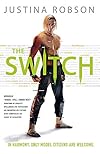
The Switch cover
The Stars Are Legion cover

Two months seems to come round very quickly.

Yesterday The Switch by Justina Robson dropped onto my doormat.

It is the latest book for review in Interzone – to appear in issue 271.

Issue 270 arrived earlier in the week. That one features my review of Kameron Hurley’s The Stars Are Legion.

Interzones 269 and 270

 The Stars Are Legion cover
Interzone 269 cover

Interzone 269 arrived today.

It contains my review of The Mountains of Parnassus by Czesław Miłosz.

A few days ago I received The Stars Are Legion by Kameron Hurley.

That review is due soon for Interzone 270.

free hit counter script