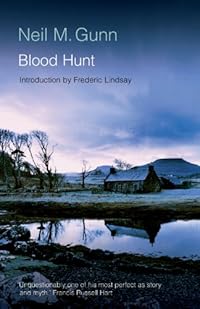
Blood Hunt by Neil M Gunn
Posted in Reading Reviewed, Scottish Fiction, Scottish Literature at 12:00 on 31 May 2026
Polygon, 2007, 265 p, plus 5 p Introduction by Frederic Lindsay.
Sandy Ross has retired from his life as a sailor to live out his time on a croft on his ancestral soil. An intrusion into his settled world comes when local policeman Nicol Menzies arrives to tell him a murder – of Menzies’s brother, Robert – has taken place and he needs to search the croft. The perpetrator is Allan Innes, one of a group of youths who used to frequent the croft.
A discomfited Sandy, all too aware Menzies is fired with an uncompromising zeal, pretends to unlock his barn and doesn’t mention the resistance he felt when pushing the door open. His more or less unconscious decision to try to help Innes lays out the novel’s path. When Menzies leaves, Sandy provides Innes with enough food to last a day or so.
Innes avoids the search for him by hiding on the Crannock (a crannog) in Loch Deoch, swimming across and back to keep in touch with Sandy, who plans to provide him with money and disguising clothing.
Fate intervenes when Sandy takes his cow to be served by the local bull. In her eagerness the cow pulls Sandy over and breaks his ribs, rendering him bed-bound. His everyday needs are looked after by the widow Macleay, a neighbour, who calls in the doctor and a redoubtable local nurse is also arranged. The widow Macleay is looked upon as a suitable husband for Sandy but he is wary of such a prospect.
A more surprising carer is Liz Murison, the woman over whom Innes and Robert Menzies had quarrelled, who turns up on Sandy’s doorstep saying she’d heard he needed help. In her pregnant state she has left the orbit of her father’s ire and his religious strictures.
The local minister drops in to try to persuade Sandy to return the girl to her family home. The minister – fond of a secret dram – says to him, “‘But if man does not take a stand on the great moral issues, woman never will. It’s not in her nature. There are times when a woman has no more moral sense than a fly on a windowpane.’”
Sandy isn’t swayed, Liz has no desire to go back and he sees no reason to ignore her wishes.
Things go on the way to their conclusion as the determined Nicol doggedly pursues his quarry to the bitter end.
Each of the characters (except perhaps for Nicol) is portrayed sympathetically. Sandy’s humanity in particular shines through.
Pedant’s corner:- In the Introduction; “Nicol Menzies’ brother” (Menzies’s,) “Allan Innes’ sweetheart” (Innes’s.) Otherwise: a missing comma at the end of a piece of direct speech, one missing before a piece of direct speech (x 2.) “It’s door was ajar” (Its door,) “finger prints” and, later, “finger-prints” (nowadays one word; ‘fingerprints’,) “fo’c’stle” (fo’c’sle – or fo’c’s’le.) “The pain, like the bruises, were on his left side” (The pain, …, was on his left side,) “tried to ease his shoulder out if its bandaging” (out of its bandaging,) a missing opening quotation mark before a piece of direct speech. “‘May be so’” (Maybe so.)