The Liar’s Dictionary by Eley Williams
Posted in Other fiction, Reading Reviewed at 12:00 on 27 July 2023
William Heinemann, 2020, 276 p.
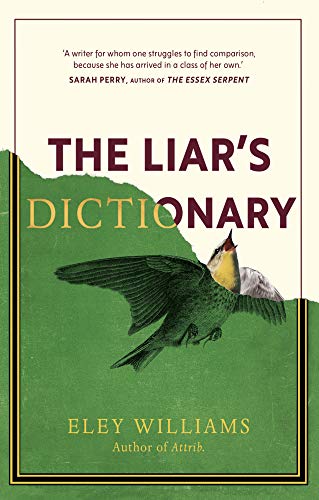 Prefaced by a seven page disquisition on the perfect – or otherwise – dictionary, this, Williams’s first novel, (I have read her book of short stories,) is a two stranded tale of workers at Swansby’s Encyclopaedic Dictionary (famously unfinished.) There are twenty-six chapters each of whose headings consists of a letter (sequentially from A to Z) followed by ‘is for’ then a word starting with that letter and its usage as (n) or (adj) or (v) as it might appear in a dictionary. One of these words, yes, is denoted as (exclam). A literary conceit, then, and a delight for anyone with an interest in words.
To put us in the mood, that preface deploys words such as corymbs, psithurism (the p is silent Williams informs us,) corbicula, anemotropism, leucocholy, smeuse. No matter if that’s not your thing, the twin stories that come after – told in alternate chapters – will hold the interest.
Mallory works on the digitisation of Swansby’s Encyclopaedic Dictionary and on occasion has to field threatening telephone calls apparently provoked by the dictionary’s changed definition of marriage to be less exclusive. She is gay, lives with her partner, Pip, but is not ‘out’ at work. Her story is narrated in the first person, so we have access to all her passing thoughts, doubts and fears. By contrast Peter Winceworth’s story is rendered in traditional third person. It is set in late Victorian times where he is employed in the dictionary’s Scrivenery, in charge of preparing entries for the letter S. His surname is somewhat programmatory as he is a reticent soul, with an adopted lisp, and finds it difficult to fit in with his fellow workers – especially the chancer Terence Clovis Frasham, whose fiancée, Sophia, he almost literally bumps into at an entertainment one evening. She is the occasion of much of Winceworth’s subsequent tribulations which include a misunderstanding in a park over a pelican in breathing difficulties.
The plot concerns Swansby’s ongoing modern financial difficulties and the presence in the dictionary of numerous mountweazels. A mountweazel is a fake entry inserted in a work of reference designed as a safeguard against copyright infringement. Through uncovering them Mallory comes to a perception of Winceworth’s state of mind. Inventing these and their definitions can be an amusing pastime. How about asinidorose (n.), to emit the smell of a burning donkey, or agrupt (n.), irritation caused by having a denouement ruined? Or else an idle pursuit. We are even vouchsafed the definition of winceworthliness (n.), as the value of such an endeavour.
A (real) word which I found delightful was grawlix, for the meaningless symbols used to represent a profanity; as in %?£&!.
But none of this would be of any note were it not wrapped up in two stories that are engaging and occupied with recognisable characters. There were times when all the word-play did threaten to get a bit too much but Williams always managed to draw it back. We read fiction to understand and empathise with people after all. The words are merely what we need in order to do that.
However, Winceworth at one point thinks to himself, “a well-crafted sentence runs through the reading mind as a rope runs through hands but when that sentence contains errors or distracting ambiguities, eccentric syntax or bleurghs of vocabulary or grammar, its progress is stalled or coarsened.” (I couldn’t agree more. Hence why my reviews on here contain a pedant’s corner.)
Pedant’s corner:- cameleopard (usually spelled camelopard,) hugger-mugger (used as a synonym for poppycock, codswallop, folderol, balderdash, piffle etc. First I’ve heard of it.) “‘You need to know you’ve lain a trap’” (laid a trap,) “to not” (several times, with different verbs; ‘not to’.) “Like like the sun” (doesn’t need two ‘likes’.) “What the hell is an alembic is for starters?” (no need for the second ‘is’,) “paperwork strewn across on his desk” (either ‘across’ or ‘on’, not both.) “His hands and noticed they had balled up” (seems to be missing ‘He looked at’ before ‘His’,) “with such obvious a lie” (with so obvious a lie, or, ‘with such an obvious lie,) mountweasels (x 1, elsewhere spelled mountweazels.) “The light through office’s windows” (through the office’s windows.) “He smiled ghastily” (ghastlily.) “He stopped to pet one of the Swansby cats on the way out and humming some bars of Tchaikovsky” (‘while humming’ would be a more usual way to phrase this – unless it was the cat which was humming some bars of Tchaikovsky,) “the woman who had shrank back” (who had shrunk back,) hiccoughed (the word is hiccupped, the spelling hiccough is via a confusion with ‘cough’.)