Archives » D G Compton

Farewell Earth’s Bliss by D G Compton

Tandem, 1971, 187 p. Originally published in 1966.

The story starts on the annual ship carrying the latest deportees to a penal colony on Mars. They have been given false names to hide their identities and their food has been drugged to calm them. Nevertheless, there is still room for conflict on board, as exemplified when “Jacob,” (sensitivity warning) is called a nigger. The text also uses the word negro about him and later he is even addressed in dialogue as “Sambo.”

On arrival they are treated summarily by the previous deportees. Their remaining food is confiscated supposedly to be redistributed to the colony. Even though all on Mars are criminals (whether actual or perhaps political) this is a strict system run by the Governor, assisted by his henchmen. There is too an emphasis on religious observance, with partly misremembered prayers/texts since few books are ever brought on the one way trip.

The Mars presented here is not quite as we know it these days. There is an atmosphere of sorts (but still deadly if exposed to it,) there is an indigenous wild life food source, dubbed rabbits, and a moss which they eat and which is also edible by though not really palatable to humans.

The newcomers are in effect on probation in their new environment, having to fit into the customs which have evolved in the colony with any transgressions being treated harshly.

Jacob is taken on by the “rabbit” hunting group who one day witness what could be interpreted as a miracle like the burning bush, but which one of them rationalises as an escape of natural gas.

The governor is keen to exploit this phenomenon but at one point has an odd thought about his secret lover’s “female lack of the ability to let things ride. The lack that was her greatest strength.”

The attitudes depicted here are homophobic as well as being racist. I suppose for a book published in 1966 that’s not too surprising.

Compton was reasonably well regarded in his time. This isn’t one of his best, though.

Pedant’s corner:-  “had been found inacceptable” (inacceptable is archaic; modern usage is ‘unacceptable’,) a missing full stop at the end of a sentence. “On earth” (On Earth,) ditto “‘But we aren’t on earth.’” A missing comma before a piece of direct speech, “photo-synthetiser” (nowadays this would be ‘photo-synthesiser’,) “hread-like” (thread-like,) “ a ryme of red dust”(rime,) Phobus (Phobos,) “‘Shadrak, Meshak, Abednego’” (Shadrach, Meshach, Abednego.) “‘That a euphemism’” (That’s a euphemism’,) “insistant hunger” (insistent,) Daimos (Deimos,) “‘The though. makes me’” (The thought makes me,) “illegally horded” (hoarded,) “could never have born the skin against his skin” (never have borne.) “Three of Dickens’ novels” (Dickens’s,) “‘it dosn’t mean’” (it doesn’t mean,) fidgetted (fidgeted.)
D G Compton

I saw in Saturday’s Guardian that writer D G Compton has also died (in November. They took their time publishing the obituary.)

His was a familiar name on the British SF scene from the 1960s onwards but his work was always a little out of the SF mainstream.

However looking at my records I only seem to have one of his books on my shelves, Nomansland, published in 1993.


David Guy (D G) Compton: 19/8/1930 – 10/11/2023. So it goes.

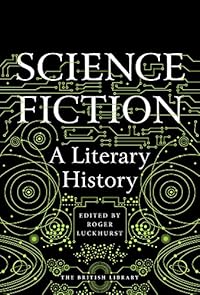
Science Fiction: a Literary History Edited by Roger Luckhurst

British Library, 2016, 254 p (including 2 p Preface by Adam Roberts, 3 p Introduction by Roger Luckhurst, 2 p Notes on Contributors, 1 p Picture Credits and 18 p Index.

Science Fiction: a Literary History cover

Adam Roberts’s Preface notes SF’s relative ubiquity in today’s world and praises this book as as compact and exhaustive an introduction to the subject as you will find. Roger Luckhurst’s Introduction, by way of reference to Jorge Luis Borges’s short story The Garden of Forking Paths (which presaged many-worlds theory by a considerable time,) acknowledges the impossibility of summing up SF in such a short space as a single book but hopes it will provide pointers to newcomers to the genre and to old hands alike.

The overall approach is more or less chronological. Chapter 11 sees Arthur B Evans tackle early forms of SF in The Beginnings. Roger Luckhurst himself covers the transition From Scientific Romance to Science Fiction in Chapter 2. The Utopian Prospects of 1900-49 are considered by Caroline Edwards in Chapter 32. There is some overlap in time here with Mark Bould’s Chapter 43, Pulp SF and its Others, 1918-39. Malisa Kurtz examines immediate post-war SF in Chapter 54, After the War. Chapter 65 has Rob Latham look at The New Wave ‘Revolution’. Chapter 7’s voyage From the New Wave into the Twenty-First Century6 is undertaken by Sherryl Vint. Gerry Canavan brings us up to date with Chapter 8, New Paradigms, After 2001. Each Chapter is repletely referenced and has a list of “What to Read Next” at its end. Imagine my satisfaction when finding I had read most – if not all – of the relevant recommendations. Plus I am in the process of ticking off another right now.

Perhaps the most interesting part (because the most remote) was Chapter 1 wherein Evans identifies many instances of SF or proto-SF from before 1900 and exemplifies two of its fundamental attributes at that time; diversion (imagination) and didacticism (cognition) – or, as Jules Verne’s editor/publisher Pierre-Jules Hetzel put it, instruction that entertains and entertainment that instructs. Well before the twentieth century subterranean or interplanetary adventure became well established – along with time travel – and u- and dystopias have always abounded. It is noted that early interplanetary spaces were modelled on colonial spaces – Space Opera and Star Wars your origins lie here. Indeed the colonial adventure (King Solomon’s Mines etc) can be considered as SF. Examples of the genre emanating from outwith the anglo- or francophone spheres are given due note, including SF works from pre-revolutionary Russia, Africa, Asia, Latin America – and also by black US writers – of which I was not previously aware.

The New Wave chapter laments that “unique talents” such as R A Lafferty, D G Compton, David R Bunch and Edgar Pangborn are little read these days. In one of those omissions Luckhurst acknowledged would occur discussion of one of my favourites from the time, Richard Cowper, is absent.

For anyone wishing to acquaint themselves with the genre this is an admirable place to start. It also provides potential new avenues for aficionados to pursue.

Pedant’s corner:- 1“by adding this own critical observations” (his own,) “the series of six novels … are set” (the series is set.) “But all is not perfect.” (But not all is perfect,) Cerillas’ (Cerillas’s.) 2“Has strengthened African-American will and prepared them for an international liberation movement” (“them” is the wrong pronoun here but to avoid it the whole sentence needs recasting.) “An imperial cabal of … plot to undermine the ..” (a cabal plots.) “As the new intake are given” (the new intake is given,.) “Slovakia’s defence strategy, and the novel’s SF element, employs the technique of…” (notwithstanding the parenthetical commas that “and” requires a plural noun; so, employ the technique.) 3“a series of coups weaken the fascist grip” (a series weakens the grip.) “The expedition… encounter” (the expedition encounters.) 4”from embracing the ‘the divine right of machines’” (omit the “the” before the quote,) “as the scientific elite have developed…” (the scientific elite has developed,) “the dark side of the Moon” (every side of the Moon is dark, for 14 days out of 28; I believe the “far side” was intended.) 5fit (fitted,) New Worlds’ (New Worlds’s.) 6ascendency (ascendancy,) a missing full stop, “between this world and the our present” (either “our” or “the”, not both,) “thus rejected earlier version of speculative genres” (versions of,) “it was posed to become” (poised to become.)

free hit counter script