Archives » Czech Fiction

The Farewell Party by Milan Kundera

King Penguin, 1987, 186 p. Translated from the Czech by Peter Kussi. First published as La Valse aux adieux, © Éditions Gallimard, Paris, 1976.
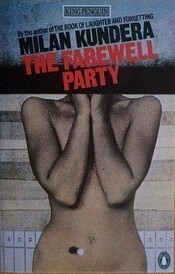
This novel’s story unfolds over five days, the events of each of which make up the book’s sections.

Klima is a jazz trumpeter who has an erotic secret. As he tells his friend Bartleff, a rich American, “I love my wife.” That, however, has not stopped Klima from having sex with other women, one of whom, Ruzena, is a nurse in a fertility clinic in the spa town where Bartleff lives. An earlier phone call from Ruzena to Klima announcing she is pregnant has brought Klima scurrying to the town to try to resolve the situation. Their story is mixed in with that of Dr Skreta who runs the clinic, his friend Jakub, a former political dissident who has just received permission to leave the country and Jakub’s ward, Olga, the daughter of the man who betrayed Jakub to the authorities.

Skreta has had great success in enabling his clients to have babies. He has a sperm bank using his own semen as a result of which many of them have features resembling those of the doctor. “I have cured quite a few women of childlessness by using this approach.”

Klima wishes Ruzena to have an abortion but she refuses, at least initially. Skreta heads the abortion committee before which Ruzena would have to appear. Its two mature women members are generally unsympathetic to those who come before them wishing the procedure, an attitude Skreta interprets by saying women are the greatest misogynists in the world, always doing other women down. Misogyny, though, is a strain which tends to run through the book.

The character of Jakub allows Kundera to comment on the restrictions of a repressive state and the traits that inculcates, “All you have to do to turn people into murderers is to remove them from their peaceful circle of family home and work. Every now and again history exposes humans to certain pressures and traps which nobody can resist.” On people who seek revenge for their plight on the descendants of their persecutors he opines that victims are no better than their oppressors.

Bartleff, too, has observations to make, including that Saint Paul was not only a disciple of Jesus but a falsifier of his teaching. “His somersault from Saul to Paul. Haven’t we seen enough of those passionate fanatics who jump overnight from one faith to another?” (I note here that Christianity’s evolution after Saul’s conversion makes a case for the religion(s) it became to be named Paulinity rather than Christianity.)

The Farewell Party (some translations give the title as The Farewell Waltz) is intricately plotted, the connections between the two main strands woven together in an unexpected but somehow inevitable – albeit harsh – way. The overall feeling though is one of distance, that we see the characters as through frosted glass. They don’t seem to act for themselves so much as take the parts ascribed to them. But that is what living under a repressive regime must be like.

Pedant’s corner:- “surely a more likable being that Raskolnikov’s usurious hag” (than Raskolnikov’s,) missing full stops at the end of two sentences.

Dancing Lessons for the Advanced in Age by Bohumil Hrabal

Harvill, 1998, 107 p. Translated from the Czech Taneční hodiny pro starŝí pokročilé, (published by Československý spisovatel, 1964,) by Michael Henry Heim. Illustrated by Vladimír Suchánek.

This is a seemingly rambling but actually very focused assemblage of scenes and observations from our narrator Jirka’s life as he relates them to a group of ladies. It is all unveiled in a breathless style, moving from one story to another almost without pause, with the whole book comprising a single sentence, jumping hither and yon, occasionally returning to previous musings. Adding to the sense of dislocation, the book just ends, there is no full stop at its sentence’s end, as if terminated mid-flow. A literary conceit, then, like the last part of Gabriel García Márquez’s The Autumn of the Patriarch.

And it is a conceit, for there are elisions in the narrative where punctuation could quite easily have been inserted. But the rush from one incident to the next is undoubtedly the point, the urgency expressing the necessity for the tales to be told – to be heard before it was perhaps too late.

It is Hrabal’s embodiment of the time and place in which it was written, impossible to imagine emanating from a luckier country. The back cover blurb describes it as “an informal history of the indomitable twentieth-century Czech spirit.” It muses on humanity’s foibles and sets great store by “Batista’s book on sexual hygiene,” or “Batista’s book about safeguards of marital bliss, which says that shivers run down a man’s spine whenever he sees a beautiful woman and his first thought is how to get her, as Bondy the poet says from the vertical to the horizontal.” It “warns men against giving in to their passions, no more than three times an afternoon or four times for Catholics, to prevent sinful thoughts from taking shape, you never know where they might lead.”

It does though at times display anti-semitic attitudes.

The illustrations are noteworthy; as eclectic as the prose, like a cross between surrealism and Terry Gilliam’s montages in <em>Monty Python’s Flying Circus</em>.

Pedant’s corner:- “I stood like Montgomery at Tobruk” (This must be an example of metonymy since I don’t think Montgomery was ever personally at Tobruk.)

Mr Kafka And Other Tales by Bohumil Hrabal

Vintage Classics, 2019, 150 p, including 6 p Translator’s Afterword. Translated from the Czech by Paul Wilson.

These are stories set in and around Prague in the late 1940s and early 1950s when the city was still recovering from the Second World War. Several of them are situated in a steel works with apparently no safety protocols and with workers culled from various former walks of life. Misogynistic attitudes which in those days would have been unquestioned do not bear much scrutiny to the modern eye.

Concentrating on ordinary encounters and snatches of conversation exhibited in all their bizarrerie Hrabal achieves a kind of heightened realism, emphasising that nothing is truly ordinary, the grimmest of industrial settings assuming a fantastical aspect. In the circumstances that pertained in that time and place, though, the ordinary bordered on the subversive. At bottom, resorting to the ordinary is the only defence against oppression, authoritarian or otherwise.

In Mr Kafka a character named Franz Kafka strolls the streets of Prague describing all the strange encounters he has.
Strange People concerns a labour dispute in the steel works, riffs ironically on the worker’s State and provides a glimpse into the many ways in which people cope with their working environment.
The putative Angel is the overseer of a penal workforce who likes to think of himself as protecting his charges. They themselves perform small acts of human consolation as they get on with their work.
In Ingots a merchant and a doctor of philosophy discuss the times as they load up hoppers with scrap metal while a woman meant to be starting a jail sentence the next day has to succumb to the (lack of) comfort of strangers. The doctor of philosophy says, “And what’ll become of you? The same as all this scrap. The tools of your trade … you’ll be ingots too. This new age is melting you all down.”
A Betrayal of Mirrors presents fragments of a hot summer, boys practising the Czech wall pass, a stonemason repairing a statue of St Jude Thaddeus, submissions to an art exhibition, schoolchildren’s responses to the question of how to make the country an even more beautiful place, the preparations for the demolition of a statue of a figure referred to as the Generalissimo (but in reality Stalin.)
Unusually for this book Breaking Through the Drum is a single-stranded narrative which it is tempting to look on as an allegory of the Cold War. In it, amid some philosophising about the moral nature of ticket collecting, a conscientious ticket collector who has worked himself up to ticket taker for the Prague Municipal Symphony Orchestra in the Waldstein Gardens, which is separated from the St Thomas brewery, where Mr Polata’s Sumava Regional Brass Band plays in the beer garden, by a high wall, the two seemingly in competition, uses a ladder one evening to look over the wall. He sees the beer garden is overlooked by a former monastery now a home for old women and he perceives the patrons there are dancing “for the old women to see, these women who no longer had anyone to touch, who would never again be embraced that way, which was why the old women’s eyes sparkled as they did, why they glowed with longing and envy and resentment; and I saw that there were walls not just dividing symphonic music from brass music, but people from people as well, walls far more real than the one I was sitting on.”
Sharing as narrator the same Kafka as the first story in this collection Beautiful Poldi is Hrabal’s hymn to the steelworks to which he was assigned in the “Putting 77,000 to Work” scheme introduced by the post-war Communist government. Apart from featuring overheard observations on the bus to work and dialogue between Kafka and his colleagues we also see the nightly performance of a woman in the next-door convict barracks, well aware of her male audience peering through the knotholes in the fence. In the end though, “Everything exists in the elasticity of perspective, and life itself is illusion, deformation, perspective ….”

Pedant’s corner:- Translated into USian, organdie (organdie,) “the one who hung himself” (does this confusion between ‘hung’ and ‘hanged’ exist in Czech?) a missing end quotation mark, “reached into to the aquarium” (no ‘to’ needed,) “lay it against his cheek” (past tense, laid it,) “where the part ran through his thick hair” (parting,) “put then into a box” (put them,) “like a aureola” (an aureola.) “Aw shucks” (does not seem to me to be a likely Czech expression,) wolfram (that metal’s modern name in English is tungsten.)

Ignorance by Milan Kundera

faber and faber, 2003, 197 p. Translated from the French L’Ignorance by Linda Asher.

Kundera left Czechoslovakia (as it then was) in 1975 to live in France. His last few books have all been written in French and he wishes them to be considered as French literature, not Czech. This novel could have been designed as a riposte to anyone who questions that wish, dealing as it does with the condition of the émigré, especially one who makes a return to his/her original country.

He tells us, “the émigré is always thought to be forever longing for his/her homeland” and, citing the Odyssey as a template, says, “Homer glorified nostalgia with a laurel wreath and thereby laid out a moral hierarchy of emotions.”

Kundera begs to differ. For his émigré characters here, that hierarchy (taken as read by others) is an unwarranted assumption. They do not have such a longing. They have made a life for themselves elsewhere, have memories of those lives and do not have the same memories as those who stayed. There is a mutual incomprehension there, “for memory to function well it needs constant practice.” That practice is not available to someone no longer living in a country and “nostalgia does not heighten memory’s activity, it does not awaken recollections; it suffices unto itself, unto its own feelings, so fully absorbed is it by its suffering and nothing else.” Indeed on return even the native language appears at first to be barely intelligible.

Kundera also notes the unthinking cruelty of a US journalist who asked the composer Schoenberg only a few years after the Holocaust had led him to leave Europe, “Does an artist’s inspiration wither when it no longer has the roots of their native soil to nourish it?” Well, no. But what insensitivity.

Kundera’s absence from his native land has certainly not quenched his inspiration. Ignorance is saturated with thoughts of Czech identity, the Czech experience. Twice, he says, in 1938 and 1968, Czechs had been willing to die “to keep that landscape their own.” He says, “To be willing to die for one’s country: every nation has known that temptation to sacrifice.” However, the patriotism of large nations is different: “they are buoyed by their glory, their importance, their universal mission. The Czechs loved their country not because it was glorious but because it was unknown; not because it was big but because it was small and in constant danger. Their patriotism was an enormous compassion for their country.”

Geography is a factor in this. “The Scandinavians, the Dutch, the English are privileged to have had no important dates since 1945.” (Actually, as far as the English are concerned, twenty years on from when that thought was published, it is arguable that that ‘privilege’ has had a baleful effect.)

The two émigrés in Ignorance, Irena and Josef, meet by chance in a Paris airport waiting for a flight to Prague. Irena believes she had a connection to Josef when they were still in Czechoslovakia but Josef cannot remember her. They tentatively arrange to meet once they get to Prague. Both have unfortunate encounters with their relatives or friends who stayed behind and when they get together in a hotel room the outcome is as disheartening as might be expected.

Then again, the modern world is a constant distraction. Kundera tells us Schoenberg said, “Radio is an enemy …it force-feeds us music,” over the hearing of which we have no choice, hence music becomes just noise. I wondered idly if, to Kundera, sex, or the description of it, is just noise. In Ignorance it isn’t necessarily joyful. For example, in her absence, Irene’s husband Gustaf, who has set up a branch of his business in Prague, is seduced by her mother. Surprised, his initial reaction is “an immemorial error of men: having appropriated for themselves the role of seducers, they never even consider any women but the ones they might desire; the idea doesn’t occur to them that a woman who is ugly or old, or who simply stands outside their erotic imagining, might want to possess them.” The thought doesn’t stop him though.

Despite discussing what might be called high ideas Kundera invites us to mistrust them. “Conversations carried on in the stratospheres of the mind are always myopic about what goes on, with no reason or logic, down below: two great armies are battling to the death over sacred causes; but some minuscule plague bacterium comes along and lays them both low.”

Josef’s past life, when he rejected a girlfriend, leading to a bizarre consequence unknown to him, seems like a different world. Perhaps because it is; both to him as an émigré and to us as readers in translation.

Pedant’s corner:- Odysseus’ (Odysseus’s,) “by the emotion wracking that beauty and distorting it” (racking.)

The Little Town Where Time Stood Still by Bohumil Hrabal

Abacus, 2011, 173 p, plus x p Introduction by Josef Škvorecký. Translated from the Czech, Mĕstečko, kde se zastavil čas (A Small Town Where Time Has Stopped,) by James Naughton.

 The Little Town Where Time Stood Still cover

It makes sense to publish this story in the same volume as Cutting it Short since it carries on the story of Francin Czilágová and his cousin Uncle Pepin from that tale.

The Little Town Where Time Stood Still has an odd narrative, though, since it starts being narrated by the son of Francin and Anna, describing how, inspired by the tattoos of the working men at the Bridge Inn (where the patrons are much amused by tales of the local priest Dean Spurný lifting his maids up to the ceiling by the leg of the chair they’re sitting on so that their skirts flap round their cheeks) he wished to have a tattoo of a small boat. Mr Alois obliges him but when he finally sees his tattoo it is of a stark naked mermaid. Thereafter the narrator’s own life is as if forgotten and the novel reverts to the life story of his father, Francin, and Uncle Pepin.

By now Francin has swapped his Orion motor-bike for a Škoda 430 car, which, despite it never going wrong, unlike the Orion, he still takes apart every weekend to see why it works so well. Pepin is still riddled with nostalgia for the old Empire and for the pair, “time was slowly standing still while another time, of different people, was out there full of its own élan and new energy and endeavour.”

Details of everyday life fill the pages while wider events take place more or less off stage. The Second World War is almost an incidental occurrence, impinging little on the town even though Pepin gets into a confrontation with Mr Friedrich, in his Reichs uniform, over whether Austrian or German soldiers would win, Pepin insistent that, “Austrian soliders will ever be victorious,” with an almost pantomime exchange of “wills” and “won’ts” kept up between them over the years afterwards. The arrival of Soviet troops is marked by Pepin being involved in a dancing competition with them.

When the brewery is taken over by the workers they agree Francin had been good to them – unlike the chairman – but they explain that made his behaviour worse as it had served to reconcile them to the old regime. The way the brewery is managed from then on is viewed by the text with a critical eye (not the sort of thing to endear Hrabal to the authorities that were) as Francin and Uncle Pepin carry on seeing the world in the same old way. The progress that wasn’t is all but an irrelevance to them as they continue to live in their minds in a town where time stood still.

Except it didn’t. Pepin becomes bed-ridden, and Francin realises, “what a benefit it was for an old person to be able to do things for himself, not to be dependent on people” and on watching a cemetery being torn up that, despite some resistance, “they had succeeded, they had to succeed, in tearing those old times out of the ground.”

Once again the text is sprinkled with Scottish terms; Hogmanay, ploutering, and wee (for small.)

Pedant’s corner:- vicarage (is this the correct word for a priest’s house?) a missing comma before a piece of direct speech, “ammonium” (ammonium carbonate I should think, ie smelling salts,) missus’ (missus’s,) galop (gallop,) bandoleer (bandolier.)

Cutting It Short by Bohumil Hrabal

In The Little Town Where Time Stood Still, Abacus, 2011, 134 p. Translated from the Czech, Postřižiny (Cutting,) by James Naughton.

 The Little Town Where Time Stood Still cover

From the sixty-metre chimney of the limited-liability municipal brewery it is obvious that the small town where this short novel is set is situated on an island in the Elbe. The story is narrated by Anna Czilágová, (born Kalovice, in Moravia.) Her husband, Francin, manages the brewery and loves order and regularity. They are somewhat ill-matched as Anna loves chance and the unexpected. Francin constantly complains that the ways she does things are not suitable for a decent woman. Only when she is sick can he feel that she needs him as much as he needs her. He owns an Orion motor-bike, which very rarely survives an outing without breaking down and which he sequentially invites every man in the town to help him service (which takes hours) so that they avoid his eye thereafter.

Uncle Pepin, actually Francin’s cousin, descends on the couple one day to stay for a week or so but never leaves. In his spare time he frequents only drinking establishments which have ladies’ service. He is a hit with the ladies, or likes to think he is. Nostalgic for the old Empire, Pepin’s recurring phrase is, “a soldier of Austria can never be defeated.”

Anna’s golden hair (which is always lifted out of the way by the local shopkeepers as she mounts her bicycle to keep it from tangling in the wheels,) which she had to avoid treading on on the way up, flies out like a beacon in the wind, where she sits having scaled the brewery chimney with Uncle Pepin, watching the fire brigade called out to rescue them from their perch, as those below thought they were engaged in a suicide attempt. This is only one of the scenes which have a magical realist feel, but there is also a layering of everyday detail, as when Anna helps the local butcher to make sausages, or she consumes cream horns (in an unsuitable unlady-like manner, of course.)

The new fashion comes to the town with the advent of wireless, soldiers bringing in the apparatus, allowing everyone in turn access to an earpiece with the sound, but thinner, stretched out, of a brass band playing Kolíne, Kolíne all the way from Prague. In the build-up to the book’s final significant event various things get cut short, the brewery chairman’s horse’s mane and tail, Anna’s skirt, her dog’s tail.

A curiosity is that the story is partly translated into Scots. At first, because the words appeared in Pepin’s speech, I wondered if this was an attempt to represent a regional Czech accent but then Scots words (doucely, spale, wame) cropped up in the main text. (The translator was brought up in Edinburgh.)

Pedant’s corner:- “the dynamo pumping the …… where the light bulbs shine, the dynamo starts to” (dynamo was probably repeated in the original Czech but its repeat is superfluous,) maw (it’s a stomach, not a mouth.) “‘Direktion!’” (why use the German spelling?) pelargonias (pelargoniums. If, in any case, the word had a Greek plural it would be pelargonia,) Jesus’ (Jesus’s,) “hundred of barrels” (‘hundreds’.)

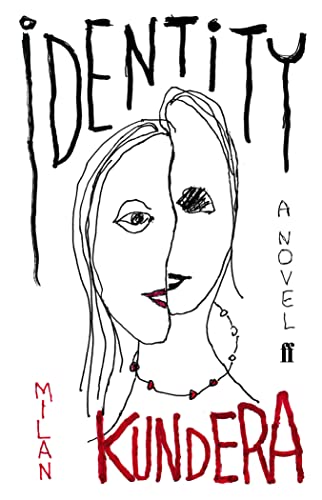
Identity by Milan Kundera

faber and faber, 1999, 155 p. Translated from the French L’identité (Gallimard, 1998?) by Linda Asher.

Identity cover

After the loss of a baby from a previous marriage, the constant refrain from her husband and his family that another child would set things right Chantal left to take up with Jean-Marc, who feels he only engages with the world through her but is fearful that is only an illusion and without her he’d lose any connection to the world. Her realisation that, ‘Men don’t turn to look at me any more,’ is the starting point of the couple’s estrangement. She begins to receive anonymous letters, keeping them from Jean-Marc, and imagines who might be their writer. Eventually their contents contain too many details of her activities to be the work of someone who does not know her well. The confrontation that ensues sees Chantal take a trip to London, in part to escape.

In its early stages this book reminded me of the work of John Banville but then it took a left turn into a phantasia of unlikely occurrences which it is a tribute to Kundera’s skill are nevertheless entered seamlessly without any jarring to the reader.

Identity, the awareness of self, is of course the theme of the book. “Remembering our past, carrying it with us always, may be the necessary requirement for maintaining the wholeness of the self.” Saying friends help to bolster this sense, Jean-Marc calls into evidence Dumas’s four musketeers and claims friendship is, “proof of the existence of something stronger than ideology, than religion, than the nation,” but Chantal tells him. “Friendship is a problem for men. It’s their romanticism. Not ours.”

Chantal works at an advertising agency. One of her colleagues declares, “‘Only a very small minority really enjoys sex.’” When challenged, he adds, ‘If someone interrogates you on your sex life, are you going to tell the truth?….. while everyone may covet the erotic life everyone also hates it, as the source of their troubles, their frustrations, their yearnings, their complexes, their sufferings.’” Sex is never far from the surface in a Kundera book. Here advertising is characterised as, “Toilet paper, nappies, detergent, food. That is man’s sacred circle, and our mission is not only to discover it, seize it, and map it, but to make it beautiful, to transform it into song.” We are, “condemned to food and coitus and toilet paper.”

Identity is a slight volume at 155 pages but packs a lot in. However, the simile in, “her voice wavering like the lament of a woman raped,” strikes an off-note.

Pedant’s corner:- Patroclus’ (Patroclus’s,) Alexandre Dumas’ (Dumas’s,) unfriendlike (is that a translation of a French word for which there is no direct English equivalent?) “an burdensome thing” (a burdensome thing, surely? Or was it a peculiar emphasis in the French?) a missing comma before a piece of direct speech, Britannicus’ (Britannicus’s,) “to épater les bourgeois” (not translated, but italicised,) a curious shift to past tense for one paragraph in a section otherwise rendered in the present.

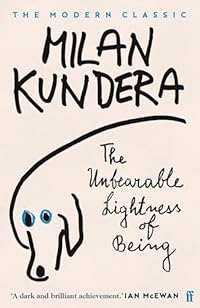
The Unbearable Lightness Of Being by Milan Kundera

Translated from the Czech, Nesnesitelná lehkost byti, by Michael Henry Heim.
Faber, 1995. 305 p.

This is a book to bring home how parochial and inward looking most fiction written in the English language is. There is no possible way that The Unbearable Lightness Of Being could have been written by a British or US author, or indeed any other anglophile. The mind set, the life experiences and especially the history it is written from are all too different. While the thrust of this book is by no means the same, I was reminded by its sensibility of the work of Bohumil Hrabal – not surprisingly also a Czech author.

The book is unusual in another sense; it breaks most of the rules that aspiring writers are advised to adhere to. A lot of the action is told to us rather than shown, Kundera addresses the reader directly, inserts his opinions into the narrative, tells us his interpretations of the characters. He also messes with chronology (admittedly not a major drawback, if one at all) and parenthetically gives us important information about some characters in sections which ostensibly deal with others. In parts, especially in the author’s musings on kitsch as the denial of the existence of crap – in all its senses – in the world, it reads as a treatise rather than an exploration of the human condition. That is, at times it is not fiction at all.

Kundera is highly regarded, so is this the essence of high art in fiction? That, as well as dealing with “important” subjects – or perhaps being considered to be circumscribed yet still endeavouring to tell truth to power (whatever truth may be) – the author should step beyond the bounds of narrative; of story?

The problem with such an approach is that it tends to undermine suspension of disbelief. The characters become too obviously constructs; the reader is in danger of losing sympathy, or empathy, with them; or indeed to care. It is a fine line to tread.

Where The Unbearable Lightness Of Being is not unusual is in its treatment of those novelistic eternals love, sex and death. Indeed at times it seems to be fixated on sex.

While the exigencies of living in a totalitarian state do colour the narrative, the treatment is matter of fact, oblique, almost incidental. The choices the characters make merely fall within the constraints of such a system. It is true, however, that something similar could be said for characters in any milieu. There are constraints on us all.

What I did find disappointing was that rather than finish, the book just seemed to stop. While the fates of the characters Kundera leaves us with are already known, this hardly seemed fair. “Leave them wanting more” may be an old showbiz adage but in the context of a one-off novel might be thought to be a failing.

free hit counter script