Archives » cosy catastrophe

Earth Abides by George R Stewart

Black Swan, 1985, 362 p.  Cover art by Eduardo Paolozzi.

During the late twentieth century this was considered as a classic Science Fiction novel of the post-apocalyptic variety.  I bought it many moons ago but somehow never got round to it till now.

Our protagonist Isherwood Williams is bitten by a rattlesnake when out on a hunting expedition. When he recovers he finds the human world has succumbed to a disease of some sort. Cities and roads are mostly deserted (the book was first published in 1950 when cars were much scarcer than they are now) but infrastructure – electricity, water, fuel – is still working. Overcoming his reluctance to use what wasn’t his property he takes a car and rides from his home in California across what was the US to the east coast and finds very few people have survived. Those who have, are disorientated and demoralised though three “negroes” have gone back to living off the land. Williams (in what is to modern eyes clearly a racist assumption) thinks they are more suited to this due to the way they lived before.

Back home in California he sets about life on his own but one day, when the electricity has finally failed and the street lights have faded away he notices a light at night. This leads him to a woman called Emma and the pair get together. Emma is of black ancestry so Williams’s racism is not too overt. (But then again in such a situation you could not afford to be overly choosy.) Emma is a resourceful and wise woman so it is just as well.

The pair set about surviving as best they can and even decide to have children. Along with a man called Ezra and the family he had collected around himself they form a community, which over the years grows and forms rituals of its own. Ish’s hand-held hammer becomes a totem, the long-lost Americans (of which to his community he is the last) and their accomplishments held in awe by the younger members. The difficulties of coming to terms with a new mode of life and of meeting other survivors or their communities  are explored briefly but mostly this is the story of Ish.

Some of the seeds of later post-apocalypse novels – especially the ‘cosy catastrophes’ of 1960s British SF – can be discerned in this book, so in that sense it can still be seen as a classic.

Pedant’s corner:- “extra ordinarily pleased” (extraordinarily,) “upon articles of dust” (particles of dust,) “but he heard only far off, the rasp and crackle of static” (needs a comma before ‘only’, “had take command” (had taken,) wistaria (x2, wisteria,) “whimpered her sleep” (whimpered in her sleep,) grape-fruit (grapefruit,) “what might, by generous interpretation, he called a social group” (be called a social group,) generaly (generally,) “electrical impluses” (impulses,) a missing comma before a piece of direct speech (x 2.) “Near by a smooth rock surface” (Nearby,) youngesters (youngsters,) geograhy (geography,) feminity (femininity,) Mohenjadaro (Mohenjo-daro.)
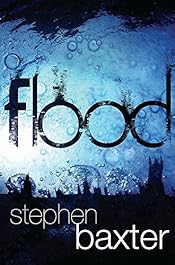
Flood by Stephen Baxter

Gollancz, 2008, 478 p.

This could be seen as a revival of the British SF tradition of the disaster novel (sometimes dubbed the cosy catastrophe as there were always survivors just about coping) in the manner of the Johns, Wyndham and Christopher. There are resonances in Flood of The Kraken Wakes, but also of J G Ballard’s The Drowned World. Baxter’s take on it is his own, though.

Sea levels are rising – and not slowly. Very rapidly coastal cities are inundated and the rise continues, indeed progresses faster as time goes on. It is not mere global warming, then, and Baxter has come up with a scenario involving huge reservoirs of subterranean water brought to the surface through thermal vents at tectonic plate boundaries.

His treatment of the tale is episodic – much like that of his novel Evolution – but the time scale here is not that of millions of years but at most decades, and the ongoing scenes feature recurring characters, principally one Lily Brooke.

Just before the floods began she and three others, plus the baby one of them had had during their incarceration, had been freed from five years’ captivity at the hands of terrorists in Barcelona by agents of a corporation known as AxysCorp. Its head, Nathan Lamockson, takes an interest in the welfare of these five survivors (a sixth was killed just as the rest were being liberated) and their lives from then on. Baxter relies on the survivors’ concern for each other as a driver for the reader’s interest. However, in their actions they seem to be relatively unaffected by those experiences and show little sign of psychological trauma. The baby, Grace, the result of the rape in captivity of Helen Gray by a Saudi prince, becomes the subject of diplomatic dispute when she is relinquished by AxysCorps to the Saudis and spirited off to the Arabian peninsula. Only much later is she returned from there.

The main focus of the narrative is on the relentless sea rise, the efforts of humans to flee to higher ground and of the various characters involved to protect themselves and their families. In particular Lamockson manifests his megalomaniac tendencies in a series of ever more elaborate schemes, the last of which is to build a full-scale replica of the Queen Mary,  which he calls Ark Three, to house those of his friends, associates and employees which it can carry. Ark One is a starship onto which Grace is inveigled not long before its launch when what remains of humanity is reduced to living on huge rafts. That leaves Ark Two’s existence or whereabouts unrevealed at the book’s end. (There is a sequel titled Ark.)

Pedant’s corner:- mentions the projected 2018 World Cup in England (this shows the dangers of authorial short term projection of the future,) and regarding that same tournament’s later abandonment says the US team was among the favourites (no comment required,) “peering at streets signs” (usually rendered as street signs, if not it should be streets’ signs,) Himelayas (Himalayas – as in a later appearance,) “the wetsuits were one item that were wearing out fast” (one item that was wearing out.)

Exiles on Asperus by John Wyndham (writing as John Beynon)

Coronet, 1979, 154 p.

John Wyndham was one of the big names of British SF in the 1950s and early 60s, most famous for The Day of the Triffids, The Kraken Wakes, The Chrysalids and The Midwich Cuckoos (filmed as Village of the Damned.) Gifted with a plethora of forenames (John Wyndham Parkes Lucas Beynon; his surname was Harris) he wrote under several almost aliases – Lucas Parkes as well as John Harris, John Beynon and John Wyndham. It is those latter, more mature works for which he will be remembered – even if Brian Aldiss did dub the sub-genre of the disaster novel for which they stand as exemplars as ‘cosy catastrophes’. This book contains three tales, two novellas plus one shorter story and could not be more different in intent from those novels.

Exiles on Asperus. Humans have colonised Mars and Venus and the three planets are at loggerheads with each other. A Martian faction has rebelled and prisoners are being taken to the asteroids. On the way they turn the tables on their captors but are forced to land on the asteroid Asperus where another ship had crashed many years before. They find winged aliens called Batrachs have captured the previous humans and forced them to work underground. The factions join together to try to free them. It is not plain sailing. To modern eyes Asperus is an impossibly lush and hospitable place for an asteroid but this novella first appeared in 1933. Expressive of that era’s attitudes the characters too readily resort to violence, marriage is an unquestioned institution and women are called girls.

In No Place Like Earth (first published in 1951) humans live only on Mars and Venus as Earth was shattered into a collection of asteroids (presumably by acts of planetary war.) At the story’s beginning, viewpoint character Bert – this surely verges on breaking Gene Wolfe’s prescription on naming characters Fred – is living on Mars but longs for the old days on Earth. He is persuaded to leave Mars, and the prospect of settling down with Zaylo, a local “girl”, by the arrival of a manned spaceship from Venus offering “a future”. On that planet he works overseeing the labour of the indigenous life-form called griffas but the promise of advancement and acceptance into the dominant layer of Venusian society fails to materialise. He comes to realise there’s no place like Earth.

The Venus Adventure (from 1932) incidentally has people usually come into the world by incubation rather than natural birth but its main tale is of the first two human journeys to Venus – many centuries apart. In that elapsed time the original arrivals have separated into two groups, Dingtons and Wots, descended from the two heads of the expedition, an idea probably prompted by Wells’s The Time Machine. The Dingtons have made friends with the Venusian Gorlaks with whom the Wots are more or less at war. The newcomers by force of circumstance take the side of the Dingtons against the “degenerated” Wots. The characters’ dialogue displays colonial attitudes. One uses the phrase, “went native,” and explains it by, “‘In the tropics we find that a white man either conquers the conditions, or is conquered by them.’”

These stories nowadays have to be read through a filter. It is in the nature of such early tales of interplanetary adventure that science has since overtaken the details of the narrative. Mars does not have sufficient oxygen (or indeed partial pressure) for humans to exist on its surface unprotected. Never mind perpetual rain and lack of visibility, Venus is totally inhospitable. An asteroid such as Asperus will have no atmosphere, full stop. Societal norms have evolved, especially in terms of sexual roles and the prevalence of cigarette smoking. Attitudes to the writing and reading of SF itself have changed profoundly. Characterisation here is rudimentary and the assumption of hostility to humans by aliens is not interrogated. These are primarily stories of action adventure, though No Place Like Earth does have a more reflective side, perhaps since it was presumably written about twenty years after the other two stories here; about the same time as The Day of the Triffids.

Pedant’s corner:- “A broad path let from the ship” (led from.) “They had run into a meteor shower and had been lucky in not being carved to bits. Happily most of their score of leaks had been small.” I suspect an encounter like this would have destroyed any spaceship and stripped it of air, however small the leaks,) the text refers to Venus as a younger planet (it isn’t of course, but the sense is metaphorical in terms of exploiting its resources,) transcendant (transcendent,) “they champed in silence” (they were eating, so, ‘they chomped in silence’,) “but it is probably that you have not found more” (probable.) “Crawshaw, himself, and Heerdahl” (it wasn’t three people, it was two – Crawshaw himself, and Heerdahl,) “from their alarm of the unearthly roar” (alarm at the unearthly roar,) “for old time’s sake” (old times’.)

free hit counter script