Archives » Candas Jane Dorsey

Black Wine by Candas Jane Dorsey

Tor, 1997, 283 p.

 Black Wine cover

On starting to read this I was quickly reminded of N K Jemisin’s The Fifth Season (which of course was published 11 years later.) We have three different narrative strands each with a female protagonist, obviously connected (but in what way not immediately apparent,) a recognisable world yet different from our own, possibly far in the future, featuring places with portentous names, Trader Town, the Fjord of Tears, the Remarkable Mountains, the Land of the Dark Isles, an unfamiliar social system – or systems, there are different polities here – to navigate. However, as it unfolded the resemblances diminished somewhat. In particular, the relationship between Jemisin’s strands was a more bravura writing accomplishment. But Black Wine is good all the same.

We start with the story of a woman, amnesiac as a result of falling from the sky, with another, mad, woman living in a cage in the courtyard outside. They live in a society – the Zone of Control – where a favour bestowed consequently imbues obligation. The mad woman had not received any such favour and so managed to live without the burden of repayment. The amnesiac, however, had, and so is a sexual slave to her master and the nurse who looked/looks after her. Here also, minor acts of defiance can lead to tongues being removed. The amnesiac forms a friendship with a male slave who has suffered from this. The tongueless have devised a sign language for themselves of which their owners are unaware.

The resemblance of the amnesiac, whom we later find is named Essa, to the titular ruler – actual rule has been devolved to her son-in-law – of a different polity (as shown on its coins) is marked. When the mad woman finds Essa is going to voyage there she tells her to avoid the regent and certainly not to have sex with him. The female ruler is a cruel type, as is her son-in-law, and the connection between her, the madwoman and Essa is the motor of the plot.

The world Dorsey describes is a little strange. For the most part it appears to be without advanced technology – though it does have airships (from which you can fall from the clouds) – a lot of the travelling involved seems to be on foot, but at one point one of the characters decides she wishes to get somewhere faster and a quicker transit system is utilised.

A touch of fantasy arrives with the Carrier of Spirits, who imbibes the memories of everyone who dies. (She carries Essa’s pre-amnesia existence, but not of course those gained after the fall.) Essa’s relationship with the muted slave allows Dorsey to comment on the nuances of free will and the dependence of the exercise of it on social status.

Observations such as, “‘Look. I am this stone. I have been tumbled and moved, and it has all shaped me,’” are as much an expression of the universal as an outcrop of the story being told. Occasionally the text comments on itself or the writing process, (or perhaps reader expectations,) as in, “‘The mad king is a trope of literature and myth.’”

Black Wine is the first Dorsey novel I have read. It is less opaque than some of her short stories and encouraged me to look for more.

Pedant’s corner:- “the effect was shouting underwater” (was of shouting underwater,) a missing comma before a piece of direct speech, “none of them were done” (none … was done,) “a deep courtesy” (curtsy,) “any of them even know it” (any of them even knows it,) connexion (Ugh! Several times; connection.)
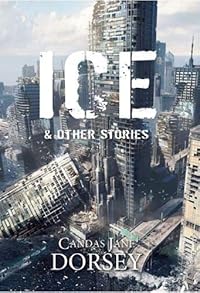
Ice and Other Stories by Candas Jane Dorsey

PS Publishing, 2018, 316 p.

 Ice and Other Stories  cover

Dorsey has been described as Canada’s Ursula K Le Guin. While her writing is good I wouldn’t go so far as to compare it with Le Guin’s. Overall in these stories I found there is something of a reserved quality to it.

In (Learning About) Machine Sex viewpoint character Angel writes the first computer progamme that can bring you to orgasm, with no need for all that love stuff. Despite also positing the need for human interaction the story presents a pretty bleak view of male sexuality. But that has ever been what it is.
Sleeping in a Box is nominally set on a Moon where everything is expensive and imported from Earth but the story is really about restrictions and how we all have to live with them.
Here Be Dragons is a metaphor for navigating through a life filled with obstacles. A woman exacts a small measure of revenge for the destruction of a domed habitat.
Presented as a historical report, Turtles All the Way Down tells of the development of a new scientific explanation for “reality faults,” cracks where the world opens and closes.
Dvorzjak Symphony is the story of a nightwatchwoman who has a clandestine lover on the premises.
A tale about how little we may know those nearest to us, in Death of a Dream dreams have become almost real places, monitored by the Dream Police. The narrator’s dream daughter is abducted by her ex-husband. Of course she sets out to find her.
The far future narrator of Living in Cities has returned to Earth and is giving to another returnee a tourist guide of the city she has curated.
In Going Home to Baïblanca, described under its title as a homage (femmage?) á Elisabeth Vonarburg, a human-like sea creature rescues a man from drowning only to find he’s not what he seemed.
Mapping sees a man abused in childhood trace patterns on his skin with razor blades before eventually seeing a psychiatrist.
Ice is set in a warmed world where our protagonist goes round blowing up partially drowned skyscrapers while holding the memories of a dream child under the influence of a drug named spike.
The lack of a question mark in the title of How Many Angels Can Dance forces a reading in which an explanation of angels dancing is necessary, which the story then goes on to provide.
Locks has the feel, but not the form, of a fairy story. There is a castle with locked rooms and a guardian, a forest, and someone under an enchantment. All you need really.
Despite its first eleven words Once Upon a Time…. is not a fairy- but instead a cryptic love story, which alludes to faery and metaphor in a meta-fictional commentary on the idea of story.
Blood From a Stone is a fantasy which sees the balance of a mother and her daughter’s isolated existence upset when a male water finder arrives.
In Mom and Mother Teresa the famous nun turns up on our narrator’s mother’s doorstep. Her mother’s Scots Presbyterian childhood, “with its message of duty, sacrifice, and unhappiness” had not been erased by adult years’ attendance at the local United Church but her own parents’ training made her offer the little woman tea and the second most comfortable bed in the house. Mistake. Mother Theresa moves in – complete with twenty-five alphabetically named orphans and a host of homeless folks. There is another twist to come.
In a deep dark winter of ice-fog, shortages – and electric cars – in “…the darkest evening of the year…” a group celebrates midwinter in the old ways, roasting meat, seeking the return of the light and coming together.
Written for Canada Reads 2006, A Trade in Futures reads like a hard-boiled detective story but its narrator is a poet laureate and the client who comes through the door wants his raison d’être to be found again for him. The text does though make the obvious joke about having a poetic licence.
The allusion in the title of Seven in a Boat, No Dog to Jerome K Jerome is somewhat misplaced. There are seven characters, possibly the last North American survivors of an apocalypse – certainly the last with memories of the old days – but there are at least two boats and the tone is not as light as might be expected.
First Contact may be just that but is more likely a metaphoric allusion to the fact that any initial intimate encounter between a woman and a man is laden with unknowabilities. This story is not for those with tender sensibilities as regards frank language and the sexual act.
In Dolly the Dog-Soldier the titular Dolly is part of a pack of uplifted dogs, able to speak and being trained for an assassination mission.
The Food of my People sees a young girl whose father has been badly injured in a rig blow-out taken in by a neighbour, Cubbie, after school. Attempting jigsaws seems to be instrumental in helping her dad recover. Cubbie is fond of home-cooking and there is a Dorsey family recipe for bread pudding at the end of the piece.
End of the Line, or, Desperate Russian Girls Looking for Love is another reflection on story, and on living life on-line beset by email spam.

Pedant’s corner:- I read an Advance Reading Copy (somewhat belatedly) so many of these may have been changed before publication. I note from the cover that the author’s first name – given as Candice on the ARC – has been. Elsewhere; a missing comma before a piece of direct speech (several times,) forbearers, (forebears,) Dvorzjak (okay it’s a character’s name; but the composer’s was spelled Dvořák,) “When I reached to door” (reached the door,) reflexion/reflexions (reflection/reflections) gaffer’s tape (gaffer tape,) Dr Jones’ (Dr Jones’s – used later,) Polariodä camera (Polaroid,) “because of the visor no-one would never see me again” (would ever see me again,) connexion (connection,) focussed (focused,) “heaven forefend” (forfend,) “a tinker’s dam” (damn,) “I took him in his my arms” (Dorsey may have intended this – to represent a disoriented state – but ‘my arms’ would not be such an opaque over-elaboration,) “not just cock into cunt into but into all molecules” (again perhaps intended, but again over-elaborated,) “all the pack are younger than I am” (all the pack is younger,) “ma chou” (even though the person being spoken to was female, the French word chou is masculine in gender; ‘mon chou’. Do Quebecois use “ma chou” in this way?) ambiance (ambience.) In the Story Notes; “this this story” (only one ‘this’ needed.)

free hit counter script