Out of the Darkness by Harry Turtledove
Posted in Fantasy, Reading Reviewed at 12:00 on 3 June 2026
Pocket Books, 2005, 661 p, plus vi p Dramatis Personae.
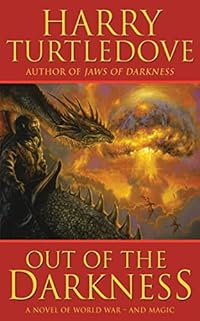
The usual fare from Turtledove as his mirroring of the Second World War in a world where magic/sorcery is a prevalent feature and fantasy creatures abound comes to an end. The episodic structure, returning to its viewpoint characters every so often, continues to frustrate with its repetitions of things the reader already knows about the people portrayed and their circumstances. So, too, does the misogyny of many of the characters. But this is an unenlightened world, and while it has good people in it there are not enough of them to make a material difference. They are only operating at the margins.
The equivalences with our world are not exact. For example there are no republics here, King Mezentio, the leader of the racist aggressors, does not die by his own hand but asks a soldier to do it and the magical counterpart to the Manhattan Project achieves its goal only unlike in our world is demonstrated to citizens of its proposed victims before its final deployment – on the capital city rather than provincial ones. It is interesting, though, that the developed magic/sorcery has been throughout the seven Darkness books subject to theoretical calculation. (Not quite magic then?) Though apart from drawing energy from the not always handy ley-lines it still needs life force to power it.
As Turtledove’s Derlavaian War winds down several of those we have come to know (very few of whom have experienced character development) meet their ends, others have happy endings – of sorts. The parallels with our world extend to an equivalent of the Nuremberg Trials. The book doesn’t end so much as stop, but as far as its survivors were concerned this was also true of our Second World War. Life goes on, if in different circumstances. Not all of them congenial.
Pedant’s corner:- “Tsavellas’ small kingdom” (Tsavellas’s,) “Iskakis’ wife” (Iskakis’s,) “not as if he’d take a step” (context suggests ‘not as if he’d taken a step’,) “floating fortress’ stick” (fortress’s,) “the marquis’ air” (marquis’s,) “but we liked to come into Priekule to listen to him” (not Priekule; Pavilosta,) “‘I should have won Algarve should have won’” (is missing a punctuation mark after that first ‘won’,) “Captain Frigyes’ bloodthirsty magic” (Frigyes’s,) “‘Assuming what you say about Mezentio is true, will will grant your soldiers their lives’” (… is true, we will grant …,) “Balazs’ smile” (Balazs’s. Balazs’ appeared again once,) “the ballocks” (I assume Turtledove, being USian, has only heard this word and doesn’t realise it’s spelled ‘bollocks’,) “Gyongos’ skirmishes” (Gyongyos’s,) Kunhegyes’ battered old palisade” (Kunhegyes’s.)
