Archives » A Calculated Life

Sleeping Embers of an Ordinary Mind by Anne Charnock

47 North, 2015, 227 p, plus 3p Author’s Historical Note, 2 p Acknowledgements and 3 p Bibliography.
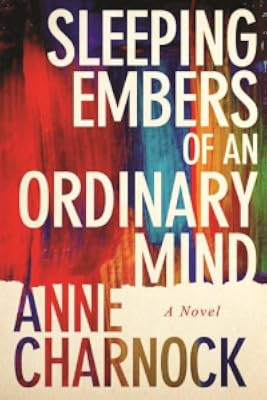
This, Charnock’s second novel, (after A Calculated Life, chapter one of which is appended here following the Bibliography,) has a tripartite structure. Succeeding chapters tell the stories of Toniah, a woman from a parthenogenetic family living in 2113, adolescent Toni from the book’s publication’s present in 2015, and budding female artist Antonia Uccello in 1469 Florence.

Toniah lives with her sister and niece in London – all born parthogenetically, as was Toniah’s mother. She has recently been employed to reassess the work of Gauguin by a firm which specialises in historical revisionism – usually from a feminist perspective. In particular she finds antecedents to Gauguin in the paintings of Émile Bernard, but which also reflect back to Italian renaissance art.

Toni and her father are still trying to recover from the death of Toni’s mother in a car crash. Her father is an artistic copyist, working legitimately. A commission from a Chinese client leads them to spend some time in Shanghai.

Antonia’s artistic talent has been recognised by her father Paolo Uccello, a pioneer of linear perspective in the Italy of the time, who is teaching her both to read paintings and to paint herself. Her mother does not keep well and is haunted by the necessity to find a husband for her daughter. Antonia’s aunt’s life in a convent bears implications for her future.

All three lives are connected by the painting Antonia executes of her ill mother.

The speculative content – cloning of females – is presented as an unremarkable aspect of life one hundred years hence. The lack of recognition of female artists through history is not laboured but rendered subtly.

Pedant’s corner:- “she wishes her father were stood by her side” (wishes her father were standing,) “her father is stood at” (her father is standing at,) “she looks through a grill (a grille.)
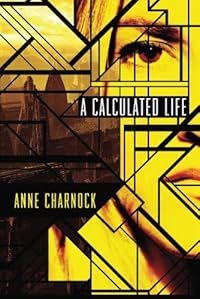
A Calculated Life by Anne Charnock

47 North, 2013, 199 p, plus ii p Acknowledgements and i p about the Author.

Jayna has an affinity with numbers and is employed as a researcher into trends for a firm called Mayhew McCline. But she is also a simulant, a type of clone developed to carry out high grade tasks for the corporations who dominate this future society.

Most humans, known as organics, are immunised against violence, addiction and over-indulgence and – except for a few allowed to do more menial tasks – spend their time in enclaves. So-called bionics (humans deemed suitable) have been given implants to enhance their capabilities, are relatively freer and better employed.

Simulants spend their out of work hours in rest stations, where their food and even sleeping times are controlled. As a result, Jayna’s life tends to be repetitive. Normal human interactions, such as sexual liaisons and it seems empathy, have been edited out of their make-up. However, Jayna keeps stick insects as pets of a sort. Simulants who show themselves to be unsatisfactory in some way are subject to recall and reinitiation – taken back to the Constructor.

Jayna begins to doubt herself when some of her predictions turn out to be off the mark and begins to wonder if she needs more contact with organics. Earlier simulants have been withdrawn from use but Jayna’s cohort has been endowed with better olfactory senses which she believes are tied up with emotions and ability to empathise.

The novel is a slow unfolding of Jayna’s development and – as she mixes more with bionics and organics – of her questioning her role and treatment.

The prose in A Calculated Life is stilted at times but this is a reflection of Jayna’s thought processes as a simulant. In all, the novel is an understated examination of a dystopia. Let’s hope it’s treated as a warning and not a blueprint.

Pedant’s corner:- Published in USian. “‘Pigeons are not animals. They’re birds.’” (Birds are animals; like humans, they belong to the class of vertebrates,) “rinsed it and lay in gently on the wooden board” (and laid it gently.) “‘That’s funny we were chatting the other night’” (needs a comma after ‘funny’,) “asked a women” (woman,) luck-luster (lack-luster; or in British English ‘lack-lustre’.)


free hit counter script