Adama by Lavie Tidhar
Posted in Other fiction, Reading Reviewed at 12:00 on 26 February 2026
Head of Zeus, 2023, 397 p.
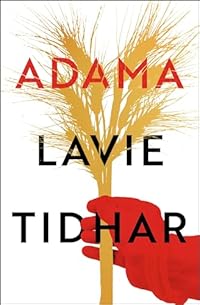
This is the second in Tidhar’s Maror sequence, in which he examines the history of Israel. I reviewed the first here. In Adama (the name is Hebrew for earth, and here is used as a synonym for homeland) the focus is on the setting up and evolution of the Israeli state as seen through the experiences of the members of one family. The book is episodic in nature, ranging in time from Haifa in 1946 and a displaced persons, DP, camp in Germany in 1947 via the war to establish Israel (what Palestinians refer to as the Nakba,) the aftermaths of the Six Day and Yom Kippur wars, events in Kibbutz Trashim in intervening years, to Florida in 2009; not necessarily in date order.
Told in fifteen parts starting with one titled The End and with the last called The Beginning, our viewpoint characters are matriarch Ruth, her sister Shosh, their children Yoram, Ophek and Yael, grandchildren Lior and Esther, fourth generation Hanna and Shosh’s husband Dov.
As a staunch believer in a Jewish homeland, Ruth made her way to Palestine early, leaving behind in Europe her family who were apparently betrayed to the Nazis by Shosh’s then boyfriend Nathan Deutsch – upon whom Ruth later wreaks an extended revenge. Only Shosh survived. Unlike her sister, Shosh was not invested in the dream of Israel, only ever wanting to make her way to the US. Their descendants navigate the vicissitudes of the Israeli experience, the souring of the kibbutz ideal of socialism, its failure (and by extension Israel’s) to live up to its promise, the compromises and accommodations necessary to keep things going.
Ruth does what she has to as a member of the Jewish underground during the British mandate; as does Shosh in her efforts to be away from the DP camp. Only Ruth has some success. Dov’s tale relates to the 1948 war and shows its unforgiving nature. Kibbutz life is illuminated in passing as the book’s incidents unfold.
In 1989 Lior returns to the kibbutz from Tel Aviv for the funeral of his friend Danny, not believing the story he is told about Danny’s apparent suicide, and finds something rotten in its state. “Lior knew what hash smelled like, it smelled like Lebanon, there was so fucking much of it.” In this section Chief Inspector Cohen from Maror makes a brief appearance, reminding the reader (if any such were needed) of the murky underbelly of Israeli society which Tidhar is exploring.
A prominent recurring reference in the novel is a fictional film called The Vultures, starring actor Bill Goodrich, a film shot partly in the kibbutz, perhaps here intended to show the founding of Israel as Israelis would like to see it: but extortion, drug running and violence are never far away from any of the characters in this book.
Tidhar’s writing is immediate; sharp, abrasive and to the point. Despite its tight focus, Adama contains multitudes.
Pedant’s corner:- “Ruth was sat in front of the television” (‘was sitting in front of the television.) “They were sat in the Casino” (They were sitting,) “where there were nothing but camels” (where there was nothing but….,) “the metaplot” (elsewhere spelled metapelet.) “‘Did he, fuck,’ he said.” (no need for that comma after ‘he’; plus it actually changes the meaning.)
