Shanghai Nights by Juan Marsé
Posted in Other fiction, Reading Reviewed at 12:00 on 20 September 2025
Vintage, 2007, 202 p. Translated from the Spanish El embrujo de Shanghai (Plaza & Janés, 1993,) by Nick Caistor.
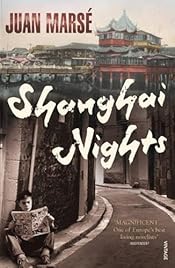
There is a certain quality to translated fiction – or at least to the best translated fiction – which marks it out. That sense of subtle strangeness, other ways of seeing, perhaps even other ways of being, and yet, reading it, the essential qualities of human interactions still shine through.
Shanghai Nights is set in Barcelona in the immediate aftermath of the Second World War and both that conflict, and more importantly the then also recent Spanish Civil War, hang over the book, an understated but permeating presence.
Narrator Daniel is a young adolescent whose father never returned from that Civil War, and several of the characters are subsumed by it, most obviously Captain Blay – called the Invisible Man for the bandages he wears to conceal his wounds but also Nandu Forcat, on whose initial furtive appearances everyone expects to be arrested at any moment. How much more so for those characters who are, or have been, in exile in France, at least one of whom is exiled permanently.
Blay is obsessed by a smell he attributes to a gas leak underneath a local pavement and ropes Daniel in to help him canvas for signatures on appetition against the leak and a chimney which spouts noxious smoke. Blay’s ineffectiveness is such that only about 14 people ever sign up.
Daniel falls into the orbit of Señora Anita’s daughter Susana, a consumptive (Marsé makes frequent mention of the Koch bacillus) girl whom Blay wants Daniel to draw as a victim of the smoke from that chimney but whom Daniel sees in a different light. She is the daughter of Joaquim (Kim) Franch, one of those exiles.
Forcat worms his way into Señora Anita’s graces and apparently has some sort of healing/heating powers. He begins to tell Susanna and Daniel a tale of her father’s adventures in the Far East, sent to Shanghai by the exiles to kill a man suspected of being a German Colonel guilty of war crimes in France and to retrieve a book with yellow covers, a book with revealing secrets. This is a lurid tale of unlikely encounters and an attractive Chinese woman named Chen Jing. It is sometimes couched in racial terms, (lousy chink, slant-eyed, a blackamoor) and clichés (dresses slit to the waist.)
Doubt is cast on this story by the appearance of Luis Deniso Mascaró (‘Denis’) a returned exile who has a grievance against Kim and whose revelations and influence alter Susana’s life.
This is a fraction of the contents of a book full of vivid characters such as the above as well as Blay’s wife, Doña Conxa, and the Chacón brothers, and which builds to a climax which is at once sordid but touched with nobility, and entirely true to its essence.
In it we read “everything passes, and it is all exactly the same, masks and the faces beneath, sleep and waking” and “however much we grow and look towards the future, in fact we are reaching back towards our past, in search perhaps of our first moment of awareness.”
Pedant’s corner:- “vocal chords” (vocal cords,) focused (focused,) “‘Denis’s’ parents’ home” (several times the possessive of ‘Denis’ appeared as ‘Denis’s’, surely it must be ‘Denis’’s,) “the waitress’ skirt” (waitress’s skirt,) “to smoothe down” (x 2, smooth down,) “fo’castle” (either ‘forecastle’ or ‘fo’c’sle’, not fo’castle,) “you’ll know you seen so much” (you’ve seen so much,) (Captain Tu Szu’s words” (elsewhere the Captain is always Su Tzu,) “to traffick arms” (to traffic arms,) “shammy leather” (technically it’s chamois leather.) “He was in the Peace Hotel can remember” (He was in the Peace Hotel and can remember.) “It is true then that …….. betrayal?) (Is it true then that …….?) “Contrary my mother’s expectations” (Contrary to my mother’s expectations.)
 This is a striking novel. It is told from the viewpoint of an unborn child (though as if being remembered from enough years later for that child to be able to write.) Any objections to such an unlikely story teller are forestalled by the sentence, “It’s precisely because I didn’t see it that I can imagine it much better than you.” (Imagining it is, after all, what novelists do all the time.) Scenes and times shift abruptly but always comprehensibly. Later events (even those subsequent to the narrative) are treated proleptically, but then again, to the narrator they will already have taken place. There are conversations – envisioned or hallucinated – between characters who have not met, the contents of which are not given quotation marks.