News of the Dead by James Robertson
Posted in James Robertson, Reading Reviewed, Scottish Fiction, Scottish Literature at 12:00 on 29 January 2024
Penguin, 2022, 374 p.
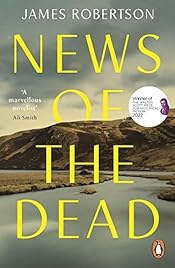 The book is set in a remote(ish) Highland glen, Glen Conach, named for the (unofficial) Saint who first converted the locals to Christianity, in three different time periods.
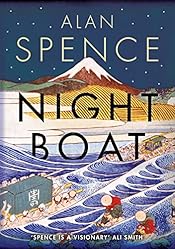
There are extracts from the Book of Conach, amounting to tales of his doings and good deeds. (In many ways these reminded me of the life of the Zen Buddhist, Hakuin Ekaku, as told in Alan Spence’s Night Boat. Then again the lives of religious ascetics are all probably very similar.)
That book was in the early 1800s in the library of Thomas Milne, Baron of Glen Conach, and a certain Charles Kirkliston Gibb had been invited (or invited himself) to examine and translate it. Dated entries from Gibbs’s journal of the time, found in the house’s ruins after it was destroyed by fire in the 1830s, are the other major thread. Gibbs thinks Milne is “surely a Tory but even sixty years since that did not oblige a man to be a Jacobite.…. Most Scots are Jacobite to some degree, whether they own it or not. Lamenting ‘what might have been’ eases our guilt at having thrown in our lot with the English. It is part of our character, I think, to love a lost cause.” The ‘sixty years since’ reference to Scott’s Waverley and the latter sentiments of this passage are another example of this perennial Scottish Literature itch.
The third strand, from the present day, gives us the thoughts of an old woman, Maja, who has a benign interest in a young boy, Lachie, who tells her he has seen a ghost. Her musings are a kind of framing device, topping and tailing the book. This gives the novel’s structure an unbalanced feel, though. The extracts from the book of Conach are undoubtedly necessary but they are too many and can feel repetitive. (Read about one ascetic and you’ve read about them all.)
The book’s transcriber Gibbs is a complete chancer, wanting to spin his examination of it out in order to avail himself of his host’s hospitality for as long as possible and casting around in his mind for which laird of his acquaintance he can sponge off next. Nevertheless, his debates with Baron Conach provide scope for philosophising. The Baron tells him, “‘Humans are the same in whatever condition they are found, though when men from different societies are by chance thrown together they may perceive themselves to be so unalike that one takes flight, while another worships, a third enslaves and a fourth murders his fellow creature. This is tragedy, my dear Charles, but is it not true? When Cain slew Abel he slew himself also.’”
Gibbs finds himself at first repelled by the Baron’s daughter Jessie’s birthmark but they become drawn together as much by proximity as anything else. The servant, Elspeth, though, has the best lines. She sees through Gibbs from the off and is as perky and sassy as you could wish. Her connections to the family are strong enough for her to have eyes on the estate’s heir. She says she’ll take a soldier for herself. Alexander Milne is indeed away with the army – as countless others from the glen have been, some not to come back, a familiar Highland tale. The army’s expedition to Walcheren ends badly, of course. But it does bring Elspeth her soldier.
The village is a microcosm, the local dominie and the minister both harbouring secrets. Gibbs reflects on one of the minister’s sermons that “The common folk of Scotland yield to none in their religiosity but I do wonder sometimes how deep it runs, and if one day they might suddenly discard it.” Perhaps a latter day thought untimely ripp’d.
In the present day researchers from university are scouring the glen to record oral tales of Conach, the details of which sometimes differ from those in the long lost book.
We end with Maja’s tale of the dumb lass, a stranger like Conach, who turned up in the glen in the aftermath of the Second World War and was taken in. “We humans have our waifs and strays like any other species of animal. We probably have far more.” The lass was dumb only in the sense that she did not speak.
A book, then, about kindness to strangers, refuge, and place in the world.
Robertson is never less than worth reading.
Pedant’s corner:- “came to nought” (came to naught.)
 Spence’s previous novel