Archives » YA

Tom Swift and his Jetmarine by Victor Appleton II

Sampson Low, 1954, 187 p.

Judging on the evidence of this and the previous Tom Swift book I read Appleton seems to have written his series to a template. Not a bad thing I suppose if your target market is pre-pubescent boys in the 1950s. Not so appealing to an adult 70 years on. But the cover is just so of its time I couldn’t resist it.

Here, the villains of the piece have been sinking ships in the Caribbean and Tom wants to find out who and how so as to stop them. This eventually leads him to an island off Cuba.

Again, the invention the book’s title suggests will be to the fore is not in fact deployed till late on with many diversionary incidents involving people wishing to hinder Tom in his activities. The titular jetmarine is in effect nothing more than a submarine. It’s said to have a revolutionary propulsion system drawing in water and then energising it to much greater speed. I’m still puzzled as to how that could possibly work. As written it sounds as if water goes out faster than it came in, which is impossible. Best not examine too closely.

Chef Chow appears again and I was much more struck in this “adventure” by the implicit (and most likely unconscious) racism in the writing – or at least the USian exceptionalism. I think my curiosity about Tom Swift and his inventions has now been sated.

Pedant’s corner:- “Time interval later” – or equivalent – count. At least 30.
Otherwise; “anything worth while” (worthwhile,) the jetmarine is somehow subjected to a pressure equal to a mile under the sea while in a tank in a lab. They would need a tank at least a mile deep then. “Pin point it” (Pinpoint it,) “indentifying cards” (identifying,) Jeffers’ (Jeffers’s,) “right way” (right away,) a missing quotation mark at the beginning of a piece of direct speech (x 2,) a missing quotation mark at the end of a piece of direct speech, “lightninglike” (lightning-like.)

Tom Swift and the Captive Planetoid by Victor Appleton II

Collins, 1969, 157 p. Illustrated by Ray Johnson.

This one is definitely of its time. A boys’ own adventure written in breathless prose full of exclamation marks and with a “Gee Whizz!” and “Jumpin’ Jets!” style of dialogue. It was part of an ongoing series – five others are listed on the back cover – and refers to Tom Swift’s many “brilliant inventions” (some of which seem to have been able to be brought to market in short order by a couple of retainers) and previous “thrilling adventures”.

His latest wheeze is a thermal wing for re-entry – which is used for bouncing on the atmosphere like a skimming stone. This is his Duratherm Wing – or Durathermor for short (though Durathermor is hardly any shorter) and Durabuoy crash shield. Other late sixties coinages the author makes are repelatrons, Tomasite, and asbestalon. (That last would surely be given a health and safety swerve these days.)

Incidents come thick and fast – we start with an attack on a US spaceport base by black clad raiders whose costumes are blazoned with a sphere and lightning bolt symbol. This is followed up by Tom accused of being involved and his plan to hollow out an asteroid for use as a space vessel as a threat to his country. A package delivered to him turns out to contain deadly flying insects. Mysterious men arrange meetings with patsies to further implicate Tom. Despite his troubles on Earth Tom still finds time to make an excursion to an asteroid which has been brought into Earth orbit by some force or other. Using it as a test bed for his plan for an asteroid ship he finds it has a sapphire core. He manages to hop into and back from space as if he’s taking aeroplane trips. On one occasion he is accompanied by a chef named Chow. Tom’s sister and her friend make a brief appearance as companions for Tom and Bud on a trip to the beach and have as little agency as you would expect from “girls” in late sixties “juvenile” SF.

In its favour the colourful cover and grey and white endpapers are wonderfully redolent of the age though the four interior black and white illustrations are more humdrum.

I note, however, that this was a time when British publishers took care to reproduce US publications using, for the most part, British spellings. Hurrah!

Pedant’s corner:- Time interval later (or equivalent) count; 21. Otherwise: dryly (drily,) “lighter-than-air buoyancy” (less dense than air buoyancy,) Petronius’ (several times; Petronius’s,) a missing comma before a piece of direct speech.

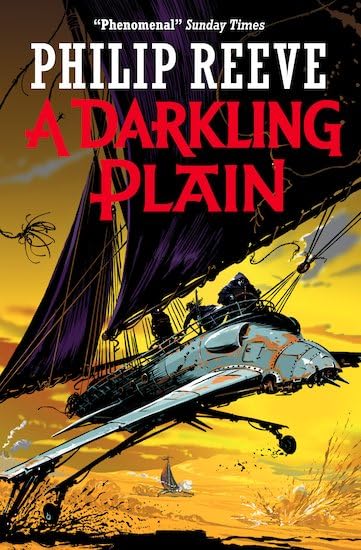
A Darkling Plain by Philip Reeve

Scholastic, 2006, 580 p, plus i p Acknowledgements and vii p Timeline of the Traction Era.

A Darkling Plain cover

This is the last in Reeve’s Predator Cities series of novels, continuing on from where we left off in Infernal Devices.

Tom Natsworthy now with a dicky heart after his shooting by Professor Nimrod Pennyroyal, and his daughter, Wren, are trying to pick up the pieces of their lives since their estrangement from Hester Shaw (respectively his wife and her mother.) In Wren’s case this is made easier by her attachment to Theo Ngoni. The plot kicks off when Tom thinks he recognises a woman, Clytie Potts, from his days in the now destroyed London, but she disclaims all knowledge of him. However an encounter with Wolf Kobold, the son of the ruler of the traction city Murnau leads to them going on his “suburb” Harrrowbarrow through the lines of the anti-traction army the Green Storm to where the remains of London lie in its surrounding debris fields. London turns out to be not quite the derelict it appears. Its surviving inhabitants have taken great care to keep themselves secret as they build a new city capable of magnetic levitation on the Earth’s Magnetic field.

Things haven’t gone entirely smoothly, though, as Wren and Theo have been separated by his enslavement – from which he is rescued by Hester. Other characters to reappear from the earlier books are the aforementioned Professor and the machine-like Shrike and Anna Fang. The latter of these drives part of the plot as she is able to control an orbiting WMD called ODIN using it against both sides of the traction city wars to undo a peace initiative.

As usual in YA fiction there is an abundance of action and incident, though a degree of coyness with matters of attraction between the sexes. Reeve lards his text with extratextural references (some of which may go over the heads of a YA audience.) We have characters named Lurpak, Nutella, Lego and Duplo, a street in Murnau called Über-den-Linden, a traction city named Peripatetiopolis, stories of awful salvage-stealing Wombles, a tunnel-like street called Holloway Road – heavy-handedly re-stated as Hollow-Way Road – mistakes about old-time usages (contract lenses,) and mention of a statue of Thatcher, the all-devouring goddess of unfettered Municipal Darwinism. I did wonder whether Cynthia Twite was possibly a nod to Joan Aitken’s Black Hearts in Battersea.

All great fun if you like that sort of thing and not entirely without jeopardy but one caveat.

I know the concept of predatory cities roaming the plains aiming to devour each other is an extrapolation ad absurdum but is the emphasis on violence not perhaps an unsuitable way to socialise the young?

Pedant’s corner:- burgermeister (burgomeister, but presumably Reeve didn’t want to alienate his YA audience,) “the Green Storm were” (the Green Storm was,) “than the old-fashioned jigs and reels than Wren had learned” (that Wren had leatned,) off-of (off,) “the old brake-blocks which supports Crouch End’s roof” (brake-blocks which support.) “Was that was this was all about?” (Was that what this was all about?) “Stories which she had had scoffed at” (only one “had” required,) “wondering where he had sprung him” (sprung from.) “A group of Green Storm aviators were running” (a group was running,) “one less regret” (one fewer.) “A party of his men were herding ..” (a party was herding,) “a saucer-shaped antennae” (antennae is the plural, one of them is an antenna.)

free hit counter script