Archives » Bayern Munich

Mario Zagallo, Franz Beckenbauer

Hot on the heels of the news of the death of Mario Zagallo, the first man to win the World Cup as both a player and manager, comes the death of the second, Franz Beckenbauer.

Zagallo’s playing career was a bit before my time but he won the World Cup twice as a player, in 1958 and 1962, and was at the helm when Brazil won their third World Cup in 1970. He was assistant manager for their 1994 win. This makes him the most successful footballer in World Cup history.

Mário Jorge Lobo Zagallo: 9/8/1931 – 5/1/2024. So it goes.

Beckenbauer leapt into the British consciousness during the 1966 World Cup in England, where he stood out as a new type of footballer, striding about the midfield like someone playing a different game altogether. Not long after he more or less invented the role of the attacking centre back from the seeper/libero position. His control of games led to his German compatriots giving him the nickname Der Kaiser. Domestically he was the driving force behind making Bayern Munich the abiding success they are today.

In later years his reputation was tainted by allegations of corruption surrounding the securing by Germany of the hosting of the 2006 World Cup but it his achievements on the pitch which will be his legacy.

Franz Anton Beckenbauer: 11/9/1945 – 7/1/2024. So it goes.

Gerd Müller

Sadly Gerdy Müller, one of the best strikers I’ve seen play football, (never in person though, though only on television,) has died.

With Bayern Munich and the West German national team he won every competition going. He scored 51 times in 31 appearances for TSV 1861 Nördlingen before joining Bayern (then not in the West German top flight!) for whom he bagged 566 goals in 607 games and an incredible 68 in 62 appearances for his country. That record speaks for itself. Despite not looking like a typical footballer, squat and a bit ungainly looking, he had great pace over short distances and a quick mind for the chance to shoot at goal. He was so good he was nicknamed Der Bomber. He finishe dhis career in the US at Fort Lauderdale Strikers, again averaging more than a goal a game.

In those days chances of seeing a player of a foreign club were few and far between – possibly highlights of a European tie involving them and a Scottish or English club or just, maybe, the final of the European Cup. Even European championship games weren’t routinely on domestic TV.

So it was in World Cups where these exotic foreign stars were revealed to us.

In the 1970 World Cup in Mexico Gerdy got a singleton and two hat-tricks in the group stages to set up their quarter-final against England.

I didn’t see that game live (I was young and foolish) but I heard the early score.

When I got home – not knowing the result – I said to my dad, “England 2-0 up?” A nod.

“2-2 full-time?” (hopefully.) “Yes.”

“3-2 Germany after extra time? “Yes.”

“Gerdy Müller?” “Yes.”

Maybe it was wishful thinking (even in 1970 Scots had got fed up with 1966 and all that) but somehow I knew what the outcome would be and that Der Bomber would make the difference.

Mind you, if I had watched the game maybe I would have been less sanguine. By all acounts (or is that English acounts?) England were bossing it till Alf Ramsey took off Bobby Charlton to save his legs for the semi. Then Franz Beckenbauer took over the midfield. Whatever, poor Peter Bonetti, stand-in keeper after Gordon Banks caught a stomach bug, got the blame. West Germany lost that extra time thriller of a semi 4-3 to Italy, but Gerdy scored twice.

Four years later it was a different story. (England didnae make it cause they didnae qualify. Oh sorry, that line came four years later.) Gerdy scored only once in the first group stage but got two in the second, helping West Germany to the final where they played the Netherlands, Johan Cruyff and all.

Their brand of football made Holland most neutrals’ favoured side and they even took the lead from a penalty in their first attack. But after another penalty evened things out Gerdy scored the winner in a home World Cup for West Germany, forever sealing his legacy.

Gerhard (Gerd) Müller: 3/11/1945 – 15/8/2021. So it goes.

Lifted Over the Turnstiles by Steve Finan

Scotland’s Football Grounds in the Black and White Era, D C Thomson Media, 2018, 257 p. With a foreword by Chick Young.
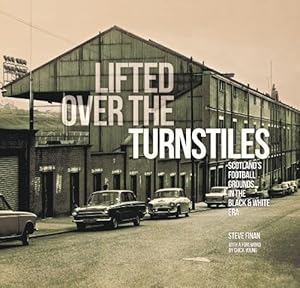
 Lifted Over the Turnstiles cover

Annfield, Bayview, Boghead, Brockville, Broomfield, Cathkin Park, Douglas Park, Firs Park, Love Street, Muirton, New Kilbowie, Shawfield, Telford Street, Kingsmills. Names to conjure with – and all gone to dust (or housing, or supermarkets.)

To Scottish football fans of a certain age (which I am) this book is a magnificent nostalgia fest. It features 41 of the historic grounds of the present day SPFL football clubs, plus two more, Shielfield (at time of publishing Berwick Rangers were still in the SPFL,) and Firs Park. The only ones missing are Peterhead’s former ground at Recreation Park and Annan Athletic’s Galabank. The criterion for inclusion in the book was that a photograph had not been widely published before or else illustrated some quirk of the ground concerned. (I was somewhat disappointed that only one photo of Boghead, former home of the mighty Sons of the Rock, appears; but I have my own memories to savour.) And of course for Inverness Caledonian Thistle you get two former grounds, Telford Street and Kingsmills. In the course of following the Sons I have visited most of the stadia here in their heydays, excepting only those belonging to the ex-Highland League clubs (though I have walked past Telford Street Park several times and even been to Clachnacuddin’s Grant Street Park in Inverness for a game – a pre-season friendly they played against East Fife; in 1976, while I was in the town.) I have frequented many over the years since.

The book is a delightful celebration of the history of the beautiful game in Scotland – and also a memorial to what has been lost. Cathkin apart, all of the grounds on the list above have been replaced by bright(ish) new(ish) stadia but most of those have yet to invoke the glories of these now mouldered (Cathkin again) or vanished (most of the rest) temples to Scotland’s abiding sporting obsession. With only one exception, Hampden, the book tends not to delve as far back as pre-World War 2, hence the absence of even longer gone grounds such as the Gymnasium, home to St Bernard’s FC, of which photographs would in any case be vanishingly scarce.

There is a 1930s, Art Decoish-looking, building in the pictures of Shawfield that I don’t remember from my only visit there and which I assume was demolished years ago. My favourite old ground, Firs Park, is shown in the days before that huge concrete wall was erected at one end to stop the ball going on to the access road to the retail park beside the ground; before, even, the office building that overlooked that end of the park in the 1970s. That other redolent relic, Cliftonhill, is shown lying in a natural bowl perfect for siting a football stadium.

The text is studded with various titbits of arcane information. Glasgow had at one time three of the biggest football grounds in the world in Hampden, Celtic Park and Ibrox. And there were plans to extend Shawfield’s capacity to add to that list of superstadia. The world’s first penalty kick was awarded against Airdrieonians (away at Royal Albert in a charity Cup match) and was scored by a James McLuggage. (Not from a penalty spot, that had yet to be invented; from any point along a line twelve yards from goal.) A WW2 pillbox was constructed at Borough Briggs with slit windows/gun ports all round (those sly Germans could after all have attacked from any direction) and remained in place till Elgin City joined the SFL in 2000. It was Ochilview which hosted the first ever floodlit match in Scotland. Falkirk once held the world record for the highest transfer fee and Brockville was the venue for the first televised floodlit game. Rugby Park used to be ‘mown’ by a resident sheep – three in total over the years. Hampden’s square goal posts now reside in St Etienne’s museum as they were held by that club to be responsible for their defeat at the hands of Bayern Munich in the European Cup Final of 1976 since two of their team’s efforts rebounded out from the goal frame instead of scraping over the line. Les poteaux carres is still used as a phrase for bad luck in the city.

Attending football matches is no longer as economical as it was back in the day. One photo shows a 20p entrance fee at Firhill in 1970. After inflation that 20p would equate to £3 in 2018. Try getting into even a non-league ground for that now! Some things definitely were better in the good old days.

Pedant’s corner:- “the current club were established” (was established,) “the club were on the up” (the club was) sprung (sprang, x2.)

What’s the Question?

So Tottenham Hotspur have appointed Jose Mourinho as manager after sacking Mauricio Pochettino.

Really?

Granted Spurs haven’t been doing well in the league this season and are well off the top four – much nearer the relegation spots in fact – but they’re well placed to qualify out of their Champions League* group even though they got gubbed 7-2 at home against Bayern Munich. And the players surely are as accomplished as they were last season. If it is true they may be a little stale that can be laid at the foot of the club’s hierarchy, notoriously unwilling to make the outlays necessary to attract players to the club. (Okay, the new stadium’s costs are a factor in that.)

But Pochettino has surely outperformed his resources and is still young in managerial terms. Will his sacking come to be seen as a huge mistake?

Given Spur’s traditional style of play Mourinho’s pragmatism seems an unlikely fit – as it was at Manchester United – and will inevitably lead to dissatisfaction among the fans, and probably quite quickly at that.

This may be a hostage to fortune as it is possible (if unlikely) that Mourinho (whose best days seem to be behind him) will lead Spurs to a Champions League win this season. But.

If Jose Mourinho is the answer to Spurs’s problems what on Earth is the question?

*So-called

Borussia Dortmund 1-2 Bayern Munich

Champions (sic) League (sic) Final, Wembley Stadium, 25/5/13.

For the first half hour this had sucker punch written all over it. Bayern barely featured. After Weidenfeller saved Manzukić’s header, though, things evened out.

Amazingly for a final, it was quite a good game; fairly open with both teams not afraid to go forward. Despite him setting up the first goal I found myself wondering if Arjen Robben was a luxury Bayern couldn’t afford. Then, of course, he goes and scores the winner.

I don’t suppose it was the wrong result given that Bayern’s goals were both from open play. The penalty wasn’t in dispute and Gündoğan put it away well.

Not quite a classic though. There weren’t enough swings in fortune for that.

Bayern Munich 1-1 Chelsea (aet 1-1)

(pens 3-4)

Champions [sic] League [sic] Final, Allianz Arena, Munich, 19/5/12.

So a piss-poor team (who finished only 6th in their national championship) from a piss-poor league (whose top two were horsed in the knock-out stages of the Europa League [sic]) have become “Champions of Europe.”

If ever football at the top level showed itself as an emperor with no clothes this farrago did. Chelsea made very little effort to win this match. Had they done so they might have been worthy winners of the game, but what few attacking sorties they did make revealed them as capable of troubling the Munich defence if not of breaching it. But they had one attempt on target all game – and the keeper didn’t save it.

So it went to the travesty of penalties.

Frank Lampard at the end said, “We worked hard for this. We deserved it.”

No you didn’t deserve it, Frank. You finished second in your league last year. You shouldn’t have been in the competition at all.

And plenty people work hard and receive no reward for it.

Still Roberto De Matteo has worked wonders in the short time he’s been interim manager. If he gets the job full time though the problems with an ageing team and over-powerful players will remain. And they’ll all be a year older.

Bayern Munich 0-2 Internazionale

Champions League Final, Santiago Bernabeu Stadium, Madrid, 22/5/10

Finals are rarely exciting games. This one lived up to that billing.

Bayern were never able to get at Inter. Whether it was the absence of Franck Ribéry or not, they threaded too many attacks through Arjen Robben. This was despite the fact that Hamit Altıntop was having more joy down the left than Robben was on the right. I thought it was a strange substitution by Louis Van Gaal to replace him. Inter were well set up to counter Robben’s efforts and looked more vulnerable via Altintop.

Diego Milito and Wesley Sneijder linked well for Inter and the goals were beautifully taken.

So the special one succeeds again.

He does seem to get the best out of players.

Edited to add:- For a major final the first goal was very route 1.

free hit counter script