Archives » The Thistle and the Grail

A Would-Be Saint by Robin Jenkins

B&W Publishing, 1994, 233 p.

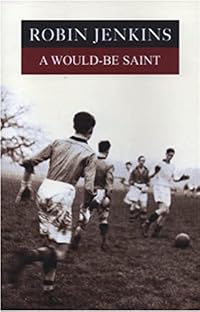
Despite the impression that might be given by the front cover the would-be saint in question is not an aspirant to play football in the colours of either Paisley’s or Perth’s best known football teams (or, given the story’s setting in time, even at The Gymnasium) but is instead one Gavin Hamilton, who at first seems a fairly normal lad growing up in the village of Auchengillan. We are shown Gavin’s immersion in village life through the lens of the Great War where his father is off fighting. The tone of the writing in these early chapters portends his father’s inevitable death. All Gavin’s young life he has had no contact with his father’s parents due to some dispute that occurred before he was born but his grandmother introduces herself to him one day in the street, a fact he instantly knows he must conceal from his mother.

In the post-war years Gavin secures a scholarship to Cadzow Academy which creates a barrier with his contemporaries as they shy away from his now perceived difference. At the Academy he forms a friendship with a lad called McIntyre from the intervening town of Lendrick whom he meets on the bus taking him there on his first day. Apart from McIntyre the only other pupil who has time for him is Rachel Hallad, whose father is a writer. However, McIntyre’s father is ill and not long for the world.

When McIntyre has to leave, Jenkins gives us a reflection of that stoicism instilled by the lads’ background and times. “If they had been men they would have shaken hands, if they had been girls or women they would have embraced or kissed cheeks. Being boys, and Scottish boys at that, they nodded, smiled, and turned away.”

Gavin’s life trajectory is changed again when his mother also dies. His grandmother and grandfather come to look after him and he is immediately removed from the Academy as his grandmother thinks folks like them should not get above themselves, (grandfather doesn’t get a say,) so instead of University and perhaps a teaching career he ends up with a job with a solicitor in Lendrick.

Gavin is graced by his talent as a footballer and his involvement with the Church. As right half for Lendrick Rangers he helps them win the Junior Cup which brings to the town much needed glory a time of joblessness in the 1930s. He takes the opposition’s buffetings with equanimity and never retaliates. He is clean living (his prospective fiancée Julia, the solicitor’s daughter, is frustrated by his lack of interest in physical matters) as opposed to the team’s other stalwart the notoriously dissolute Grunter Houliston, whose resolute displays meant there was “no necessary connection between a man’s private morals and his public performance, whether as a footballer, a clergyman, or a politician.”

It is when the Second World War comes, though, that Gavin’s real difference shows itself. Kind to a fault, his beliefs mean that he decides he must become a conscientious objector. The relevant Board sends him to work in forestry in the far west of Scotland. Those who live locally do not much take to having conchies nearby but again Gavin shows his indifference to other’s ideas and again shows his prowess in a football match arranged between the forestry workers and the villagers. Even here, though, Gavin is as strange to most of the men he works with as with his fellow villagers in Auchengillan.

The early parts of the book – and not just the football aspect – reminded me of the same author’s The Thistle and the Grail, (some of the incidents have close similarities,) while the forestry scenes echoed The Cone Gatherers. Its structure is made oddly bifurcated by the two settings (village and forestry) but all the characters ring true and come to life on the page. As a depiction of rural Scottish life in the mid part of the twentieth century and of a man apart, A Would-Be Saint is excellent.

Pedant’s corner:- bannister (banister,) Iron Brew (did Jenkins not wish to use the brand name, Irn Bru?) “Mind you ain fucking business” (your ain,) ice-flow (ice-floe.)

The Thistle and the Grail by Robin Jenkins

Polygon, 2006, 296 p, plus vi p Introduction by Harry Reid. First published 1954.

The thistle of the title is the local team of the small town of Drumsagart, Drumsagart Thistle Junior Football Club, whose blue shirts have a red thistle crest. The grail is the ultimate quest for a Junior* football team, the Scottish Junior Cup.

Despite the apparent thrust of the title that the novel will be about football, it isn’t really. There may one day be a definitive novel that deals with that perennial Scottish obsession but this isn’t (quite) it. The quote from John Cairney on the cover to the effect that this is “easily the best book written on the relation between football and society in Scotland” may well be true but the novel’s narrative more or less skirts football. Instead, it is more about a small town, the characters who inhabit it, and the distraction from their lives that football represents. Bill Shankly is supposed once to have said, “Football isn’t a matter of life and death; it’s more important than that.” While at times, in the throes of a match, it can perhaps seem that way, it really isn’t. But as a distraction from life’s tribulations it can be a temporary balm – even while adding to them.

At the start of the novel Drumsagart Juniors are hopeless, suffering regular drubbings – usually to nil – every week. This culminates in a mass protest after a 7-0 humiliation at the hands of their fiercest local rivals, Lettrickhill Violet, wherein the committee members are the subject of intemperate threats and club president Andrew Rutherford is in danger of being dismissed. Mysie Dugarry, granddaughter of the club’s most famous player, who had gone on to play for Scotland, suggests they try one Alec Elrigmuir whom she describes as the best centre forward in Scotland. (He plays for a pit team and she is sweet on him.) Under pressure Rutherford agrees. Committee member and local pub owner Sam Malarkin offers to provide a free drink to everyone should the Thistle go on to lift the Cup, safe in the knowledge it won’t happen.

Apart from the possibility of Elrigmuir, a further potential hero arrives when Turk McCabe, a former centre-half, returns to the town from a sojourn in England. Now in his mid-to-late thirties he is an unlikely saviour but has determination and turns out still to have positional sense. And so the journey to the grail begins. There is a brief description of the first-round game at Carrick Celtic but Jenkins’s writerly gifts are not convincing here. (I suspect this may be true of any attempt by any novelist to depict an imaginary football match.)

There is a whole cast of minor characters each of whom is drawn realistically and sympathetically. Sam Malarkin’s interest in Alec Elrigmuir is more than football related as is his sister Margot’s – a source of dismay later on when Mysie gets to hear of it and Elrigmuir threatens not to play as a result of her displeasure. Elrigmuir himself may be a good footballer but off the field he is all but a simpleton.

Despite not being published till 1954 this reads like an interwar, even a 1920s, novel. Harry Reid’s introduction tells us, though, that Jenkins was a reluctant author with many manuscripts kept in his locker.

The attitudes to women of the male characters in the book read as being decidedly off-kilter these days. “The apple had been a gift. Eve’s to Adam had been free too, and it had soured the world,” and, “With women it was, of course, different; their brains were lighter, no-one could expect them to be as serious as men.” At a club committee meeting discussing the team’s problems we have, “‘Have you noticed, gentlemen,’ said Wattie Cleugh, ‘how it’s women causing all the trouble? …. It would seem that what started in Eden’s still going on.’” However, Agnes Elvan’s observation that, “‘There’s not a woman in Scotland doesn’t know the importance of football is exaggerated,” is probably still widely applicable. There is also a wonderful Scotticism when a character describes another as having, “the mind of a five-year old lassie whose backside was underskelped.”

That the times have changed in other ways too is illustrated when a doctor – called in to examine Turk after his put upon mother had poured boiling water over his feet – says of the offer of a cigarette, “‘Do him good.’ The doctor intercepted the packet and took one himself. ‘Do me good.’”

Turk is of course an habitué of the pub. When the local minister, who does not like football – or pubs – came to proselytise, Turk, in his eagerness to berate religion but wanting to show some knowledge, responded with a misquote, saying, “‘I am become a sounding brass or a tingling simple.’ That’s Bible.” A few lines later Jenkins transforms this double Malapropism into an inspired pun. On leaving the pub McCabe castigates those who remain as, “A shower of tingling simples.’”

The novel does not neglect wider issues. There is a small diversion into Politics. Rutherford’s father is a long-time socialist councillor, while Rutherford himself runs on behalf of his brother-in-law a biscuit factory, producing Drumsagart Bannocks in their distinctive blue and red liveried packets. His dismissal of Lizzie Anderson for theft, leaving her and her mother to likely penury excites his father’s ire. That Lizzie has falsely implied Rutherford had got her pregnant does not weigh in the balance for him. In his turn Rutherford interprets his father’s concern for the poor as a desire not to have the latter’s grandson well provided for. Poverty and the misery of unemployment are described but presented as matters of fact. Fecklessness on the part of impecunious men spending money on a triviality like football is implicitly deplored.

Yet it does not escape Scottishness. On a trip to an away game Rutherford reflects, “Scotland was a country where faith lay rotted like neglected roses, and the secret of resurrection was lost. We are a dreich, miserable, back-biting, self-tormenting, haunted, self-pitying crew, he thought. This sunshine is as bright as any on Earth, these moors are splendid: why are not the brightness and splendour in our lives? Seeking them, here we are speeding at fifty miles an hour to see what – a football match, a game invented for exercise and recreation, but now our only substitute for faith and purpose.” But there is still the lingering shadow of Calvinism, “too much pleasure on Earth weakened the promise of heaven and strengthened the threat of hell.”

*This designation does not mean for young players. It was a peculiarity of the Scottish footballing landscape that up until a year or so ago there were two separate non-amateur grades of football in Scotland; the Seniors, all those whose names are familiar from the Saturday football scores plus some in four non-national leagues, and the Juniors, still (semi-)professional but playing in a different set of closely geographically-based leagues – except for the all-encompassing Scotland-wide Junior Cup. The former Junior sides have now all joined the Scottish football pyramid system.

Pedant’s corner:- In the Introduction; “fifty miles and hour” (miles an hour.) Otherwise; “Wheehst” (Wheesht,) “‘They’s come flocking in’” (they’ll come flocking in,) “crotcheted tie” (x 2, crocheted,) Saunders’ (Saunders’s,) a missing comma before a piece of direct speech (x 2,) “as any owner at potential Derby winner” (at a potential Derby winner.)

free hit counter script