Archives » The Heart of Mid-Lothian

The Antiquary by Walter Scott

The Edinburgh Edition of the Waverley Novels, Edinburgh University Press, 2011, 541 p, plus 37 p Essay on the Text, 48 p Emendation list, 2 p list of end-of-line “hard” hyphens, 7 p Historical Note, 72 p Explanatory Notes, 18 p Glossary, i p Foreword, vi p General Introduction to the Edinburgh Edition, and iii p Acknowledgements. One of the Herald’s “100” best Scottish Fiction Books.

See my review of The Heart of Mid-Lothian for the intent behind the Edinburgh Edition of the Waverley Novels.
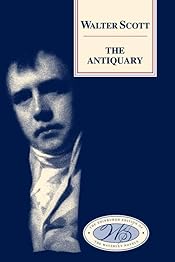
The Antiquary cover

We start in Edinburgh where the titular antiquary, Mr Oldenbuck, known as Oldbuck of Monkbarns, is awaiting the arrival of a coach to take him to South Queensferry to catch the tide there. He makes the acquaintance of a Mr Lovel, also to be travelling on the coach and on to the same final destination, the town of Fairport, near which lies Oldbuck’s estate of Monkbarns. Oldbuck is forever animadverting on the derivations of place names and the like and seeking out antiquarian antecedents for objects – and is often mistaken in his attributions. The usual longueurs and prolixity which beset Scott’s novels are again present, here exacerbated by the novel taking a long time to get into its stride. Different plot strands are set off and pursued and these appear at first to be almost occurring at random. Only about two thirds of the way through do the connections between several of the characters become apparent and that in a way which is immediately obvious to the modern reader but may well have been more of a novelty in Scott’s time. As with The Heart of Mid-Lothian the strands are eventually tied together a bit too neatly and in this case perfunctorily.

Scott here rather over-indulges in nominative descriptivism. We have mention of a Dr Dryasdust, the local minister is Mr Blattergowl, the bailiff Mr Cleansweep, Mrs Mailsetter deals with the post, the butcher’s wife is Mrs Heukbane, Mrs Shortcake is married to the baker, and there is a German con-man, Herman Dousterswivel.

Despite its title the book focuses more on the gaberlunzie (i.e. licenced beggar) Edie Ochiltree, than on Oldbuck. We first meet Ochiltree when he contradicts Oldbuck’s views about the presence of remains of a Roman camp on the latter’s estate by saying, “I mind the bigging o’t,” (in other words the structure’s origins lie within living memory) but thereafter he is the active force in many of the scenes. He also speaks in very broad Scots. This surely must have been disconcerting to Scott’s English readers on first publication, but it is of course the marker of his importance to Scottish literature.

Pedant’s corner:- on the inside cover flap; Lovell (the text always has Lovel.) The usual Scott renderings, sprung, sunk, sung, etc as per the Scottish usage of the time but here also run for ran. Similarly we have the usual stupified, but then, surprisingly, stupefaction. In one case a new speaker’s new paragraph is not indented. “‘He had had the pleasure,’ Lovel answered, ‘to see her at Mrs Wilmot’s, in Yorkshire.’” (Since it is Lovel who is speaking – about himself – should that “he” not be “I”? Or else remove the quote marks.) “No. I.,” (Scott’s punctuation?) At least three different spellings of ecstasy (two of them with an x,) invaasion (an explanatory note says this is the spelling in Scott’s manuscript. I can only think this indicates an idiosyncratic pronunciation by Ochiltree.) In the explanatory notes; “(who gave his name both to the Cameronian sect)” (????) Hary (Harry, as in Blind Harry, author of the poem The Wallace,) tansfer (transfer,) marriage marriage (unnecessary repeat of marriage.)

Football and the Bible

There is only one football team named in the bible.

Such is the claim anyway.

The relevant quote comes from Matthew 12.42:-

“The queen of the south shall rise up in the judgment with this generation, and shall condemn it:”

Notch one up for Dumfries’s finest.

In my present reading, Walter Scott’s The Heart of Mid-Lothian (which itself by way of a dance hall provided the name for another football team,) there is much talk of religion and quotation from the Bible. An explanatory note had this reference from Proverbs 17.3 which casts doubt on the declaration in the first paragraph of this post:-

“The fining pot is for silver, and the furnace for gold; but the Lord trieth the hearts.”

Granted the relevant noun would need to be capitalised to make the abbreviation truly apposite but then so does the QoS one. At any rate I’m sure many Jambos (see nicknames in the link’s sidebar) would concur with the sentiment.

The Persistence of Scott

My previous post’s title was of course a reference to the alternative title of Sir Walter Scott’s first novel Waverley otherwise known as Tis Sixty Years Since.

I am of course reading that author’s The Heart of Mid-Lothian at the moment which means he has been on my mind.

Scott’s influence continued to be felt long after his death. Edinburgh’s main railway station is named Waverley in his honour and there is of course the huge monument to his memory on Princes Street.

Scott Monument

On seeing this Belgian author George Simenon is supposed to have asked, “You mean they erected that for one of us?” then added, “Well, why not. He invented us all.”

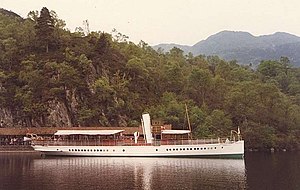
Also named after him is the main steamer on Loch Katrine in the Trossachs, the SS Sir Walter Scott, which was built by Denny’s of Dumbarton, dismantled, its pieces numbered, then the whole transported by horse cart to Stronachlachar on Loch Katrine where it was reassembled.

SS Sir Walter Scott
SS Sir Walter Scott

She is by no means the only ship with a Scott connection which I have sailed on.

The Heart of Mid-Lothian‘s main female character is named Jeanie Deans, a name previously familiar to me – at least in her second steamship incarnation – from several of those trips “Doon the Watter” that used to be so much a part of a West of Scotland childhood.

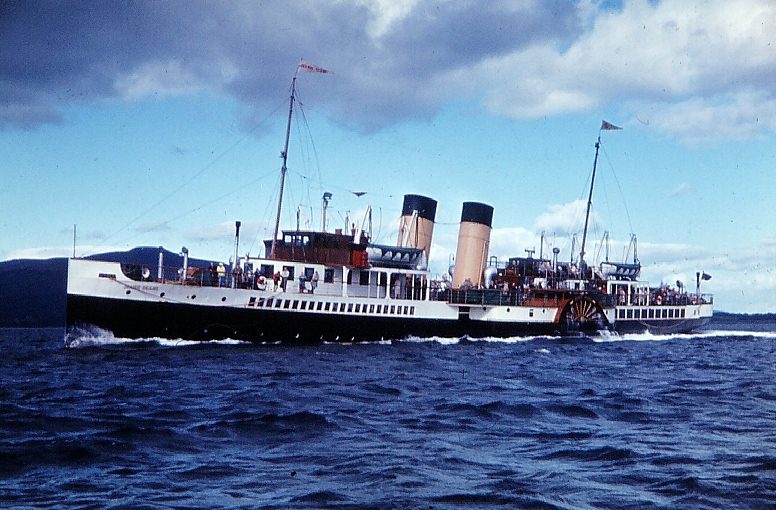
PS Jeanie Deans
PS Jeanie Deans

There was a short branch line (now long gone) off the main-line station at Craigendoran (about 8 miles from Dumbarton) which took trains right up to a platform on the pier where the ship would be waiting for its passengers to detrain and embark – usually for Rothesay. I believe something similar pertained at Wemyss Bay.

One of the delights of the trip was to descend into the lower parts of the ship to see the engines; mesmerising visions of gleaming, oiled steel and brass, powerful flywheels spinning, pistons thundering, regulators twirling. “Taking a look at the engines” was also used as a euphemism by those suitably aged gentlemen patrons who wished to avail themselves of the licensed facilities on board.

There was also an earlier PS Jeanie Deans. Indeed the North British Packet Steam Company and North British Railway seem to have named their ships almost exclusively after Scott characters. Have a look at this list of their ships, some of which were transferred to later operators.

Only one of these floating mini-palaces still exists. The second PS Waverley (built in 1949) is now the sole ocean-going paddle steamer left in the world and still carries out excursions from its base on the Clyde near Glasgow Science Centre, in the Bristol Channel, from London, the South Coast and Wales under the auspices of the Paddle Steamer Preservation Society.

PS Waverley at Ilfracombe

Waverley at Ilfracombe

If you can avail yourself of the opportunity to take a trip on the Waverley (or indeed the SS Sir Walter Scott, though she is much smaller and does not quite afford the full experience) I would urge you to do so.

free hit counter script