Brain Plague by Joan Slonczewski
Posted in Reading Reviewed, Science Fiction at 12:00 on 5 November 2020
Tor, 2000, 382 p.
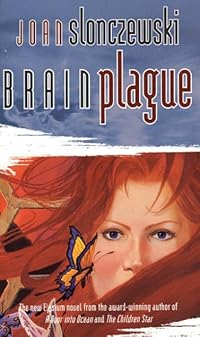
Since the events of The Children Star – the third in Slonczewski’s tales of The Fold – the people of Valedon have come to terms with the microzoöids found on the planet Prokaryon spreading through their population. With some hosts the tiny creatures are under control (usually by means of restricting access to the arsenic necessary for their survival but also via rewards of the chemical azetidine,) in others their proliferation runs rampant resulting in a disease (the Brain Plague of the title,) whose victims become zombie-like. A rogue human element known as slavers promotes fear in the population by abducting citizens to their concealed planet.
The book’s protagonist is Chrys (Chrysoberyl,) an artist who can see infrared. Initially she is struggling to pay her rent and keep painting and when she is introduced to her colony of microbes, which reveal themselves and communicate with their host by flashing colours in the host’s eyes, some of her former friends and associates withdraw from her. Since the hosts have power of life and death over them the microscopic creatures refer to their hosts as gods. They also have only a limited understanding of their hosts’ lifestyles.
Chrys’s colony, known as Eleutheria and to whose leaders she gives names corresponding to the colours with which they “speak” to her, inspires her work and her paintings become collectable. Her microbes are also mathematicians and allow her to gain a contract to refurbish a failing piece of architecture known as the Comb, whose ever expanding structure has become unstable. The colony members’ lifespans are short and they have their internal politics for Chrys to contend with.
There is plenty of Valedon politicking to occupy Chrys outside all this and some intrigue involving the slavers whose secret planet she is the first to be abducted to and return to tell the tale.
Brain Plague is 392 pages of fairly small font size print and continues Slonczewski’s trait of incorporating biological and chemical ideas into her SF. It is rewarding enough reading and deals with a common SF concern (alien invasion of the body) with an unusual slant.
Pedant’s corner:- shrunk (shrank,) “the stress must have wreaked its program” (wrecked, I think, [and I spell it ‘programme’,]) “the shear newness” (sheer,) “laying low” (lying low,) a missing quote mark at the end pof a piece of direct speech. “The sphere cut in, it’s the plane of section…” (The sphere cut in, it’s plane of section.) “She shined her light inside” (shone.) “‘Such an distinctive cut’” (Such a distinctive cut,’) “Chrys grasp his back” (grasped.)
