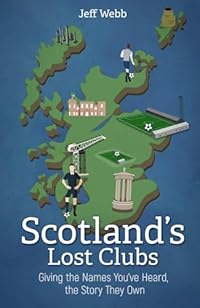
Giving the Names You’ve Heard the Story They Own
Pitch, 2021, 254 p, including ii p Bibliography.
It is a little odd that the introduction to this book focuses on a football club that isn’t lost at all – has in fact gone from strength to strength in recent years – but that club is the pioneer of football in Scotland, Queen’s Park, without which the history of Scottish football would have been different, and perhaps (though this is an unlikely altered history) not have started at all.
Then there is a chapter on the setting up of the Scottish Football League – at the prospect of which and of the impending professional status which it portended Queen’s Park balked, only relenting in 1899 – and its history up till its merger with the SPL to form the present SPFL.
There follow chapters on individual lost clubs starting with the first World Champions from Scotland, Renton, and of Vale of Leven both of whose stories a Son of the Rock brought up a couple of so miles away knows quite well. These clubs were both in the end victims of that professionalism which Queen’s Park stood against for so long. The Vale’s name, though, did not disappear entirely. After an interregnum where Vale OCOBA (Old Church Old Boys’ Association) played on their Millburn Park ground it was revived when OCOBA became a Junior Football club. (I have mentioned Junior football’s separate status several times before.)
Like Renton and Vale of Leven, Third Lanark won the Scottish Cup more than once. Formed as the Third Lanarkshire Rifle volunteers their heyday was in the late nineteenth and early twentieth centuries but their demise due to a reckless/unscrupulous owner (delete as appropriate) in the 1960s – their last game was a heavy defeat against Dumbarton at Boghead – was one of the saddest and potentially avoidable of the losses discussed in this book.
Arthurlie never reached the heights of a Scottish Cup win but enjoyed many seasons in the SFL before the financial crisis of the late 1920s forced them to resign. They can not really be described as lost though, since they seamlessly joined the Junior’s ranks – with some early success.
Cambuslang were founder members of the SFL, ending a creditable fourth in its first season but finishing second bottom the next and not being re-elected. They also managed to reach the Scottish Cup final once, only to suffer the biggest final defeat in the competition’s history, losing 6-1 to Renton in 1888. Like so many others they fell prey to financial problems due to travel costs.
At one time the town of Helensburgh had no fewer than five football teams – Victoria, Merchants, Hermitage Former Boys, West End and Helensburgh FC but only the last of those (and that the third club of that name) ever played in the SFL – in the short-lived Division 3 in the mid-1920s. They were at the top by one point when the league was dissolved and that disappointment resulted in the club folding.
Edinburgh’s earliest officially formed football club, St Bernard’s, started life under the name Third Edinburgh Rifle Volunteers but soon so much of the soldiers’ time was taken up with football that discipline had begun to slip and the military stepped back. The committee then took its new name from St Bernard’s Well by the Water of Leith. The club won the Cup in 1895 during a decade that also saw them have their most sustained success in the top Division of the SFL. After failing a re-election they were never gain to reach such heights (despite winning the Second Division twice) and had to be wound up when a deceased director’s loan was called in by the executors in 1942, having to sell their home ground, the magnificently named Royal Gymnasium, to pay the debt.
King’s Park were a club from Stirling which never made it to the top Division, though once, in 1928, narrowly missed out on promotion. Their demise can be directly attributed to one Adolf Hitler, as their ground, the original Forthbank Stadium, was hit by one of only two bombs to land on Stirling in the entire Second World War, (both dropped by a bomber trying to lighten its load to get back to base.) The explosion ruined the north terracing and made a 30-foot crater in the pitch.
Cowlairs were formed in the railway works at Springburn in Glasgow. Though not regarded as a top club they were nevertheless founder members of the SFL. The club’s stay lasted only that first season, as financial mismanagement saw them suspended for a time and their pitch was not maintained. After a few years outside the SFL the new Second Division’s formation saw them admitted but their second-place finish was to be their best. After one more season they were not re-elected and with no other league willing to admit them, haemorrhaging players and money, their fate was sealed.
Abercorn were a team from Paisley who were founder members of the SFL but only ever had a total of three seasons in the top division and not much more than that in Division 2. Their demise was due to lack of a fixed ground (five in total from 1879-1919) resulting in them having nowhere to play when their landlords refused to renew their lease in 1919.
Airdrieonians were the longest surviving of the clubs covered in this book. Founded as Excelsior FC in 1878 (changing to Airdrieonians in 1881) their glory days were in the early 1920s, finishing second in the top Division no less than four times and winning the Scottish Cup in 1924. They also managed a European Cup Winners’ Cup appearance in 1992 due to losing to champions Rangers in the Cup Final that year but lost to Sparta Prague 3-1 on aggregate. Their demise was due to new stadium requirements for admission to the top flight to which they aspired. Since their quaint Broomfield ground wasn’t suitable for adaptation the debts incurred on building a new one and the loss of spectators while sharing Broadwood in the interim crippled them. They folded in 2002.
Leith Athletic lasted from 1887 till 1955. Like St Bernard’s, living in the shadow of Hearts and Hibs cannot have been easy. They finished fourth in their first season in the SFL in 1892 but never reached that height again. Most of their SFL existence was in the Second Division but post World War 2 they were placed in the ‘C’ Division (which included reserve teams to which they objected.) They were thrown out when they refused to fulfil fixtures, folding in 1955. Ironically the season after that the ‘C’ Division was wound up and the non-reserve teams absorbed into Division ‘B’.
Clydebank has had two clubs of that name in the SFL. The first had relative success in and around the war years of 1914-1918 with several seasons in the top flight. It was the Depression of the late 1920s which did for them. The second came after the Steedman brothers’ attempt to move East Stirlingshire to the town, merging with Clydebank Juniors as East Stirlingshire Clydebank and playing for a season at their Kilbowie Park, was quashed by a court ruling. The Steedmans then carried on at Kilbowie by forming Clydebank FC, who were voted in to the SFL a year later. This club had better success than the earlier one till the decline of the town’s economy (the shipyards and Singer’s sewing machine factory having closed) forced them to sell the ground. Seasons at Boghead and then Morton’s Cappielow saw spectator numbers fall off a cliff – mainly in protest at the moves. The club didn’t actually fold though. It was taken over by the new Airdrie United, set up following on from the demise of Airdrieonians, who had both the money and the ground to house them.
Dundee Wanderers, formed by a merger of two of Dundee’s oldest clubs, Wanderers and Strathmore, had only one season in the SFL and in it managed to suffer the biggest ever defeat in league football, 15-1 by Airdrieonians. They then had a few seasons of non-SFL league football at Clepington Park before the lease was snatched from under them by Dundee Hibernian (now called Dundee United.) In return for this treachery, Wanderers club members removed certain items of equipment from the park – including the small grandstand. Only the grass was let. Homeless for two years, they lost fans and money, and even at their new home in Lochee couldn’t survive.
Armadale had a decade in the Second Division after it was revived following the Great War but were another club which succumbed to the Great Depression, not having enough income to provide opponents with their match guarantee fee.
The original Edinburgh City formed as amateurs in 1928 and applied to join the SFL in 1931. Surprisingly they won the vote handsomely but life in the League as an amateur side – when Queen’s Park had the draw of playing at Hampden to entice the best players – was too difficult. Only twice did they not finish bottom of the pile. Post World War 2 they were assigned to the ‘C’ Division but moved to the Juniors in 1949. In 1955 they lost the lease of City Park and decided to stop playing football. Their name survived as a social club though, and was allowed to be taken over by Postal United in 1986. That club has since advanced to the SPFL. (However their permission to use the name has been revoked since this book was written.)
Gretna receives a somewhat extravagant 30 pages perhaps because its story is a classic rise and fall, both a potential encouragement and a warning. Formed after Word War 2, most of the club’s existence was spent playing in the English football system and in 1983 it became the first team based in Scotland to play in the FA Cup for nearly a century. It reached the First Round proper in 1990 and made a final appearance at that stage in 1993. Its success in the Northern Premier League would have meant much higher travelling costs and so application was made to the SFL, with two disappointments in 1993 and 1999 before succeeding on the demise of Airdrieonians in 2002. By this time millionaire Brooks Mileson had become Gretna’s owner. His backing meant the club went on a meteoric rise through the divisions, played in a Scottish Cup Final and made a UEFA Cup appearance. It was already beginning to fall apart when Mileson fell ill and it later turned out his fortune had evaporated. In his lifetime he had given money to or in various ways sponsored around 70 football clubs. His stewardship of Gretna, though, meant that a hitherto successful club existing within its means went under. Meteors do tend to burn out.
We end with portmanteau chapters containing brief overviews on clubs from the West of Scotland; Beith (in Ayrshire,) Dumbarton Harp, Galston (again Ayrshire,) Johnstone (by Paisley,) Linthouse (like Cowlairs connected to the Springburn railway works,) Northern (also from Springburn,) Port Glasgow Athletic, Thistle (South Glasgow): the South of Scotland; Mid-Annandale (Lockerbie,) Nithsdale Wanderers (Sanquhar,) Solway Star (Annan): and the East of Scotland; Lochgelly United, Bathgate, Bo’ness, Broxburn United, Clackmannan, Dykehead (Shotts,) and finally current clubs, Ayr United (merged from Ayr FC and Ayr Parkhouse,) Dundee Hibernians (Dundee United,) Peebles Rovers, Royal Albert (from Larkhall) who were the first team in Scotland to be awarded a penalty kick – which was scored by the improbably named James McLuggage – and Meadowbank Thistle (formerly an Edinburgh works side, Ferranti Thistle, but now Livingston FC.)
Some of the clubs mentioned above have not disappeared per se since they morphed into or merged to become Junior clubs or otherwise evolved as noted above. Clydebank’s fans formed a phoenix club (Clydebank) as did those of Gretna (Gretna 2008) while a new Leith Athletic was set up in 1996. With the movement of Junior clubs into the pyramid system all survivors have the opportunity to progress to the highest tiers once again.
Pedant’s corner:- On the inside front cover; “27 Mid-Annabelle” (Mid-Annandale.) Otherwise: “cities sprung up” (sprang up,) the text implies Queen’s Park created the passing game. I have read elsewhere that that honour belongs instead to Dumbarton FC, “played 22 matched” (matches,) “outside of (several times, just outside, no ‘of’,) attract (attract,) “the creation a Scottish league” (creation of a,) “had its application their join” (application to join,) “a very credible draw” (x 2, creditable,) “as pulled off something of a coup” (as they pulled off,) “were starting to be need” (no ‘be’ required,) “from the get-go” (get-go is a USian expression, ‘from the start’ is much more elegant,) “but that the AGM came around” (but when the AGM,) “they finished on the same points told as” (points total as,) “to not have” (not to have,) “seemed too be good” (seemed to be good.) In the East of Scotland section; Bathgate (ought to be 2: Bathgate with subsequent numbers in that section advanced by one,) “Shell oil industry” (shale oil,) “pull their resources” (pool,) “off of” (just ‘off’; no ‘of’.)