Bright of the Sky by Kay Kenyon
Posted in Reading Reviewed, Science Fiction at 12:00 on 25 November 2025
Pyr, 2008, 453 p.
A catastrophe in a spaceship traversing a Kardashev tunnel, a kind of wormhole, leads to the discovery of a wrong kind of neutrino – wrong angular momentum, wrong spin state, “‘Reversed actually,’” – evidence of another dimension, a parallel universe.
Minerva Company, which operates the tunnels, now realises that its ostracised former employee, Titus Quinn, who had turned up a few weeks later and light years away from the disaster which destroyed his ship – but with memories of being in a parallel universe – might have been telling the truth.
Eager to preserve the Company’s business (failures in transit not being good for that) they persuade him to return to negotiate on their behalf to secure ways to make interstellar travel easier; shortcuts, basically.
Quinn has his own reasons to return; both his wife, Johanna, and daughter, Sydney, had been transported with him but they became separated and remained stranded. His Jacobson’s organ is altered to enhance his sense of smell before he undergoes the procedure. This is a curious detail of the story but not much is actually made of this enhancement latterly.
The narrative then takes a step change as he ventures once more into the Entire, a vast universe lacking stars, with many different habitats but all seemingly in the one plane, lit by the sky-bright, a churning river of light, constantly changing, yet always the same, ruled by enigmatic creatures known as Tarig, one of whom he had assaulted in his previous sojourn. For the Entire’s power sources we are told plasma cells harvest photons from the bright. “The Tarig had remade photosynthesis in inorganic form. It made Earth’s fusion technologies seem crass by comparison.”
Kenyon seems to have modelled the Entire – at least the parts where Quinn journeys – on China. The clothes, names, and some of the inhabitants’ customs at any rate, fit that template.
Several chapters are preceded by extracts from Entire doctrine, The Radiant Way. Its first tenet is that knowledge of the Entire must be kept from the non-Entire. Quinn faces an uphill struggle on that count, then, as do those who knowingly help him. Much of the book is taken up with Quinn’s travels, face altered and using the name Dai Shen, to the power centre. Within the Entire, Quinn’s – our – universe is known as the Rose. It is peopled by various different sentient beings, some of them supposedly modelled by the Tarig on creatures from the Rose. The Chalin seem to be all but indistinguishable from humans.
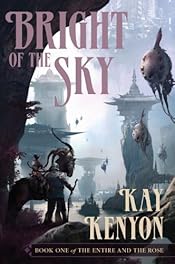
Several chapters deal with Sydney’s continued existence in the Entire. She has been dispatched to a region inhabited by horse-like sentients called the Inyx, telepathic animals who need riders but insist they be blinded, a fate Sydney has suffered. She is able to ‘see’ though, through the mind link with her mount. Her personality is beginning to alter the Inyx’s relationships with their riders and potentially that with the Tarig.
There are hints that Johanna, too, may have survived.
Though it is not really like it at all the whole thing reminded me of Mary Doria Russell’s The Sparrow. Maybe it was just that First Contact via a sole human thing.
Nothing is resolved at the end, of course. How could it be? There are three instalments of Kenyon’s saga to go.
Pedant’s corner:- Written in USian, “orthopositroniums’ missing energy” (orthopositronium’s?) “intended accomplish” (intended to accomplish,) aerie (USianism for eyrie,) garroted, garrote, garroting (several times, garotted, garotte, garotting) a capital letter on the word following a colon (several times,) “in deeply accent English” (deeply accented.) “A ochre-colored bird” (An ochre-colored [but preferably ochre-coloured,]) “sent simulacra, automatons” (automata. And why use the Latin plural of simulacrum but not the Greek one of automaton?) “murmured at Yulin side” (at Yulin’s side,) a capital letter following a comma when a question was embedded in a piece of direct speech; it needs internal quotation marks instead,) “they saw what one of the cameras had captured Quinn from a low angle” (they saw that one of the cameras … ,) “like an aurora borealis made of knives” (there’s no need for the borealis here; ‘like an aurora made of knives’ would be fine,) “a contingent of Tarig were swarming” (a contingent of Tarig was swarming,) “‘tell us the rest it’” (tell us the rest of it.)
Tags: Bright of the Sky, Kay Kenyon, Science Fiction, The Entire and the Rose

Ian Sales
25 November 2025 at 20:48
I think I liked this a lot more than you did . I wrote a long review here: https://medium.com/@ian-93054/bright-of-the-sky-kay-kenyon-eeb506c6813a
jackdeighton
25 November 2025 at 23:08
Ian,
Well, I didn’t dislike it.
And I wouldn’t disagree with what you say in your review.
It was obvious though that Kenyon’s interest was in the Entire. (And why not? She invented it.) But I felt that the stronger bits of Bright of the Sky were the ones set in the Rose.
It’s possible my assessment will alter when (or rather if, I’ve only bought Book 1) I’ve read the latter three books.