Dream London by Tony Ballantyne
Posted in Fantasy, Reading Reviewed, Science Fiction at 12:00 on 23 April 2016
Solaris, 2013, 347 p.
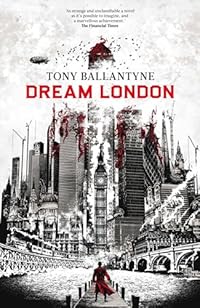
London is changing, expanding upwards and outwards, shape-shifting. In this strange new city salamanders munch beetles, the Thames is miles wide, blue monkeys roam the treetops and roofs, and a woman can say, ‘I didn’t used to be a virgin,’ without sounding ridiculous. The inhabitants too are changing, “Dream London did something to the people here. It brutalised the men …. It was softening the women.” On its ever widening two rivers, the Thames and the Roding, sail- and steamboats ply the waters, one of the only means of access. The rail systems are a mix of steam and electric power. As well as drifting into the past technologically this London seems to have the sexual and social politics of the 1950s or earlier, “the women had to hope that some man would look after them” or were “on their knees as whores or cleaners.” In addition “‘Dream London likes its Asians to dress like this’ – ie “ethnically” – ‘and run curry houses,’” and smoking is endemic once more. Not the least of its oddities is an area known as The Spiral where you can look over the edge of a precipice to see a tower growing up from another city to meet it. Like a black hole Dream London is impossible to escape. Journeys to do so twist and turn and lead back to their starting points.
Unfortunately our narrator Captain James Wedderburn is something of an exploitative sexist and minor drug pusher. (Not to mention a bit of a fraud. In his army career he never made it beyond Sergeant.) At several points he is taken to task for exploiting his workers but still remains a relatively unsympathetic character even after he gets the chance to write down his new persona on a parchment on the Contract Floor of the Angel Tower and (SPOILER) doesn’t sell his – or rather his friend’s – soul. Captain Wedderburn by his own estimation is tall and good looking. “He has messy dark hair, a knowing grin and a tendency to talk about himself in the third person.” At first he is torn between two factions wishing to enlist his aid, neither of whom he is particularly keen to serve. These are the mysterious Cartel, which is backed by foreign governments keen to see the end of Dream London and willing to do almost anything to achieve this, and Daddio Clarke and his Maicon Wailers – whose henchmen have eyes in their tongues and count in their number big, burly Quantifiers and a particularly foul-mouthed six year-old girl called Honey Peppers.
In the early chapters Wedderburn is handed a scroll containing his fortune, a scroll whose predictions start to be borne out. “ I lived in a city where the buildings changed every night, where people had eyes in their tongues, where women turned into whores over three weeks. Was a scroll that told my fortune so fantastic?” There is also a nod to prior art with its mention of a slow glass camera – called a shawscope. A picture taken by this means shows London’s parks to be strong areas of indeterminacy.
In Wedderburn’s excursion to the Angel Tower on the Cartel’s behalf we discover that Dream London’s mathematics has no prime numbers. On the Tower’s Counting Floor Wedderburn comes to recognise the order one, red, two, blue, a feeling of setting out on a journey, three, a feeling of fulfilment, yellow, four, five, orange, six, cyan, seven, eight, green, nine, purple, ten, eleven, indigo, twelve, thirteen, fourteen, ochre, fifteen, olive, sixteen, chocolate, seventeen; which sequence also serves as Dream London’s chapter numbers. (Despite this, later we are told there are 98 squares in Snakes and Ladders Square, numbered from 2 to 99.) He later visits the tower’s Writing Room, where the changes are inscribed onto paper. (This bears similarities to the written city in Andrew Crumey’s Pfitz.)
This is an outright fantasy you would think, yet Rudolf Donati whose body has been separated into its component parts but is still alive (it make sense when you read it) says, “‘Dream London isn’t a fantasy, Jim, it’s science fiction.’” [I think I spot a riff on Star Trek here.] “‘What you see here, Captain, is what you get when science is explained by artists! Something which looks beautiful, but doesn’t make any sense.’” Cynthia, a woman Wedderburn meets on a train, was a member of a team who had been ‘looking for sub-atomic particles, but we were doing it using pen and paper. We wanted to describe things smaller than atoms. Things so small that you can know where they are, or where they’re going, but not both at the same time,’ which is of course a statement of the Uncertainty Principle. Ballantyne has found an elegant way to illustrate this fictionally in his account of Wedderburn’s train journey through London, never quite getting to where he wants to go.
Then again all this could be an allegory of how life in the real London in our world has been transformed by oligarchs and financial interests. Wedderburn says, “‘when people talk about choices, it’s usually the people who are in charge who are setting the alternatives,’” and “‘all those people who earn a living off the sweat of someone else’s brow. Dream London bought and sold them all.’” Anna, the daughter of one of Wedderburn’s friends and despite her peripherality the most interesting character in the novel – at least until she fades somewhat towards its end – tells him, “The only thing Dream London fears is that we might ever join together to fight it. It wants us to turn in on ourselves, rather than having us reach out to each other.” Wedderburn’s friendly stalker, Miss Elizabeth Baines – to whom he was revealed in a fortune parchment to be her future husband – says, “‘Dream London wants every man to do nothing. To be weak-willed and selfish. What it doesn’t want is people who do what’s right despite getting paid no notice,’” and another friend Amit, “‘There were always enough people in London to resist its influence, if only they chose to do so.’” Note that “London”, rather than Dream London.
Towards the novel’s climax Wedderburn begins to feel hope when he hears, “The sound of so many people doing the same thing. Of people united to a common cause, and not expressing themselves freely.” This apotheosis of togetherness is a brass band, the culmination of a series of references throughout the book to music and musicians.
Misgivings about Wedderburn’s occupation and attitudes aside Ballantyne writes well and has had an intriguing vision. Though to have your narrator say of his escape from a dilemma, “I’ll skip how I did it though,” (on page 201) – even if he later reveals he did not in fact escape – is something of a hostage to fortune.
Wedderburn’s most serious revelation though is that, “I was nothing more than misdirection, a sideshow … the magician’s assistant drawing the eye whilst the real work took place elsewhere.” With Dream London Ballantyne certainly draws the eye.
Pedant’s corner:- “‘If the Cartel succeed’” (succeeds; but this was in dialogue.) “‘This was a half-hearted threat if ever I heard of one’” (if ever I heard one,) a brace of pheasants (the phrase is usually a brace of pheasant,) wharfs (wharves?) “to ensure that traveller’s return” (context implies travellers, plural,) “seeing her around her before” (around here,) Hieronymous Bosch (Hieronymus.) “There were a number of suits hanging” (there was a number of suits,) Miss Baines’ face (Miss Baines’s,) he didn’t give me chance to speak (a chance,) sat (seated; or sitting,) 839th (previously and subsequently all such ordinal numbers were superscripted, as in 839th,) “and a random selection of numbers were” (a random selection was,) Honey Peppers’ (Honey Peppers’s, several instances,) “as about authentic as” (about as authentic as,) your your, less (fewer; but it was in dialogue,) Moules’ (Moules’s.) “The sign … was written in a particularly curly font. It read ‘ . , .’” (contained no text in curly font; there was nothing on the page but ‘. , .’ A joke about Dream London?) “as soon as saw the place” (as soon as I saw the place,) “Never let it be said the Captain James Wedderburn” (said that Captain…,) lay low (lie low.) A group of drummers were playing (a group was: several instances of a group were,) a large crowd were waiting (a crowd was,) stood in a pool of light (standing,) a missing end quote, out back (is USian: at the back,) “‘It’s every man for themselves in the new world’” (it was dialogue but even so it should be every man for himself; as it was on the next line,) “I could use a man like you” (USian: I could do with,) “‘I stared at building’” (the building,) Baines’ (Baines’s,) much a of a problem (much of a problem,) then the screaming begin (began,) “‘their minds can’t find your way back to their bodies’” (their way back,) I had strode (stridden,) Honey Pepper (Honey Peppers,) the drummer sounded taps (taps is a US military signal, not a British one, and it’s a bugle call, not a drum roll,) “Miss Elizabeth Baines’shouse” (I note the different use of the apostrophe here compared to Baines’ above, and the lack of a space between Baines’s and house,) unphased (unfazed.)
Tags: Science Fiction, Tony Ballantyne
