The Art of Hunting by Alan Campbell
Posted in Alan Campbell, Fantasy at 15:00 on 3 December 2013
Book Two of The Gravedigger Chronicles. Tor, 2013, 433 p

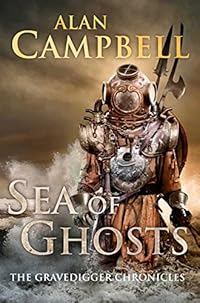
This retains many of the characters from Campbell’s previous novel in this series, Sea of Ghosts. The only Gravedigger left, though, is Colonel Granger, now more or less in the thrall of a replicating sword which produces copies of Granger to enhance his fighting powers. This takeover by the sword has the consequence that he dies in the novel (twice over) but he is still nevertheless a participating agent in the story at the novel’s end. This is, then, a fantasy after all. Other familiar names are Ianthe (Granger’s daughter,) Briana Marks and Ethan Maskelyne. Ianthe is now engaged to the Unmer Prince Paulus Marquetta, who may have wooed her merely to earn her protection. She was the power whereby the Unmer defeated their enemies the Haurstaf in Book One.
Various plot strands thread the novel. Marquetta is on a quest to recover the lost Unmer throne of Losoto, Granger to throw off the sword’s influence, Maskelyne to uncover a mysterious Unmer artefact and there is the entropath (an “elder god”) Fiorel’s wish to revenge himself on Argusto Conquillas who killed his daughter Duna in the prologue. These all come together at the climax with a sort of tournament of sorcery. In addition we find out the true nature of Granger’s, and so also Ianthe’s, lineage.
Along the way we have some philosophical aperçus. Of a particularly hideous bodily alteration:- “The human mind can come to accept even the most grievous change.” Then, “If every cell and every drop of blood … in your body had been replaced. Every memory. Would you know?”
The issues of proof reading which I noted in Sea of Ghosts were mostly absent here, thankfully. The first did not come till page 224 “He wondering” has a “was” missing, then (on page 225!) “When the reached the lamp.” Campbell does, though, make the common attribution of maw as mouth rather than stomach (which I suppose we’ll have to accept as the new orthodoxy as it appears as the first definition in dictionary.com) and there is a single misuse of “whom”.
The author’s powers of description are as prodigious as ever but as the second in a (presumed) trilogy The Art of Hunting does have a slight sense of marking time. In particular it lacks a firm conclusion. But there has to be something to make readers wish for a third volume. More of the engaging character of, Siselo, Conquillas’s young daughter would be a good thing.
Fantasy is not really my thing, but Campbell can write.