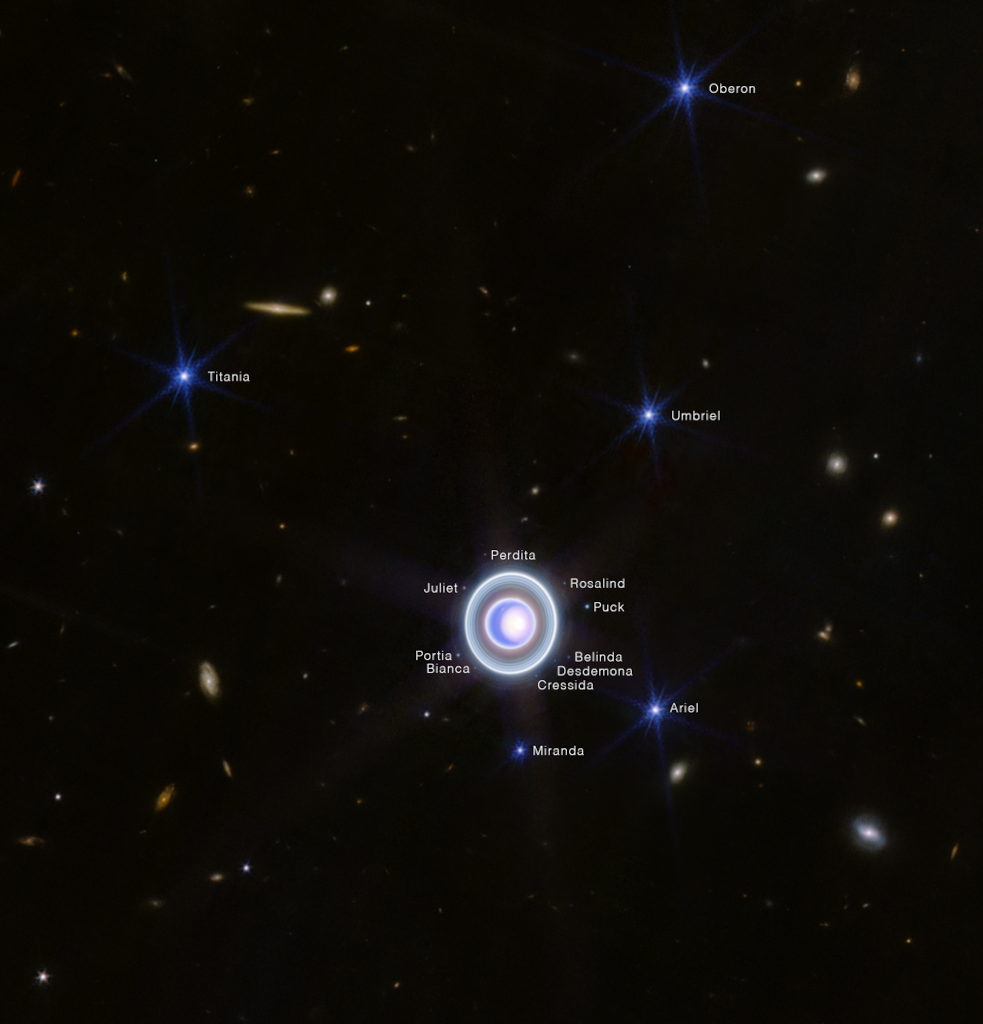
From Astronomy Picture of the Day for 29/12/23. This is an image of Uranus and some of its moons taken by the NIRCam (Near-Infrared Camera) on the James Webb Space Telescope. Uranus’s rings are also clearly visible. These moons are all named after characters in Shakespeare plays.
It never fails to astound me we can view such sharp images of faraway objects.
From YouTube via Astronomy Picture of the Day for 30/11/21.
A time-lapse video of Uranus and its four largest moons Titania, Oberon, Umbriel and Ariel, captured by the Bayfordsbury Observatorybased in Hertfordshire, England. The whole sequence takes up four hours in real time.
The cross of the diffraction spike is an artefact of the telescope used.
The apparent movement of Uranus is actually due to the orbit of Earth round the sun, changing the angle of view. The diffraction spike’s rotation appears because of the rotation of the Earth.