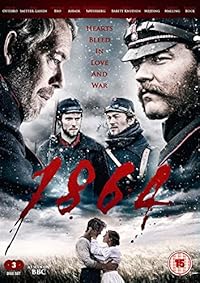
When this Danish TV series – the most expensive production in Danish television history – was first trailed on the BBC and I saw the blue uniforms I thought it would be about the War Between the States (known on this side of the Atlantic as the American Civil War) as the date fitted. I was immediately interested. I’ve read a lot about that conflict and watched the Jim Burns TV series several times. Looking more closely I realised that I didn’t recognise the painting shown on the trailer or the figures within it (I most likely would have for an American Civil War painting) and of course the uniforms’ details weren’t quite right.
I was therefore even more intrigued when it dawned the series was about the Second Schleswig War as that was something I knew vaguely about from History, at school. Once read, who can forget the comment the UK Prime Minister at the time, Lord Palmerston, made about the intricacies of the Schleswig-Holstein question – which in the series was uttered to that fine actress Barbara Flynn, in the person of Queen Victoria – that there were only three men who ever understood it; the Prince Consort, who was dead, a German professor who had gone mad and Palmerston himself, who had forgotten all about it?
As presented in the series, the war seems to have been provoked by Denmark in a fit of collective insanity. The programme, which has been criticised for historical inaccuracies (it would be difficult to portray any conflict televisually without some of that I’d have thought) certainly presented the Danish Prime Minister, Monrad, as an utter nutter. There seemed to be an element of hysteria in the air that prefigured the Germany of 1939. (Then again there was widespread welcome to Britain’s declaration of war in 1914, so no need to point fingers; except the UK hadn’t sought that conflict – at least not directly.)
However the dire results of the Second Schleswig War for Denmark meant that, to that country’s credit, no Danish military action outside its frontiers again took place until the NATO bombing of Kosovo in 1999.
Scenes were shown from both sides of the conflict and also the sidelines as Palmerston affected to intercede. The subtitles were no intrusion (1864 went out in the BBC 4 European detective slot on Saturdays at 9 pm.) As near as I could tell each nationality in the series spoke in its own language. (I have a smattering of German but no Danish except what I could glean from the dialogue’s similarities to German, English and, occasionally, Scots.)
For the series the necessity of introducing a human aspect to the conflict in the shape of estate manager’s daughter Inge and the two brothers Laust and Peter, with whom she has a special bond, allowed the introduction of those perennial literary concerns, love, sex and death. There was love to be sure, but not much sex – only four scenes as I recall, three of them having not much to do with love, plus another featuring boys attempting to masturbate – but enough death and destruction to slake anyone’s desires. The battle scenes were impressive – and visceral.
Overall the series was magnificent television, well worth checking out if you didn’t catch it, but I thought the elements of mysticism involving one of the soldiers from the village were unconvincing and the framing device wherein a disaffected young woman from our century sent to his house for a form of community service helps read out Inge’s memoirs to an old man (who is Inge’s grandson) was perhaps unnecessary, though it did give the sense of consequences cascading down the years and a contrast to the privations of the soldiers of 150 years earlier.
When I last looked in the BBC shop, the DVD of this was out of stock but the Blu-ray was available.