World Football Club Crests by Leonard Jägerskiöld Nilsson
Posted in Dumbarton FC, Football, Reading Reviewed at 12:00 on 12 January 2026
The Design, Meaning and Symbolism of World Football’s Most Famous Club Badges, Bloomsbury Sport, 2018, 255 p. First published by Pintxo Förlag, Sweden, 2016.
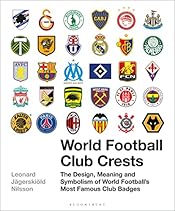
This book does exactly what its subtitle suggests, exploring the history of football club crests (that is what are called badges in the UK) or club emblems used on shirts, programs and stationery.
The contents are divided by country. There are 27 English club emblems discussed in detail, 12 each from Spain, Italy and Germany, 9 from France, 20 from the rest of Europe, 6 US clubs, 3 Australian and 5 South American. The entries give a potted history of the badge and (some of) its variations – many clubs have not kept a history of the changes – that club’s date of founding, its present stadium and capacity, its nicknames plus names of selected historic players, along with illustrations and descriptions of the relevant badge’s evolution.
As an addendum 126 “notable crests” are illustrated with the relevant badge, founding date, stadium and capacity, nicknames and country.
Sadly, despite its historical importance as the first outright winner of the Scottish League* and its badge depicting an elephant with a castle on its back Dumbarton FC’s striking emblem is not included. I note that Coventry City’s badge also has an elephant and castle and is given as one of the notable crests.
Manchester United’s historic players’ list contains Bobby Charlton and George Best but does not include Denis Law (though he appears with Derek Dougan in a photo on the Wolverhampton Wanderers pages) Sunderland’s list misses out Len Shackleton (I know a Mackem whose favourite, oft-repeated, football tale relates to him.) Tottenham’s omits Danny Blanchflower. I first supposed the author is perhaps too young to be aware of these illustrious forebears but Charlie Buchan is in Sunderland’s list and he predates Shackleton by twenty plus years.
One of Aberdeen’s nicknames – along with ‘the Dons’ and ‘the Reds’ – is said to be ‘the Dandies’. I must confess that I had never heard of this though it does appear on the club’s Wikipedia page.
This is an agreeably idiosyncratic way of discovering something of the histories of the various clubs discussed.
*Neither is that of the first winners of the (English) Football League, Preston North End, though that too is fairly distinctive.
Pedant’s corner:- The author is Swedish and the book’s first publication was in Sweden so it is perfectly understandable that some infelicities should occur. No translator is listed so the author may have performed that function himself. I noted a misplaced comma, “the claret and blue colours was the main motive” (the claret and blue colours were the main motif,) “the 1997 Champions’ League sinal” (final,) “forceably relegated” (forcibly,) “(1963/640” (1963/64,) “the Ukraine” (just ‘Ukraine’.) Arguabaly (Arguably,) “one star resembles ten titles” (one star represents ten titles.)


