Archives » Peter Higgins

Radiant State by Peter Higgins

Gollancz, 2015, 286 p.

“For centuries the Vlast had wiped histories away. The stroke of a bureaucrat’s pen created unpersons out of lives and made ruined former people the unseen, unheard haunters of their own streets.”

Higgins’s Russian inspired Wolfhound Century trilogy (I have previously reviewed the first and second instalments) is a commentary of sorts on the relatively recent history of that country. While adopting a mad whirlwind of a story arc of its own, a mix of realism and fantasy, it also has roots in Russian myth and folklore. The sentences quoted above could be a complete description of the setting if the fantasy elements were ignored but they are integral to Higgins’s vision. The three books are also unmistakably about Russia itself even if Higgins is writing about a Russia that never actually existed.

In the first part of Radiant State the Vlast Universal Vessel Proof of Concept is about to blast off for space. Literally – it is propelled by the detonation of atomic bombs beneath its pusher plate – though the actual propellant is the bombs’ casings of angel flesh pulverised to plasma by the explosions. The poor human occupants of Proof of Concept are however destined never to return to Earth. The ship, as its name suggests, is a prototype for a project to hurl the Vlast to the stars and domination of other planets.

Characters familiar from the previous two books reappear, Visarrion Lom, Maroussia Shauman, Elena Cornelius, Eligiya Kalimova. Josef Kantor – in the guise of Osip Rhizin which he had adopted in the previous book, Truth and Fear, where he saved the Vlast from defeat at the hands of its traditional foe The Archipelago – is now head of state, overseer of a vast apparatus of repression and control. “Rhizin had tens of thousands of security officers but trusted none of them because he knew what kind of thing they were and knew they must themselves be watched and kept in fear.” In the sidelines, lurking under a mountain, is the remnant of the supernatural creature Archangel, waiting to be loosed from its bonds. The main thrust of the plot, though, is Lom’s search for proof that Rhizin is Kantor and of the nature of the acts which brought him to power and keep him there.

If I found the fantastic portions overdone (I nearly always do) they are very well written, sometimes even understated, which is all to their good. In the realistic scenes Higgins is utterly convincing. His writing, while not straightforward, is almost without flaw. This is surely how it is to live in a totalitarian society. Even minor characters read as if they are real people, in all their complicity.

My only reservation is about how relatively easy it is in the end for Rhizin to be overthrown. But then again Lom has what is in effect supernatural help. Notwithstanding that, it is refreshing to find Rhizin’s removal from power taking place with no violence involved.

This trilogy just got better and better as it went on – not a usual comment on the form.

At one point Higgins uses the impeccably Scottish word smirr, at which I rejoiced, but it was in the phrase “smirrs of mist.” Technically smirr isn’t actually mist, its droplets are too large. Instead it is an extremely light, but persistent, rain; lighter than drizzle, but much more penetrating.

Pedant’s corner:- “memorising layouts and procedures she already knows by heart” (if she already knows them by heart she has already memorised them. I think Higgins meant she was reinforcing her knowledge.) “More than one of them wants to see failure today” (‘more than one’ is plural, hence, want to see.) “‘And always we have always driven them out’” (has one ‘always’ too many,) a missing full stop, Cornelius’ (Cornelius’s,) sunk (sank,) “come here very morning” (every morning,) pantoufflard (pantouflard?)
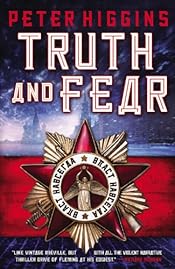
Truth дnd Feдr by Peter Higgins

Orbit, 2014, 366 p.

 Truth дnd Feдr cover

I wasn’t too taken with Higgin’s scenario in the first volume of his trilogy, Wolfhound Century. However, I realised early on on our recent cruise that I would probably be a touch short of reading matter and so was pleased to find this in the ship’s library, especially as I have the third book on my tbr pile.

Following on from the death of the Vlast’s leader, the Vorozhd, in the previous book, Vissarion Lom and Maroussia Shauman are continuing their search for the Pollandore, while trying to dodge the attentions of the Vlast’s security forces. Its security chief Lavrentina Chazia, who has designs on full power, has the Pollandore in confinement in the Lodya. Chazia has discovered that while her focus has been on supernatural eminences a secret project on the remote province of Novaya Zima has produced a technological weapon of devastating power. This project she hijacks by eliminating its instigator. In line with the book’s “Russian” background there are some scenes here which seem to be based on the Great Patriotic War. As the Vlast’s war with the Archipelago has not been going well and its forces are now capable of bombing the capital, Mirgorod, this new weapon shapes up to be a timely development.

Lom and Shauman are arrested but then broken free due to the intervention of shapechanger Antoninu Florian – a kind of supercharged werewolf. But Shauman is recaptured. Lom and Florian chase her down to Novaya Zima to where Chazia has taken her. Meanwhile the supernatural entity, Archangel, whose thoughts are rendered in italics is pursuing the Pollandore in order to destroy it. When the old hierarchy abandons Mirgorod, Josef Kantor takes charge in the guise of General Rhizin and puts the new technology to terrible use.

Higgins writes well and knows how to keep the reader turning the pages yet despite copious incidents there is a sense in this volume of marking time. Among other things, Elena Cornelius and her children are left hanging. There is, of course, that third instalment of Higgins’s trilogy to go but I am now intrigued enough by Higgins’s scenario not to leave it too long.

Pedant’s corner:- “the taste of … benzine” (no such usage in English now exists; benzene, yes, but that’s not meant here. Petrol possibly was.) “Lom had to listen the message three times” (listen to the message,) “spread out a chart out” (only one “out” needed,) “a group of seamen were playing cards” (a group of seamen was playing cards,) “just to breath it” (breathe it,) “folding his unconscious and desperately injured body in her arms” (holding makes more sense,) “to not let him die” (not to let him die,) epicentre (Sigh. it was a centre, not an off-centre,) “radios,.gramophones” (an extraneous full stop there.) “They saw women in overalls and headscarves worked at asssembly lines” (working at assembly lines.) “The hour hand on Lom’s watched crept” (watch.)

Wolfhound Century by Peter Higgins

Gollancz, 2014, 307 p

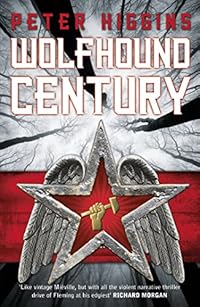
 Wolfhound Century cover

Investigator Vissarion Lom is bobbling along in the regional city of Podchornok seeking out dissidents when he is summoned to the capital city Mirgorod and there tasked with catching a terrorist. The setting is clearly based on Russia, characters have patronymics, the currency is the rouble, distances are measured in versts, the iconography of the cover is Soviet. A secret service head called Lavrentina (Chazia) adds to the impression. But it is a strangely altered Russia, named Vlast, ruled not by a Tsar nor a General Secretary, but by a Novozhd, and perpetually at war with a polity called the Archipelago. Moreover, an Archangel lies imprisoned in the countryside potentially threatening the future but first it has to ensure that the Pollandore, the vestige of an older voice which can undo the Archangel’s vision and is capable of altering reality, is destroyed. Lom has a piece of angel flesh embedded in his forehead “like a blank third eye”, giving him powers to move the air. There are giants.

It is a curious mix. The flavour of the novel is a bit like reading Joseph Conrad, the feel of the society it depicts like late Tsarist era Russia, but there are sub-machine guns. I found the thriller aspect of it to be too conventional, the circles of contact of Lom’s suspects too restricted and their connections too easily uncovered by him but it is an unusual fantasy scenario, all the more welcome for not being based on a mediæval template.

To be sure there is occasional “fine writing” but I’m afraid I lose patience when extra-human powers come into things, although such content may be true to its Russian inspiration. A more major complaint is that the novel didn’t end. An immediate threat was dealt with but the Archangel and the Pollandore were still extant. And quite why it is entitled Wolfhound Century remained obscure. If I see its sequel in one of my local libraries I might pick it up; otherwise, no.

Pedant’s corner:- “He should have waited. Showed his papers.” (Shown,) “his cap pulled down tight down over his forehead (only one down required,) and and (only one and required,) miniscule (minuscule.) “Its not on any map” (It’s,) dikes (USian? dykes,) “broken staithes and groynes” (staithes?) “with the trunk on it back” (its back,) a missing full stop.

free hit counter script