Posted in Astronomy at 20:00 on 21 August 2023
Does this somewhat eerie image, from Astronomy Picture of the Day for 19/8/23, depict Saturn and one of its moons? Or is it even from another solar system?
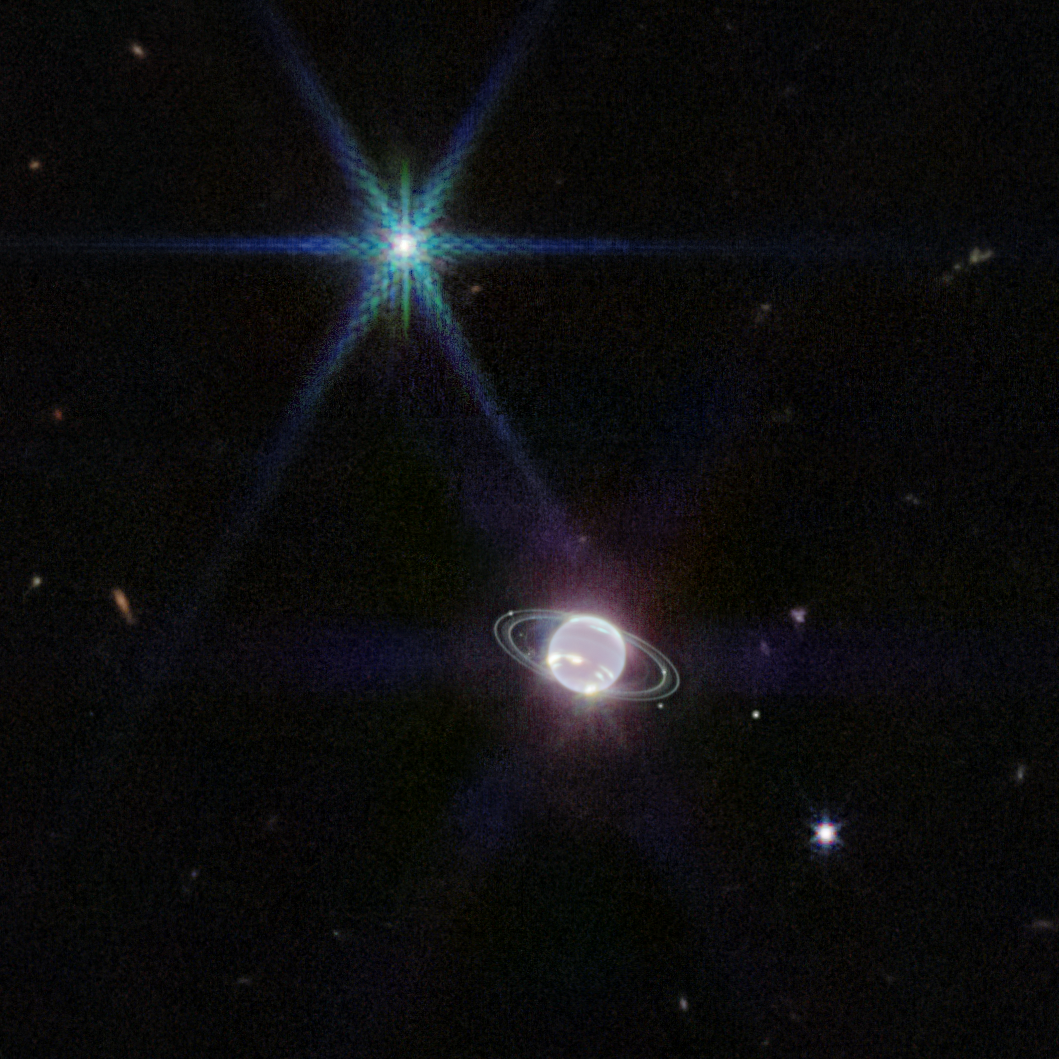
No. It is in fact the planet Neptune captured by the James Webb Telescope in infra-red light. Its largest moon, Triton, brighter than its primary in reflected sunlight, is at the top left showing the James Webb Telescope’s typical diffraction spikes.
No Comments »
Posted in Astronomy at 20:30 on 26 September 2022
A brilliant image from the James Webb Space Telescope as seen in Astronomy Picture of the Day for 23/9/22.
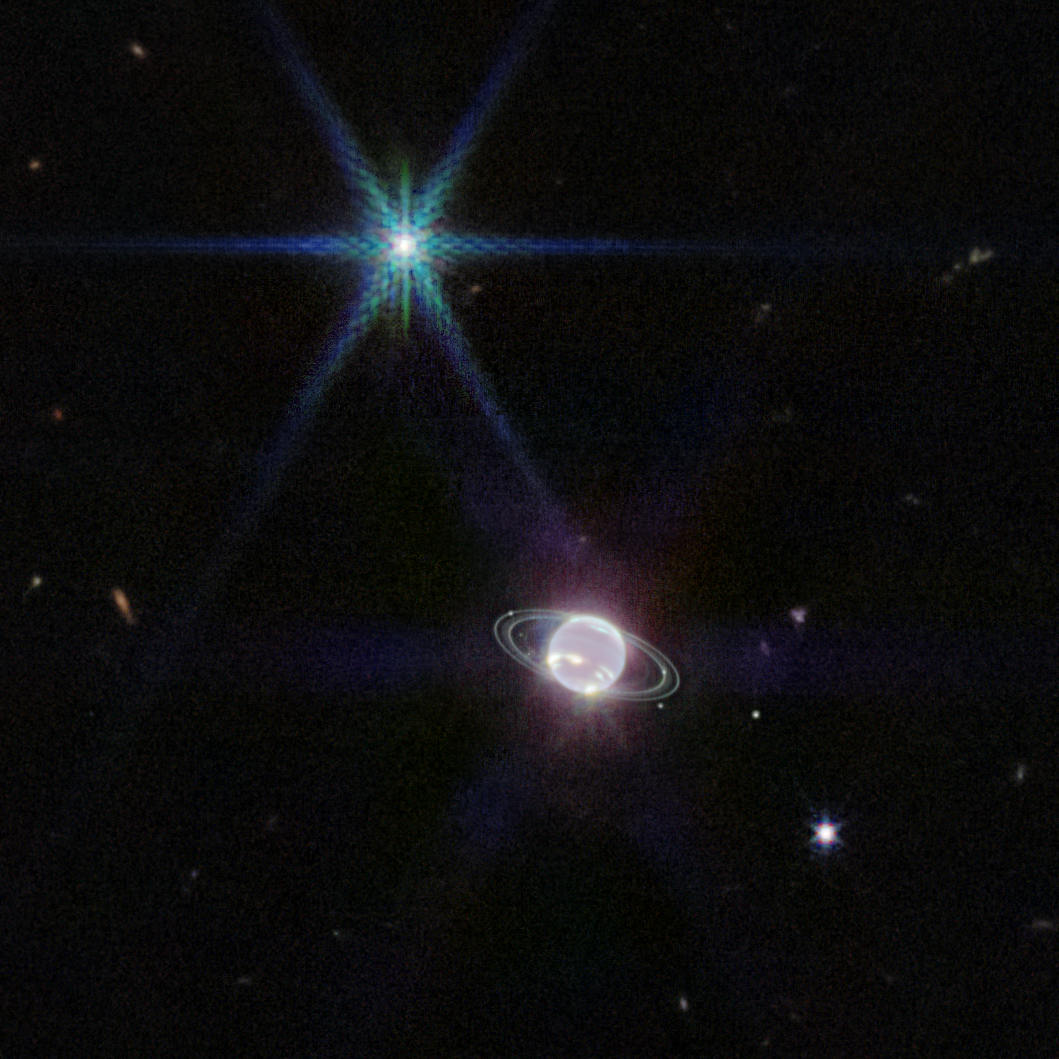
The image is different from the usual pictures of Neptune as the James Webb Space Telescope is “seeing” in infra-red light, hence the relative brightness of the rings, its planet Triton to the top left and of the storm clouds in its atmosphere.
No Comments »
Posted in Astronomy at 12:00 on 28 August 2014
This is via Astronomy Picture of the Day, 26//8/14.
Neptune’s largest moon Triton.
The movie has been stitched together from still pictures taken by Voyager 2 on its fly past.
The Voyager missions must have been Nasa’s most successful unmanned investigations of the Solar System.
Apparently the green colour of the moon is real.
No Comments »
Posted in Astronomy at 19:52 on 14 July 2011
I see from Astronomy Picture of the Day that Neptune is now one (Neptunian) year old.

Source: Hubblesite.org.
The four images are of Neptune at four hour intervals. Neptune rotates once in 16 hours and so they show one whole Neptunian day. The white stuff is cloud. The clouds contain methane crystals, rather than water ice.
The planet was discovered on September 23rd, 1846 by German astronomer Johann Galle. Since its orbit takes 165 and a bit (Earth) years, this week on July 12, Neptune has completed one revolution around the Sun since its discovery date.
Many happy returns.
No Comments »
