Archives » Memoir

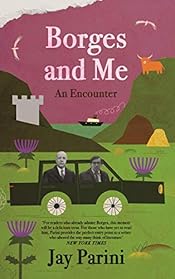
Borges and Me: an encounter by Jay Parini

Canongate, 2021, 309 p.

In his youth, as a post-graduate student at St Andrews escaping being drafted to Vietnam and contemplating a thesis on George MacKay Brown (a prospect his tutor deprecated on the grounds that Brown was still alive,) the author, a nervous individual from Scranton, Pennsylvania, with an overbearing mother also to escape, met Argentine writer Jorge Luis Borges, who was on a visit to the town to meet a local academic, Alastair Reid, with whom Parini had formed a friendship. Despite Borges’s fame, Parini had never read a word of his.

The book is constructed, and reads, like a novel, starting with a recounting of the author’s learning of Borges’s death one morning fifteen years, plus a wife and three sons, later, triggering memories of the impact Borges had made on him. Borges and Me goes on to relate the circumstances of that meeting, the car journey through the Highlands with Parini acting as the blind Borges’s eyes it led to, and how it changed him. Thirty-six years on from that, Parini was encouraged to write it all up as a complete narrative. Such a tardy account cannot be in all respects absolutely accurate, some elisions and compressions must occur. Parini’s afterword uses the phrase ‘novelistic memoir’ to characterise it. As a result the book is therefore probably more effective than a pure memoir.

In many ways the title is apposite. Borges and Me is really more about Parini than Borges. His mother on learning of his proposed transatlantic destination said, “‘Are you crazy? Nobody goes to Scotland!’” but relented, saying, in recognition of his avoiding the Army, “‘At least you’ll be safe in Scotland, though Scotch girls have a bad reputation,’” (really?) “‘and the men apparently wear skirts.’”

We hear of Parini’s preoccupations of the time; the unread letters from the draft board he stuffed in a drawer, his learning to use the word ‘rucksack’ for ‘backpack’ and what he describes as the pretentious ‘garden’ for ‘yard’, his struggles connecting with women.

The descriptions of St Andrews are of course very familiar to me. But Alastair Reid’s warning to Parini, contrasted with his experiences in the Pacific War (World War 2 was still a huge presence in so many lives in the 1960s and 70s,) “‘Remember, this isn’t a university, it’s a film set. Don’t be fooled. The lecturers, even the students, are actors. They’re here to attract tourists,’” is only partly true. St Andrews has the golf as well to do that.

An anecdote Reid told him prompted the thought, “Was this the essence of storytelling? Did one simply have to relate a tale in a believable fashion, with the authority of the imagination?” Which is of course a comment on the present enterprise – and of fiction writing in general.

And there are reflections on the Scotland of that age. Reid says, ‘What I don’t like about Scotland is that virtue is taken for achievement. And narrowly defined. We’re always judged in this fucking country…. They don’t even take off their clothes to fuck here.’ This last prompted Reid to suggest special Scottish pyjamas, with flaps in the appropriate place so that the deed could be done as secretively as possible.

(Aside. Actually I read once that the Inuit peoples of the Arctic have clothes that are indeed equipped in such a way; but that would be for purely practical purposes, to avoid the cold, not as a moral imperative.)

As portrayed here Borges was a formidable personality with an intimidating breadth of knowledge – among other things he corrected Parini’s pronunciation of Scone (Palace.) “‘It rhymes with spoon. It’s a Pictish word’” – and also aware of his own mortality. The failings of the body did at one point lead to a comic episode in a B&B in Killiecrankie. The only toilet was off the bedroom of the widowed lady proprietor and Borges had consumed a few pints.

Parini does not pity Borges his blindness as it in some ways freed him. “No wonder he lived so fully in the great room of his mind.”

At one point Borges apparently stated, “‘Israel as a state inspires me. An intractable situation, very sad, unsolvable with Palestine: competing and equally valid claims.’” Intractable indeed.

He also had an old man’s wistfulness for the loves of his youth (and present) Doña Leonor and Maria Kodama, a contrast with the young Parini’s stated lack of experience

The final stop on the car journey, for a pilgrimage across Drumossie Moor, the battlefield of Culloden, has poignant resonances, though I must say the tourist facilities there have changed a lot since that time. Parini describes them as basic indeed. When I revisited a few years ago the visitor centre was as bright and commercial as you would find anywhere.

But Borges’s influence was profound.  “One felt somehow more intelligent, more learned and witty, in his presence. The universe itself felt more pliable and yielding, and so available.”

Borges and Me is a delightful book. An elegant tribute to the great man, a tribute to the uncertainties of youth and the potentially beneficial upshots of unexpected encounters.

Pedant’s corner:- mostly written in USian. “Orkney, a remote island off the north coast of Scotland” (Orkney is an archipelago, not a single island,)  bandanna (x 2, bandana,) “a tony girls’ school in Kent” (??? Tiny? Tory?) “in pigeon Spanish” (pidgin Spanish that would be,) “following the M 90 through the town of Kinross” (the M 90 bypasses Kinross, you have to make a small detour to go through the town,) crenulations (as a castle feature it’s spelt crenellations,) “a lunch of mulligatawny and cheese rolls” (I hope it was mulligatawny soup and cheese rolls; a filling of mulligatawny and cheese does not sound appetising,) “he invariably shined warmth on his characters” (shone warmth,) “chomping at the bit” (it’s champing.) Robbie Makgill (more likely McGill,) “‘We played hooky’” (supposedly said by a Scot. It’s not a phrase we use for truanting, ‘dogging it’, ‘bunking off’, or ‘plunking’, as it was called in my youth.)

The Dogs of Peace by Rupert Croft-Cooke

W H Allen, 1973, 188 p.

Rupert Croft-Cooke, a prolific author in the immediate post-Second World War era, has been all but forgotten by the wider world in more recent years and his books are not easy to come by. He was though the favourite author of my dear friend Eric Brown (whose loss earlier this year I still have not come to terms with) and if not for his enthusiastic advocacy for Rupert, as Eric always called him, I might not have picked this up. As it was I was vaguely under the impression it would be a novel.

On starting to read it I discovered it was one of no less than twenty-one books of memoir (now classified under the general heading of The Sensual World) which had appeared by this edition’s publication date of 1973. Six more were to follow. The Dogs of Peace is the fifteenth in the series and relates to Croft-Cooke’s life in the aftermath of the Second World War. Not that knowledge of the earlier books is necessary in order to enjoy this one. Croft-Cooke’s writing is pellucid and entertaining and the book presents a picture of that lost world which is at once recognisable yet shadowy.

At times it is a catalogue of names of the literary great and good (and sometimes not so good) of the time. Croft-Cooke’s connection with the publishing world – not least his book reviewing for the weekly illustrated Sketch (he delightfully quotes one of his summings-up as “The whole story is milk-and-Waughter”) – means he was familiar with all the literary names we still recognise – and quite a few we don’t. Or at least I didn’t. He was a great admirer of the now also all but forgotten Oliver Onions whose work I have at least sampled.

Around this time Rupert inadvisedly launched a lawsuit against the publisher Hutchinson who had delayed publication of one of his books beyond the stipulated time frame in order to queer the pitch for the release of a later Croft-Cooke book due to appear from a different publisher. Rupert’s experience of the legal system is much as you would expect. An oddity I noticed was that he employed the word practicants rather than practitioners for its habituees.

The war had changed a lot in the country. Rupert reminisces about the circus troupe he had toured the country with in the thirties and spent quite some time trying to reconnect with a gypsy he had also travelled with in those days but was met with a high degree of suspicion.

He represents people’s attitudes towards the government as being resentful, saying the populace believed that government ineptitude denied them the fruits of victory. It doesn’t seem to have occurred to him (and, by extension, them) that the all but bankruptcy the UK endured as a result of the war might have had something to do with it. And of course, never having been occupied, the UK did not benefit from the Marshall Plan. Nevertheless the relative prosperity he noticed in his journey to France was striking. (I have to add that a similar difference exists today. I have only just returned from a fortnight in the Netherlands and the contrast with run-down Britain was stark. The road surfaces and signage were superb, the trains clean and on time and the supermarkets pristine and well-stocked.) Government ineptitude – not to say callousness – has certainly denied Britain any fruits at all in recent years.

Perhaps Rupert was a Tory, though. How else to explain his barbs directed at the Festival of Britain? He berates it in the book not just once but twice. He also contrasts the post-war Police with earlier incarnations, “it is generally recognised that between 1945 and 1960 much of the English police force was at its lowest a blackmailing, thieving, bullying lot of wastrels serving for the sake of the perks and exploiting the reputation for honesty and good nature which their predecessors had guarded ever since the days of the ‘peelers’.” Things haven’t moved on much since then. Perhaps they’re even worse.

Though never directly acknowledged (Rupert of course lived most of his life at a time when acting on such impulses was illegal and the habit of concealment can be difficult to break) his homosexuality can be adduced from a passage or two.

Overall this is an interesting and illuminating account of those mid-twentieth century years.

Sensitivity warning. Contains the word negro.


Pedant’s corner:- “parking metres” (meters,) “Micky Mouse” (Mickey) “Orson Welles’ acting” (Welles’s.)

The Corncrake and the Lysander by Finlay J Macdonald

In The Finlay J Macdonald Omnibus, Warner Books, 1988, 187 p. First published 1984.

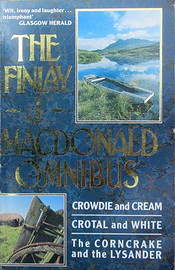
The Finlay J Macdonald Omnibus cover

This final instalment of the author’s childhood memoirs sees him, having at the second attempt passed the bursary exam, finally off to the “big” school in what he perceives as the metropolis of Tarbert though by wider standards it is little more than a village. In his new school the headmaster “didn’t really expect boys to behave themselves – he had seen too many boys for that – but he did expect them not to get caught.”

Before that, though, the author had time to aid Old Hector, debilitated by malaria contracted in his sole journey away from the village as a seaman, with milking his cow daily – which has the side advantage of providing the opportunity to have a sly smoke without the knowlegde of his parents. Hector wasn’t really old but his infirmity meant he depended on others, a dependency made worse by the death of his sister who had dedicated her life to looking after him. Macdonald, in considering how Hector would have to sell his cow when he leaves for school, conceived of the idea of advertising for a household companion ‘with a view to matrumony’ for Hector, a plan kept secret between the two of them. (Later, however, Macdonald’s father surprises him with his knowledge of Finlay’s part in the scheme. How did he know? “You never could spell matrimony.”) The first replies were unsuitable in various ways but in Macdonald’s absence at school someone did come to fulfil both aspects of the design. These machinations give the opportunity for some light humour as does the visit of the Moderator of the General Assembly of the Church of Scotland, that particular incumbent being a Gaelic speaker.

There is a more reflective aspect to the text when the author mentions the melancholy of being present when a language goes into its death throes. (Though nearly ninety years on from the times described here the Gaelic language still manages to survive.) The assumption in the village and more widely on Harris and elsewhere in the Hebrides was that to get on a child had to get out, that not to do so would be a failure, a factor which would inevitably lead to a hollowing out of life on the islands. Macdonald’s going to the big school was a first step on that journey. This quality of Macdonald’s memoir is of a piece with one of the perennial considerations of the Scottish novel; the sense of nostalgia, of things lost, of a strange incompleteness. I suspect that is one of the hangovers of the Union of the Parliaments and the formation of the United Kingdom in 1707. Macdonald also has the Scottish novelist’s eye for landscape description.

Macdonald’s growing to adulthood lay under the shadow of the looming Second World War. There is a grand set piece when the lads who have signed up are piped on to the ferry to the mainland to join their regiment, the ill-fated 51st Highland Division. This was before the actual formal commencement of hostilities when, “Nobody heard Chamberlain’s declaration of war on the Sunday because, in the Hebrides in those days, radio sets were never switched on on a Sunday – not even for the news.” The “wireless” in those days had vagaries of its own which is illustrated by the author with a comparison that is now itself outdated, “the sudden demise of the accumulator tended to have the sort of explosive effect that the telephone bill has nowadays on a house with daughters.” Macdonald’s thoughts on the whole matter are expressed by the sentiment that, “Nobody ever had a ‘good’ war and I can’t imagine how anyody could coin the phrase in cynicism or in jest.” He had a near escape himself when he and his brother unscrewed the spikes from a mine that had floated onto the shore and then hammered them onto their door as a makeshift knocker. His father was appalled when he discovered this.

He himself had been a sniper in the Great War (a conflict to which he never referred) and would not touch a gun since. So it is that on one of Macdonald’s returns home for the holidays he is surprised to find his father kitted out in khaki and with a rifle. He had joined the Home Guard. He allows Macdonald one shot of the rifle (wildly inaccurate of course) but on practice with his platoon merely jerks the rifle instead of firing it.

The drawbacks of progress are illustrated by the demise of the corncrake whose cry is Macdonald’s abiding memory of his childhood and whose habitat was destroyed by the improvement of the soil’s richness by the application of fertiliser reducing their scrub ground cover. Also the local oysters and wolf mussels die out because the run-off from the new internal toilets was being directed straight into the sea. The Lysander in the title refers to an RAF spotter plane which patrolled the waters round the islands in search of U-boats.

It is odd to see words such as ‘carry-out’ and ‘screwtops’ given quotation marks but English was Macdonald’s second language.

Pedant’s corner:- focussed (focused,) a closing inverted comma where there hadn’t been an opening one, Coolins (a curious Anglicisation given Macdonald’s Gaelic childhood, in most texts in English Skye’s mountains are spelled as in Gaelic, Cuillins,) “since the balances of males to females was totally disproportionate” (the balance … was,) some commas missing before or after pieces of direct speech, miniscular (x2, minuscular,) “honoured more in the breech” (breach.)

Crotal and White by Finlay J MacDonald

First published 1983.

Warner Books. In The Finlay J Macdonald Omnibus, 1988, 174 p.

The Finlay J Macdonald Omnibus cover

This is the second part of MacDonald’s memoirs of growing up in the southern part of the isle of Harris between the two World Wars, his recounting of a way of life that was on the way to extinction. There is no running water, no electricity – though here battery powered radios make their appearance – and no indoor plumbing; but the island’s first aeroplane sighting occurs. The Great Recession has brought poverty – sales of Harris Tweed have declined to zero – and the author’s father is reduced to killing the family’s pet sheep for food, despite his reluctance at killing anything due to his experiences in the Great War, principally as a sniper. MacDonald contrasts poverty with being broke as broke is a temporary situation, but poverty grinds unremittingly on.

The end of the author’s preliminary schooling is in sight as he sits the exam for the bursary which will allow him to carry on with education beyond the village; an education which Government and parents desired for the children but which will ensure that those children would leave the island in pursuit of the opportunities which it brought. In the meantime he wins a competition organised by Gibbs’s Dentifrice to promote their wares. Sadly the prize was not the bicycle he hoped for. Life in the family is loving but not indulgent and in amongst the nostalgia are some light moments – one involving a piss-pot laced with Andrew’s Effervescent Liver Salts, another where we are told, “There is something irrevocable about a botched haircut” – words and deeds may be forgotten or forgiven, the haircut “lingers on for an eternity, reproachfully.” As a result of his, MacDonald suffered the nickname “convick” – a Gaelic approximation to the English word – for months. We are also treated to the author’s first (and unsatisfactory for the girl concerned) sexual experience at the hands of a teenager MacDonald describes as one of a band of tinkers. The author also has that Scottish gift of an eye for landscape.

The crotal of the title is the name of a lichen that was scraped off the local rocks to be processed to provide a brown dye for Harris Tweed.

Towards the conclusion of this instalment things are beginning to look up economically but the threat of another war has begun to loom large.

Pedant’s corner:- crochets (crotchets,) “before by mother” (my mother,) “which we were lead to believe” (led to believe,) “a rift in the family lute” (??) “coom ceilings” (I have never sen this spelling before, it’s usually comb or coomb,) “the rest of the community were attending” (the rest … was attending,) “ o tell me” (to tell me,) “Callernish stones” (usually Callanish,) Niklaus (Nicklaus.)

Crowdie and Cream by Finlay J MacDonald

Warner Books. First published 1982. In The Finlay J Macdonald Omnibus, 1988, 174 p.

The Finlay J Macdonald Omnibus cover

This is MacDonald’s memoir of growing up in Harris, (which is known as the Isle of Harris even though it’s only the southern half of an island: ditto the Isle of Lewis, the northern half.)

Between the Twentieth Century’s two great wars the south of Harris was being repopulated with the aid of a Government intiative but this was still a harsh time when there were few amenities in the temporary turf-roofed dwellings the families occupied while they built their own stone ones – and not many in those – though the remains of the houses whose occupants had been cleared several generations earlier were a stark reminder of worse. There were no inside toilets – the great outdoors sufficed. Water for drinking and cooking was drawn from a nearby burn. In the times Macdonald is remembering the more convenient Tilly lamp superseded paraffin lighting and its whiter light was a source of regret. Electricity and gas were not even a dream.

The book embeds a history of Harris as the author explains his family’s circumstances and delves into the customs of the islanders while the delights of Toffee Cow (McCowans Highland Toffee, now sadly no more) become one of the author’s pleasures as he grows.

A lot of the narrative describes MacDonald’s schoolroom reminiscences, especially the initial tribulations of being solely a Gaelic speaker till he attended school (whose medium was of course exclusively English -inevitably the tawse features at times) and despite this not being published till the author was in his fifties he still manages to retain (or simulate) a child’s perspective. “Gillespie and I had long since learned to distrust adults when they were trying to sound reasonable.” He also comments on the curious circumstance by which the education all the parents desired for their children would most likely ensure that those children would leave the island in pursuit of the opportunities which that education had brought.

The coming of the Great Depression brings further hardship as the Harris Tweed trade declines. (Its use of human waste to fix the dyes require for colouring the tweed obliging everyone – visitors included – to avail themselves of the pee-pot when nature called is matter-of-factly described.)

There are several moments of humour, the new schoolteacher’s Word Game foundering on the definition of an organ, the kilted Dr MacBeth misunderstanding the question asked of him by a new father – this last had me giggling for about half a minute; not the usual response to reading tales of bygone Scottish life.

Like many a Scottish novel this autobiography is another of those laments for a past time, of the loss of a way of life, a documentation of things past. MacDonald certainly has an eye for it, and a way with words – even if they are in his second language.

Pedant’s corner:- Port Sunlight in Lancashire (it’s in the Wirral peninsula, not traditionally considered Lancashire,) “ ‘grace and favour ” (this opened quote was never closed,) while pages later we had “ away down in the south’ ” (a closing quote mark for an unopened quote,) bye-blow (by-blow,) “having failed to illicit information” (elicit,) another end quote that had not been opened, another opened quote remaining unclosed, “until we were hustled off the bed” (off to bed,) liguistic (linguistic,) “to smoothe them” (smooth them,) “even the Prince of Wales wears it” – the kilt – “whenever he ventures north of the Caledonian Canal” (I don’t think Balmoral – or Braemar – are north of there,) goloshes (my dictionary gives this as an alternative spelling but it was always galoshes in my day.)

free hit counter script