Archives » Kirkcaldy

Trains and Boats and …… Poems?

If you enter Kirkcaldy railway station on the War Memorial side, go past the ticket office, and make your way up the stairs to Platform 1 (Trains for Edinburgh and the South) you will see hung permanently on the wall of the waiting area a poem, of all things. It is cut into an unusual material for such a display, linoleum – the origin of one of the queer-like smells I posted about recently. This is partly a celebration in verse of the town of Kirkcaldy and its most famous product, but more, it must be said, of the halcyon days of the railways. It is called The Boy in the Train and was written by Mary Campbell Smith.

Curiously, I first came across these same verses thirty years ago when I was working as a Research Chemist in Hertford, just north of London. My (English) co-workers brought them to me because they wanted to know what they all meant! Imagine their astonishment when I told them I would be taking the train to “Kirkcaddy” the very next day. (I was coming up as part of my holiday to visit the good lady’s parents who, at that time, lived in Glenrothes. Kirkcaldy was the nearest suitable railway station if you didn’t have access to a car; which at the time I didn’t.) I only moved to Kirkcaldy myself twenty years ago.

The poem has stuck in my mind ever since. (It is not only cheap music that has potency.) By one of those strange word association things that probably shows what kind of brain I have, whenever someone muses on what they’ll be eating for their evening meal I always mutter to myself, “a herrin’ or maybe a haddie.”

I very much doubt that the town’s name was ever pronounced Kirkcaddy as in the poem. That usage was clearly adopted to fit the rhyme scheme.

The Boy in the Train by Mary Campbell Smith

Whit wey does the engine say ‘Toot-toot’?
Is it feart to gang in the tunnel?
Whit wey is the furnace no pit oot
When the rain gangs doon the funnel?
What’ll I hae for my tea the nicht?
A herrin’, or maybe a haddie?
Has Gran’ma gotten electric licht?
Is the next stop Kirkcaddy?

There’s a hoodie-craw on yon turnip-raw!
An’ seagulls! – sax or seeven.
I’ll no fa’ oot o’ the windae, Maw,
Its sneckit, as sure as I’m leevin’.
We’re into the tunnel! we’re a’ in the dark!
But dinna be frichtit, Daddy,
We’ll sune be comin’ to Beveridge Park,
And the next stop’s Kirkcaddy!

Is yon the mune I see in the sky?
It’s awfu’ wee an’ curly,
See! there’s a coo and a cauf ootbye,
An’ a lassie pu’in’ a hurly!
He’s chackit the tickets and gien them back,
Sae gie me my ain yin, Daddy.
Lift doon the bag frae the luggage rack,
For the next stop’s Kirkcaddy!

There’s a gey wheen boats at the harbour mou’,
And eh! dae ya see the cruisers?
The cinnamon drop I was sookin’ the noo
Has tummelt an’ stuck tae ma troosers. . .
I’ll sune be ringin’ ma Gran’ma’s bell,
She’ll cry, ‘Come ben, my laddie’,
For I ken mysel’ by the queer-like smell
That the next stop’s Kirkcaddy!

Since it is not in Standard English doctorvee considers the whole thing to be written in slang, though it is of course in a variant of Scots, which, while now declined, was once one of the great languages of mediaeval Europe, capable of producing a classic work such as Ane Satyre Of The Thrie Estatis.

I make no literary claims for the poem in question, however. Since it is written from the viewpoint of a child its language is, no doubt deliberately, debased and the “poetry” is really no more than doggerel. (Though it is more than several degrees above McGonagall.)

Since those far off days in Hertford I have always had a hankering to provide a cod English translation. So to my old colleagues at MRPRA, to doctorvee (and to anyone who cares) here is:-

The Boy in the Train 2008

For what reason does the locomotive make that piercing noise?
Is it afraid of confined spaces?
Why is the fire not extinguished
When rain falls onto it down the chimney?
What will we be eating for our evening meal tonight?
Herring perhaps, or haddock?
Has Grandmother the modern convenience of electric lighting?
Is the next stop Kirkcaldy?

There’s a hooded crow atop a raw swede,*
And six or seven seagulls,
I’ll not fall from the carriage window, mother,
It is secured as certainly as I am eleven years of age.
We have entered the tunnel and there is no light,
But there is no need to be scared, father,
Beveridge Park will soon be in view.
And the next stop is Kirkcaldy.

Is that the moon I can see in the sky?
It’s terribly small and curved.
Look! There’s a cow and a calf out there,
And a young girl pulling along a small playcart,
The attendant has checked and returned the tickets,
So give me my own, father,
Take the bag down from the luggage rack,
Because the next stop is Kirkcaldy.

There is a plethora of boats in the mouth of the harbour,
And, I say! Can you espy the cruisers?
The sweet comestible I was enjoying just then,
Has fallen and glued itself to my trousers,
Soon I shall be ringing the bell at Grandmother’s house,
She will say, “Enter, my fine young fellow,”
For I know myself, by the strange aroma,
That the next stop is Kirkcaldy!

*Edited to add:- “raw swedes” should be “row of swedes” – see Comments

The Wonder That Was Woolworths

Today, sadly, Woolworths went into administration. This looks like the demise of one of the fixtures of British High Streets (though the company started in the US) since ever I can remember. 99 years in fact. Some of their original shops were Art Deco too.

Another source of sadness is that doctorvee works part-time in the Kirkcaldy branch, so it’s like a personal blow.

It is the latest, but will not be the last, victim of the credit crunch. The company is probably viable on a day to day basis but its creditors wanted their money back. Since this has forced Woolies into administration they will now most likely not get it (or at least not all of it.)

There had been attempts to sell it to someone else for £1 and they would take the debt over, but these have fallen through.

Most likely the immediate reason for today’s administration is that the staff were due to be paid tomorrow and the money wasn‒t readily available for that; or their bank (Barclay’s) wouldn’t make it available.

Ironically, Woolies’s cash flow was probably quite good this week as they have had a 20% off offer on everything (only 10% on DVDs and electrical goods.) The Kirkcaldy store has certainly been busy. Yet I suppose these moneys would not have got through the system in time to prevent the administration.

While supermarkets have been expanding into most product areas and therefore undermining them and the rise of £ shops undercut them, Woolies was still the only place in the High Street where you could be sure of buying certain items – ironmongery and sewing thread spring to mind here and in Kirkcaldy their selection of sweets was greater than their competitors – so it will certainly be missed.

Some stores may be saved but most will soon have disappeared.

So it goes.

Winter’s Shadowy Fingers (ii)

Woke up this morning to snow on the ground in Kirkcaldy. It was more or less gone by one o’clock, though.

I remark on this since, in all the twenty years I’ve lived in this house, there has been less than a handful of times – this morning included – snow has actually lain for any length of time. (Note, here, the past participle of to lie, and not of to lay.) Only once was there ever enough snow for my sons to build a snowman or go tobogganing in Beveridge Park – which is just over the railway line from our street.

Partly this is because we live reasonably close to the sea and the temperature is therefore always slightly higher than just a hundred metres or so inland and so we rarely get snow. It is noticeable that the snowline generally starts a bit up Oriel Road. Its higher elevation as well as more distance from the Promenade helps explain that.

In my youth in Dumbarton snow was also relatively unusual – it used to start where the Clyde narrowed at Old Kilpatrick and the warming effect of the river lessened.

This did not of course apply in the winter of 1962-3 which was famously severe and during which I actually stood on Loch Lomond. I believe this was itself not a patch on the winter of 1947, which was in addition made to seem worse by the austerity of those post-war years, my father told tales of folk burning old shoes as fuel – but I wasn’t around then.

Otherwise I do not recall snow falling, and lying, before New Year, except once.

It’s still November and a week to go before December, at least five before New Year. A harsh winter ahead? In August I noted an early onset of leaves going brown.

I remember reading somewhere in the early autumn that the weather patterns in Britain this summer resembled those of 1962 and that such patterns had a tendency to repeat themselves after gaps of years.

Just what we need! Credit crunch, banking collapse, the world financial system tottering around our ears and a possible harsh winter. (You read it here second.)

Kirkcaldy’€™s Art Deco Heritage 2. The Fire Station.

Kirkcaldy Fire Station facade

This is in a much more restrained Art Deco style than Kirkcaldy Ice Rink. There are rather more horizontal than vertical aspects to the overall look here but there is some interplay.

Kirkcaldy Fire Station from access road

There also seems to have been some sort of an attempt to cohere with the Scottish vernacular architecture of the East Coast.

I think it actually looks better from the side and back where the bricks are painted red to match the detailing instead of being, well, brick coloured as at the front.

This rear view shows off the Scottish style chimney stacks. Note the pink painting on the railings of the balconies as at the front.

Kirkcaldy Fire Station rear

Kirkcaldy Fire Station tower

The tower is quite prominent from parts of Kirkcaldy’s promenade and the higher areas in the town.

This fire station is a more striking building than its equivalent in Dunfermline which has a white and grey finish and lacks much of the fine detailing seen here.

Kirkcaldy Fire Station Fire Service symbol

I love the stylised fire service symbol on the metal rails above the left hand door. It’s almost socialist realism but not quite.

Kirkcaldy Fire Station Kirkcaldy crest

This other detail, above the right hand door, is found on Kirkcaldy’s town crest. The wee man is apparently St Bryce, Kirkcaldy’s patron saint. I didn’t know the town had a patron saint until I looked up the town crest!

Book Sales

This morning I went to my local area libraries’ book sale. They have one on and off – the good lady thinks every month or so – but we haven’t been to one for a while.

It is a tiny bit niggling when you find they’re selling off books you’ve already bought and read but it does afford the opportunity to sample an author whom you may be interested in but maybe not to the extent of punting the full price of a book.

They certainly sell their withdrawn stock at ridiculously cheap prices though, well undercutting any second hand book shop I’ve ever entered, and even the internet. And there were hundreds of books available, including loads for children, (plus some CDs) on the tables. But I suppose some of them (most?) are not in the best of nick.

However, today’s haul included an all but unopened paperback copy of “One Hundred Years Of Solitude” with spine totally intact. Only the plastic cover they put on (and the ripped out page where they would have put the date stamps if it had ever been borrowed) betrays it was a library book.

You have to question the buying policy in this instance. If this has been withdrawn unread, ought it to have been purchased in the first place? I would have thought that most people wanting to read “One Hundred Years Of Solitude” now (it is 35 years after it first appeared in British publication) would wish to own their copy rather than borrow it from a local library.

I know they’re recouping some money, here, and this will go to buying new books (at least I hope it will) but how cost effective is it? By no means all the books (not just the Marquez) were worn out. They could have stayed on the libraries’ shelves for longer, surely?

The Queer-Like Smell

Yesterday, walking in Kirkcaldy town centre, the unmistakable smell of linseed hit my nostrils.

This reminded me of how, when I was young and whisky was being produced there, the air in Dumbarton at certain times was full of the smell of malt. It still takes me back whenever I get the merest hint of malting out on passing a distillery.

Kirkcaldy was once famous for its particular ‘queer like smell‘, but now, since the demise of the linoleum industry, I detect it only rarely – perhaps when the ground has just become damp after a drier spell, but I’m not really sure why. The land where the factories were sited is probably saturated with the stuff.

Nairn’s (as Forbo?) still, I believe, make Cushionflor (sic) in Kirkcaldy but that doesn’t require the quantities of linseed that linoleum did – and many fewer workers. Apparently it’s great stuff against MRSA and other hospital bugs, though. Fantastic.

Forbo also sell something called Marmoleum now, though, which seems to be a linoleum derivative. Nairn’s erstwhile main factories in the town have, however, been demolished. There was a hint that a new swimming pool might be built where they were sited but the council has opted for a location near the promenade.

The malt smell in Dumbarton has also vanished – forever it would seem, as the distillery which spewed it out is defunct and it too is for the most part demolished. Its landmark tower survives, if decrepitly, but what use will be found for that in these uncertain times is problematic.

Sadly, those now growing up in both towns won’t have that olfactory memory to bring everything back whenever they catch a stray whiff in adult life.

Kirkcaldy’s Art Deco Heritage 1. The Ice Rink.

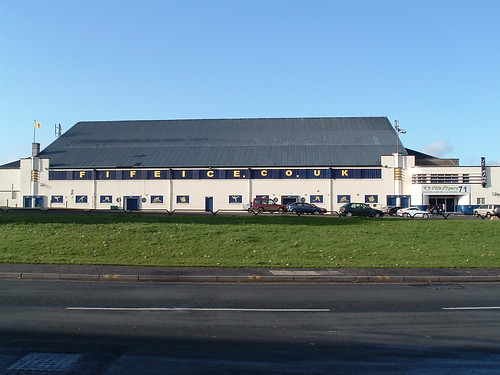
Surprisingly for a provincial town Kirkcaldy has at least two large Art Deco buildings – and publicly owned at that.

Kirkcaldy Ice Rink front

This is Kirkcaldy’s signature Art Deco building, built in 1938 to a design by local architects Williamson and Hubbard. The flagpole on the right is flying a saltire, the other the royal standard. Quite why this is I don’t know; the day I took the pictures wasn’t a high day nor a holiday. The roof has been renewed at some point in its history, relatively recently by the look of it. There is a hint here that the original roof may have been flat.

There is interplay between horizontals and verticals but it’s the detailing on the rounded entrance and the flagpoles that makes it more than a rectangular box.

Kirkcaldy Ice Rink detail

The building seems to be safe for at least five years but suffered an internal fire 20 or so months ago which happily didn’t affect the facade.

Kirkcaldy Ice Rink windows

The window glass above the entrance is still curved. Hurray!

Kirkcaldy Ice Rink left flagstaff

I like the way the line of the flagpoles is continued down through the doorways. Pity about the (mobile phone?) aerials just on the edge of the roof here.

The blue makes a good contrast to the white but is possibly too harsh. I assume the colour scheme has been adopted to reflect the one that the Fife Flyers Ice Hockey team uses.

Kirkcaldy Ice Rink gateway pillars

The tops of the driveway entrance pillars have eroded away a bit. They do seem to have been restored since this photo was taken, though.

free hit counter script