Archives » Bayview

Lifted Over the Turnstiles by Steve Finan

Scotland’s Football Grounds in the Black and White Era, D C Thomson Media, 2018, 257 p. With a foreword by Chick Young.
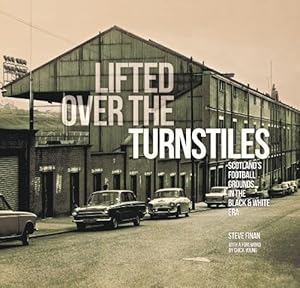
 Lifted Over the Turnstiles cover

Annfield, Bayview, Boghead, Brockville, Broomfield, Cathkin Park, Douglas Park, Firs Park, Love Street, Muirton, New Kilbowie, Shawfield, Telford Street, Kingsmills. Names to conjure with – and all gone to dust (or housing, or supermarkets.)

To Scottish football fans of a certain age (which I am) this book is a magnificent nostalgia fest. It features 41 of the historic grounds of the present day SPFL football clubs, plus two more, Shielfield (at time of publishing Berwick Rangers were still in the SPFL,) and Firs Park. The only ones missing are Peterhead’s former ground at Recreation Park and Annan Athletic’s Galabank. The criterion for inclusion in the book was that a photograph had not been widely published before or else illustrated some quirk of the ground concerned. (I was somewhat disappointed that only one photo of Boghead, former home of the mighty Sons of the Rock, appears; but I have my own memories to savour.) And of course for Inverness Caledonian Thistle you get two former grounds, Telford Street and Kingsmills. In the course of following the Sons I have visited most of the stadia here in their heydays, excepting only those belonging to the ex-Highland League clubs (though I have walked past Telford Street Park several times and even been to Clachnacuddin’s Grant Street Park in Inverness for a game – a pre-season friendly they played against East Fife; in 1976, while I was in the town.) I have frequented many over the years since.

The book is a delightful celebration of the history of the beautiful game in Scotland – and also a memorial to what has been lost. Cathkin apart, all of the grounds on the list above have been replaced by bright(ish) new(ish) stadia but most of those have yet to invoke the glories of these now mouldered (Cathkin again) or vanished (most of the rest) temples to Scotland’s abiding sporting obsession. With only one exception, Hampden, the book tends not to delve as far back as pre-World War 2, hence the absence of even longer gone grounds such as the Gymnasium, home to St Bernard’s FC, of which photographs would in any case be vanishingly scarce.

There is a 1930s, Art Decoish-looking, building in the pictures of Shawfield that I don’t remember from my only visit there and which I assume was demolished years ago. My favourite old ground, Firs Park, is shown in the days before that huge concrete wall was erected at one end to stop the ball going on to the access road to the retail park beside the ground; before, even, the office building that overlooked that end of the park in the 1970s. That other redolent relic, Cliftonhill, is shown lying in a natural bowl perfect for siting a football stadium.

The text is studded with various titbits of arcane information. Glasgow had at one time three of the biggest football grounds in the world in Hampden, Celtic Park and Ibrox. And there were plans to extend Shawfield’s capacity to add to that list of superstadia. The world’s first penalty kick was awarded against Airdrieonians (away at Royal Albert in a charity Cup match) and was scored by a James McLuggage. (Not from a penalty spot, that had yet to be invented; from any point along a line twelve yards from goal.) A WW2 pillbox was constructed at Borough Briggs with slit windows/gun ports all round (those sly Germans could after all have attacked from any direction) and remained in place till Elgin City joined the SFL in 2000. It was Ochilview which hosted the first ever floodlit match in Scotland. Falkirk once held the world record for the highest transfer fee and Brockville was the venue for the first televised floodlit game. Rugby Park used to be ‘mown’ by a resident sheep – three in total over the years. Hampden’s square goal posts now reside in St Etienne’s museum as they were held by that club to be responsible for their defeat at the hands of Bayern Munich in the European Cup Final of 1976 since two of their team’s efforts rebounded out from the goal frame instead of scraping over the line. Les poteaux carres is still used as a phrase for bad luck in the city.

Attending football matches is no longer as economical as it was back in the day. One photo shows a 20p entrance fee at Firhill in 1970. After inflation that 20p would equate to £3 in 2018. Try getting into even a non-league ground for that now! Some things definitely were better in the good old days.

Pedant’s corner:- “the current club were established” (was established,) “the club were on the up” (the club was) sprung (sprang, x2.)

Stenhousemuir 2-2 Dumbarton

SPFL Tier 3, Ochilview, 29/12/18.

Well this was a mustn’t lose – and we almost lost. Thankfully we didn’t.

On our first half performance it would have been deserved – we created nothing and had only one shot on target, Ross Forbes’s free-kick right on half-time despatched with aplomb and hit so hard the keeper couldn’t keep it out. Their goal was a defensive travesty, a litany of mistakes strating with a poor Stuart Carswell ball out (I’m not blaming him, he’s making a fair fist of centre back duties despite being a midfielder, injury needs must) an atrocious Andy Dowie (lack of) challenge and Chris Smith in goal didn’t cover himself in glory with his effort at saving it.

The start was bizarre. We walked out in Stenny’s away kit – or a Stenny away kit an Argentina clone, blue and white stripes and back shorts. Seems the ref didn’t read our email asking if our red strip would be okay. It’s the second time I’ve seen us in the home team’s away kit. The first was at Bayview (the old Bayview) many, many moons ago.

Second half was a different game – after we let them waltz through our defence to retake the lead. We then totally dominated (apart from the odd break) and had a great chance from a Dom Thomas cross which Kyle Hutton put over. Ryan Thomson had an effort from a rebound blocked.

But the amazing thing was the series of corners from Ross Forbes, one hitting the bar and another the near post with a third flapped at by the keeper. If only we had somebody to attack the ball Forbes’s delivery could be decisive but we lack height just now.

Forbes stepped up again right at the death to fire an even better placed free-kick than his first in off the post. Cue celebrations.

The comments from some Sons fans when we were 2-1 down were less than helpful. I don’t seriously believe the players aren’t trying. The time that brought it to a head was a gamble on where the ball would break that didn’t come off. It might have looked like it but it wasn’t laziness on the player’s part – just a misjudgement. If we’d been going well it would never have raised its head as an issue. But we aren’t going well.

I doubt the January transfer/signing window will change much either.

A Personal History of Dumbarton FC

A slightly shorter version of this post appeared as “Dumbarton FC, The Sons of the Rock” in The Bayview, Official East Fife Matchday Magazine, Issue 5, Saturday 27th August 2011.

Just what collection of players to wear their team’s colours fans will look back on with fondness must to a large extent depend on their age. Though someone of my years and long experience of following Dumbarton might say we rather lucked into it, young(ish) Dumbarton supporters will no doubt regard the promotion winning team of 2008-9 – none of whom now remain at the club only two short years later – with a rosy glow; albeit forever tinged with sadness at the tragic death of captain Gordon Lennon only a few weeks after lifting the trophy. And that side does have to its credit not only a 3rd Division championship but the longest consecutive playing time without conceding a goal in the club’s history; over 350 mins.

But no-one alive will remember what must be Dumbarton’s greatest achievements; a single Scottish Cup (in 1883) – a time when we were in the forefront of tactical innovation in using the 2-3-5 formation – and twice winning the top division, in 1891 (shared) and 1892.

In my memory Dumbarton have won promotion a total of six times; – a seventh lies in the distant mists of 1913 when we were elected upwards – from sixth position! (In those days promotion wasn’t automatic. A Second Division Championship in 1911 still saw us in Division 2 for 1911-12.)

My father’s generation had much less to celebrate. It was fifty long years from relegation in 1922 till the Sons finally lifted themselves back into the top Division, with only the (Festival of Britain) St Mungo Quaich win of 1951 to lighten the darkness. There was, though, a tendency to romanticise the nearly men of the mid to late 1950s; a team that flirted with promotion but always fell short. It featured Tim Whalen and Hughie Gallacher (the club’s all time record scorer with 205 goals overall) whose stays overlapped with those of the long-standing full back partnership of Tommy Govan and Andy Jardine (250 and 299 appearances respectively, according to a website I consulted, most of them together.) I actually remember seeing those guys play but it was the fact that Hughie Gallacher took over in goal one game – no substitutes at all, never mind goalies, in those days – that really sticks in my mind. He was pretty good at stopping them as I recall, but we still lost that game.

One of the promotions was the elevation to the Premier Division in 1984, an adventure that lasted only the one season. A final taste of the elite alas, as we have never made it back. That team featured Bolton manager (and ex-Son) Owen Coyle’s two brothers in its midfield and leant heavily on the goals of Kenny Ashwood.

The Second Division winners of 1991-2, when Charlie Gibson and John McQuade starred, scored the single best Dumbarton team goal I can remember. Cowdenbeath had just equalised in a crucial top of the table clash at Boghead. From the kick-off the ball circulated round the team in a great passing move before, over a minute later, and without an opposition player touching the ball, John McQuade planted it in the net. Promotion was secured on the penultimate day of the season as Cowdenbeath and Alloa, the other contenders, both one point behind, only had each other to play. The Championship was duly sealed in a draw with Arbroath.

League reconstruction (as in 1922!) saw us demoted for 1994-5, placed in the new third tier. With Murdo McLeod as manager the side needed to win at Stirling – who themselves only needed to draw with us – in the last game to be promoted as runners-up. A 2-0 win sent Dumbarton fans into delirium. What happened in the next three seasons, though, was dire. Two successive relegations, including a period of over a year when we did not win a single game, ended up with us bottom of the whole pile in 1998. The following four seemingly endless years of Division 3 football saw our tenure at Boghead, at the time the longest occupancy of a single site in British football, come to an end. In this forum, though, I’d better not dwell on the result of the final game there.

Another runners-up promotion swiftly arrived in 2002. The prolific if frustrating Paddy Flannery (77 goals for the club in 175 games) was the spearhead of that side, with the less heralded Andy Brown a willing side-kick. The promotion hero, though, was goalkeeper John Wight who saved a penalty in the last minute of the last game to make sure we could not be overtaken.

For me, though, the one that sends the memory banks into raptures is 1972. That year it all came together. The club’s centenary season, 50 years since top flight football, the town’s 900th anniversary of Royal Burgh status. Kenny Wilson had an astonishing 38 goals in 36 league games, some of them in vital 1-0 wins. Mid-season he made it onto the scoresheet in a record twelve consecutive matches, and he scored all five in a 5-0 rout of Raith Rovers. And that 38 doesn’t include the free-kicks and penalties he won for Charlie Gallacher to bang in. But big Roy McCormack scored the peach. At Love Street on Christmas Day 1971 he walloped a volley from out near the touchline about fifteen yards into St Mirren’s half. It flew over the keeper’s head, hit the stanchion full on and bounced out beyond the penalty spot. It was astounding. The ref thought it had hit the bar but the linesman gave it. Roy thumped two others not quite so good in the games either side against Alloa the previous week and Clydebank the next. Sweet, sweet.

Other highlights are Jumbo Muir’s waltz all the way from our penalty area through half of the Clyde team at Shawfield before finally putting the ball in the net, Lee Sharp’s belter at Almondvale in 1996, the 5-2 win at Tynecastle in 1982* against a Hearts side desperate for promotion (we were up the park three times in the second half and scored each one) and the 0-0 draw in 1970 in the League Cup semi-final against the Celtic team that made the European Cup Final that season. The replay was 2-2, then in extra time a (Lou Macari?) cross was flagged by the linesman as out of play until Wilson headed it in. The flag mysteriously went down. (Bitter? Me? No. It’s only been forty one years.) We did have a bit of revenge. Celtic had scored another and started to play keep-ball. When we got it back we played keep-ball too. Except we suddenly switched to a quick passing move up the left, put in a great cross and scored. In subsequent seasons we had 3-3 and 2-2 draws at Parkhead in the league. After our second equaliser in the latter of those the ref was looking round desperately for someone to give him a reason to chalk it off. The linesman didn’t help that time.

Yet the real emotion wasn’t for these or any promotion. Somehow the crucial last day relegation avoiders in 1973, 4-1 against Dundee Utd, and 2003, 4-1 again, Raith the victims, have meant much, much more. Perhaps it’s the release of the fear that makes sure it’s so. The hope fulfilled. We non-glory hunters who follow lower league sides don’t get that very often.

Addendum:-
*It seems I have misremembered this game slightly. Big Rab’s blog a week or so ago featured a newspaper clipping which says we were 2-1 down at half time that day. So we were up the park not 3, but 4 times in the second half; and scored each one. Even better.

In his afterword to the article the programme editor says that in addition to being a long-term Sons fan, “Jack Deighton lives in Kirkcaldy and has taught in Cowdenbeath and Dunfermline. Jack knows all about pain.”

free hit counter script