Archives » Uncategorised

Hanno; Or The Future of Exploration by J Leslie Mitchell (Lewis Grassic Gibbon)

Jetstone, 2021, 80 p. including 9 p Introduction by Macdonald Daly, 2 p Note on the Text and 24 p Explanatory Notes and Commentary.
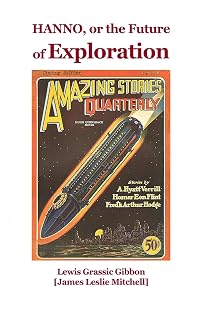
I suppose this is only really of interest to Lewis Grassic Gibbon completists. I bought it last summer along with the scarce but now also republished The Calends of Cairo, which I had been seeking to buy for years, at the Grassic Gibbon Centre in Arbuthnott (which has a very good café attached.)

It is Gibbon’s first book, published as by J Leslie Mitchell in 1928 in the series “To-Day and To-Morrow” in separate editions in both London and New York and now re-set, re-edited and annotated. To call it a book, though, is a bit of a misnomer as it consists of an extended essay only 11,000 words long. Macdonald Daly tells us the original was distended by a large typeface and generous margins and “ludicrously padded out” with end papers advertising others in the “To-Day and To-Morrow” series.  His own Explanatory Notes and Commentary here – 24 p as opposed to Mitchell’s text at 34 p – welcome as they are, perform what might be thought of as a similar expansion as their smaller font size means they probably contain more than 11,000 words.

In Hanno’s five sections – “To Sail Beyond the Sunset;” Icefield, Forest and Waste; Submarine; Subterranean; and Extraterrestrial – Mitchell, as he saw things in 1928, sets out the areas still ripe for exploration and exploratory discovery.

Some of his ideas about the Earth and the planets have since been superseded by greater knowledge. He seems to think, for example, that the Earth is hollow, or at least has a hollow portion below the surface, that the human species originated in South America and that the Moon has an atmosphere.

Notwithstanding these misconceptions and the cultural assumptions/prejudices of a man of his time (in one example railing against “the lady explorer”) Mitchell’s writing is erudite, very readable and, in some cases, makes accurate predictions – the construction of true submarines as opposed to submersibles, that Mars will be the next target after the Moon to be explored by humans.

As to the book’s title, Hanno (or Hannon) was a Carthaginian explorer – the first recorded such – who travelled out of the Mediterranean and south into the Atlantic.

Despite its attractions, quite why the front cover illustration (taken from the Spring 1928 edition of Amazing Stories Quarterly; there are two black and white illustrations on the rear of the book from the same source) was chosen is, however, a mystery as it does not give any flavour at all of Mitchell’s writing and is in fact misleading.

Pedant’s corner:- Keltic (a now largely disused spelling of Celtic; one of the few examples in this edition of an older spelling norm kept intact.) In the Notes; Mato Gross (Mato Grosso.)


Clayton Heights War Memorial

Clayton Heights is an area of Bradford. We passed this Memorial on our way to Haworth. It lies at the junction of Stocks Lane and  Highgate Road.

The Memorial is a stone cross above a tapering octagonal column on a square pediment curving upwards. It seemed to display only names for the Great War. The wreath in the photo may be covering a Second World War dedication and names though:-

Clayton Heights War Memorial

Great War names:-

War Memorial, Clayton Heights

Clayton Heights War Memorial Names

Lochinver (and Assynt) War Memorial

This one is courtesy of my younger son who sent me the photo from his trip to Lochinver last year.

Lochinver is a village in Assynt, Sutherland.

Its War Memorial depicts a kilted soldier with rifle at the ready atop a granite column above a tapering plinth.

Here can be seen dedications to both World Wars. Second World War names shown below. (Great War names are on the memorial’s sides.)

Lochinver War Memorial

Submarine Memorial, Barrow-in-Furness

A memorial in Barrow to the men of two submarines of the Royal Australian Navy, built in Barrow-in-Furness and lost in the Great War.

Submarine Memorial, Barrow-in-Furness

Submarine AE 1 was lost off Papua New Guinea in September 1914, with all hands.

AE 2 was the first submarine to penetrate the Sea of Marmara in the Dardanelles campaign, where she  was damaged by a Turkish torpedo boat and scuttled by her crew, who were captured. Four died as POWs.

Dumbarton 0-3 Cove Rangers

SPFL Tier 3, The Rock, 2/11/24.

Well, after the last two results this is disappointing.

Apparently we were all over them in the first half but their keeper made some great saves.

A different story in the second half where it sounds as if we were dismal.

Being a Sons fan is never easy.

Next week we’re at Kelty Hearts for the first ever time.


Dumbarton 2-1 Annan Athletic

SPFL Tier 4, The Rock, 11/2/23.

Another win. And now seven points ahead but with Stirling Albion having two games in hand.

We mustn’t moan, Annan have been going well recently.

Still that’s two weeks in a row now we’ve been pegged back to 1-1 (only the third time this season we’ve conceded an equaliser.)

Maybe that’s good though. After Ryan Wallace scored early they got theirs on 52 minutes. That meant we couldn’t afford to sit back and soak up pressure. We need to keep looking for goals.

Russell McLean got the winner with 12 minutes left.

Boer War Memorial, Barnard Castle

This stands by the main A 67 through the town.

Boer War Memorial, Barnard Castle

Dedicated “Pro Patria” in memory of the 3rd militia battalion of the Durham Light Infantry, the Imperial Yeomanry and local volunteers who died in South Africa.
The lower plaque describes the surrrounding area as a memorial garden to the men of Barnard Castle who lost their lives in the Second World War.

Memorial Plaque, Barnard Castle Boer War Memorial

A further plaque facing the road commemorates all those from Barnard Castle who have died in conflicts or peacekeeping missions since World War 2.

Dumbarton 0-3 Queen’s Park

SPFL Tier 3, The Rock, 5/3/22.

This was grim. We were barely in the game, couldn’t string any passes together worth the name. I’d be tempted to blame the pitch but Queen’s Park managed it quite easily it seemed.

Those two red cards last week potentially cost us but Queen’s were so much better overall that perhaps they didn’t. Big Josh missing up front through injury has been a big loss in the last few weeks.

Their first two were due to defensive errors. In both cases the bounce of the ball (or lack of it) deceived Stephen Bronsky and Gregor Buchanan respectively allowing a Queen’s player through on goal. Kieran Wright made a save at the second but couldn’t prevent the rebound reaching the attcker following up.

The only time we vaguely threatened was in the first five minutes after the restart. First Joe Mckee was free in the box but he took a touch which allowed their keeper to position himself for the save. A natural striker would have hit it first time. Then Carlo Pignatiello worked a bit of space for himself with a good take and turn in the box but the keeper made himself too big.

Their third was a joke with them exploiting too much space down our left and the cross finding a man completely unmarked.

I’m just about resigned to relegation now.

Wake me up when it’s over.

Live It Up 57: Rip it Up

Following on from the last post in this category here’s another Scottish band which found success in the 80s starting out with the now legendary Postcard Records, though by the time of this song they had moved on.

Orange Juice’s Rip it Up was also the first time that lead singer Edwyn Collins troubled the higher reaches of the UK charts.

Here’s the band playing live on the old Grey Whistle Test.

Orange Juice: Rip it Up

The Jewel and her Lapidary by Fran Wilde

Tor.com, 2016, 90 p.

 The Jewel and her Lapidary cover

As revealed in cod extracts from a later guide book quoted at the beginning of each section of this novella the Jewelled Valley was once ruled by a royal family of “Jewels” who could bind the powers of precious stones to influence minds and so tamed the gems. Each Jewel had a similarly bound servant, a Lapidary, who could hear and speak the stones.

The action of the book is set in the end-time of the Jewelled Court. Lin is the youngest daughter of the King, her Lapidary, Sima, the daughter of the King’s servant. Driven mad by the gems, Sima’s father has betrayed the Court and destroyed most of the jewels. Lin is the only member of the royal family to survive, the only person who can protect the people of the valley from the invading army of the Western Mountains. Sima sticks to her vows not to betray her Jewel.

Wilde’s control of her material is accomplished enough but it doesn’t stand up to a moment’s scrutiny. Gemstones with mind-controlling powers? That can be muted by being placed in a setting? But it is a fantasy. And short enough to read in one sitting.

Pedant’s corner:- if a Lapidary broke their vows (several instances. Lapidary is singular; so “his or her vows”.)

free hit counter script