Posted in Astronomy at 12:00 on 9 February 2026
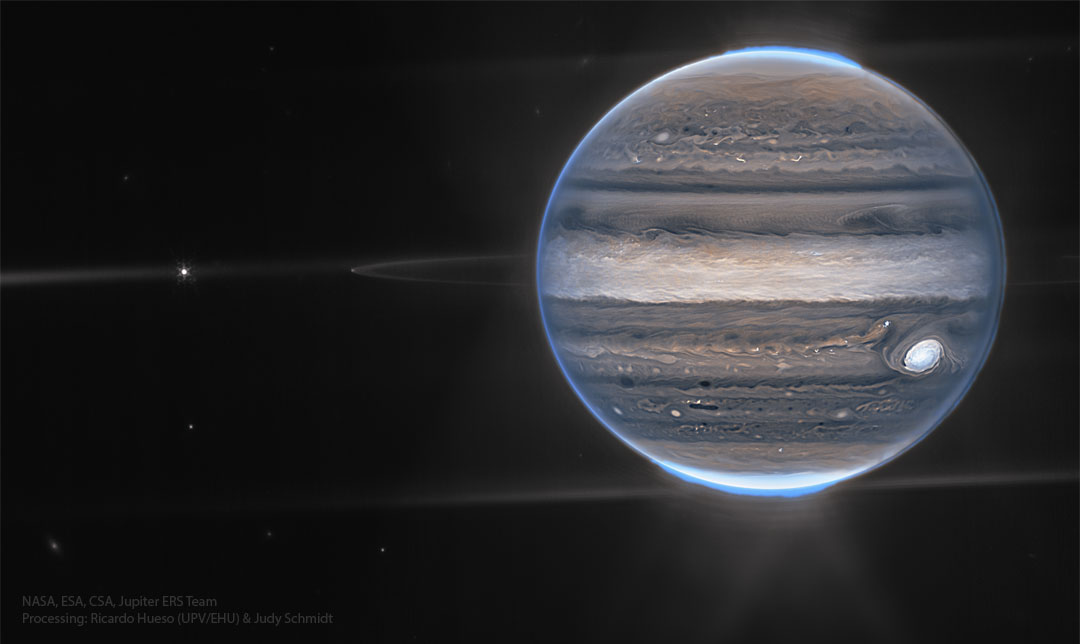
This is quite obviously an image of Jupiter, the large spot to the lower right of the planet is ummistakable. But it is also not the normal view of the planet. The colours are different for a start – and the spot isn’t red (really a rust colour.) Notable, too, are the bright polar aurorae.
Also visible is Jupiter’s ring system with the satellite Adrastea at their leftmost edge and Amalthea further out.
From Astronomy Picture of the Day for 18/1/26 this is Jupiter in infra-red light as imaged by the James Webb Space Telescope.
No Comments »
Posted in Astronomy at 12:00 on 4 September 2022
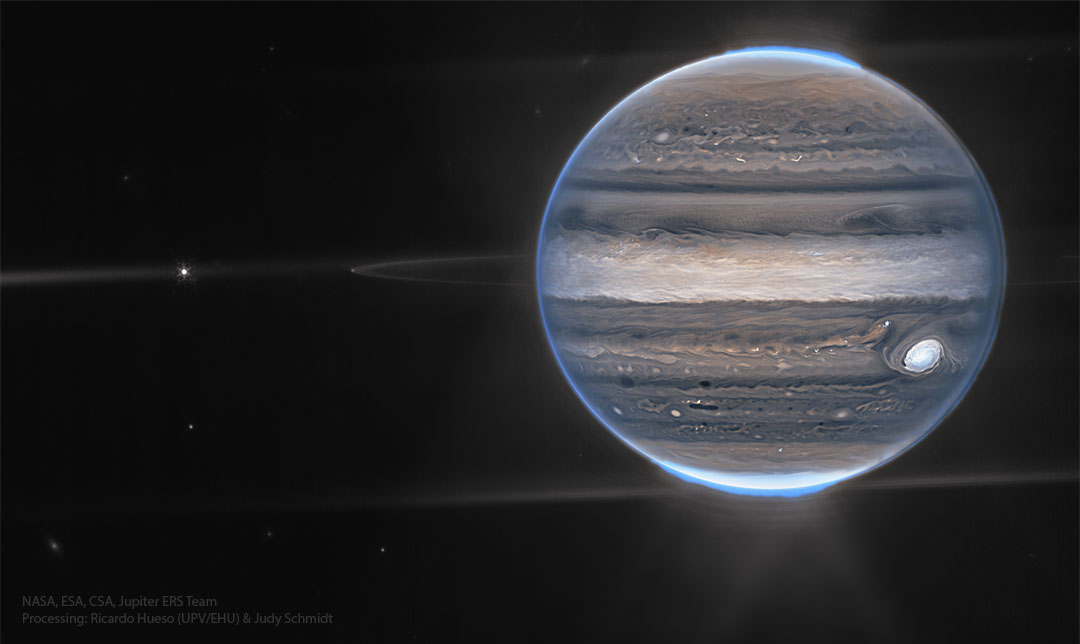
An amazing picture (via Astronomy Picture of the Day for 30/8/22) from the James Webb Telescope.
It is an unusual image of the Solar System’s largest planet but is unmistakable due to the large swirling storm at the bottom right (which in visible light is known as the Great Red Spot.)
Also notable are Jupiter’s rings, not normally easily discernible, and its southern and northern aurorae – not to mention two of its smaller satellites.
No Comments »
Posted in Astronomy at 20:00 on 24 July 2022
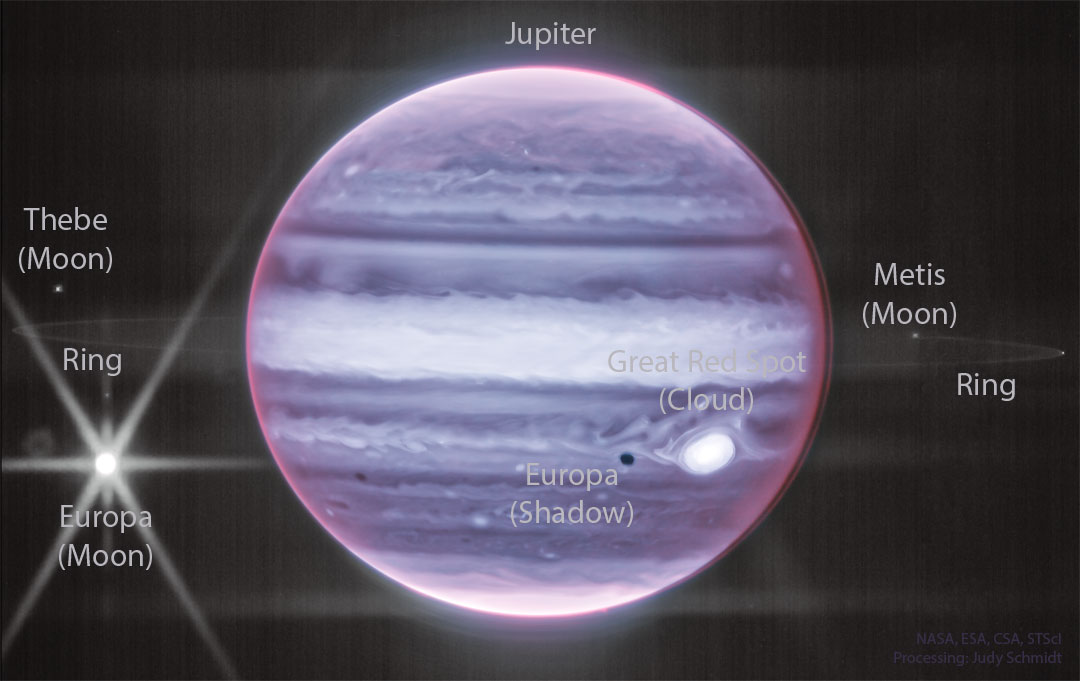
It’s not often you see an image of Jupiter’s ring.
This picture (from Astronomy Picture of the Day for 20/7/22) though shows both planet and ring in infra-red light as captured by the James Webb Telescope.
Also prominent is the Great Red Spot as a bright white feature in infra-red and the moon Europa at the centre of a large diffraction spike.
 </center<
No Comments »
Posted in Astronomy, BBC at 23:06 on 11 February 2016
Not only Astronomy Picture of the Day and the Daily Galaxy but also the BBC News majored today on the first detection of gravitational waves.
I first heard of such waves while I was still at University back in the long ago when a Physics Prof at Glasgow University came along to the Alchemists’ Club (as the post-grad Chemists association was called) to tell us all about his research, so it’s been a long time coming.
The discovery is a major confirmation of Einstein’s general theory of relativity certainly but can it really be the opening of a new window onto the universe akin to Galileo’s pointing of a telescope at Jupiter as the TV news had it? Given that the signals are so hard to detect as a result of the disturbances to matter being so small surely the technique cannot become as routine as results from electromagnetic instruments are?
No Comments »
Posted in Astronomy at 13:00 on 19 June 2012
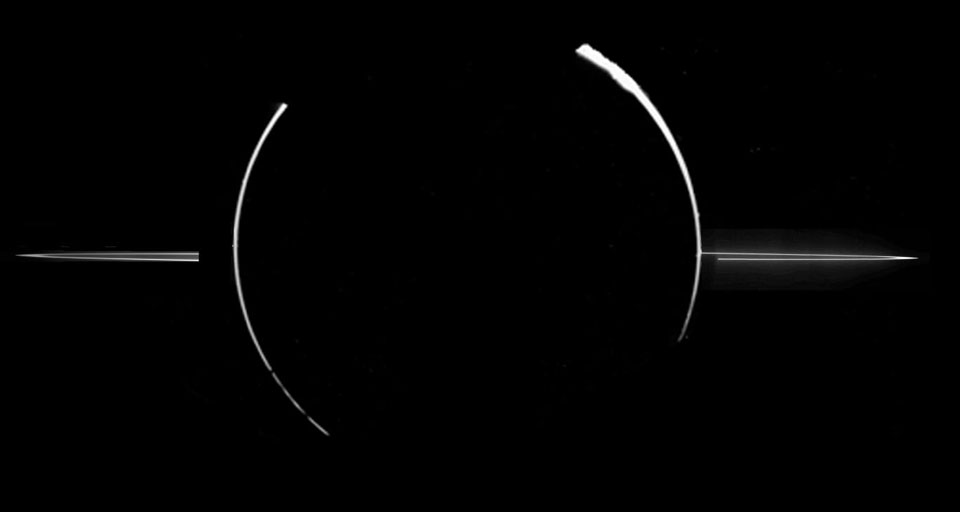
From Astronomy Picture of the Day again. This was the view on 17/6/12. It shows the Sun eclipsed by Jupiter. The rings are backlit by the Sun. Normally they would be just about invisible. The bright areas round Jupiter itself are due to dust particles in Jupiter’s atmosphere also scattering the Sun’s light.
I’m lucky to be alive at a time when these pictures became possible.
No Comments »
Posted in Astronomy at 12:00 on 31 May 2012
This picture (from Astronomy Picture of the Day 14/5/12) shows all the water of Jupiter’s moon Europa as if gathered into a ball and a similar depiction is done for Earth.
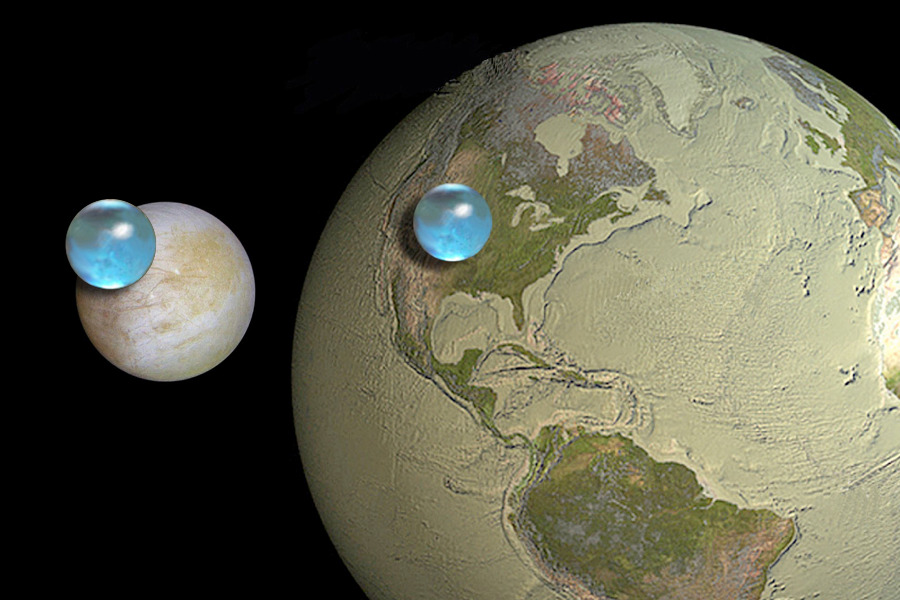
If you look at the sizes of the two spheres of water you can see Earth actually has comparatively little. It’s just spread over a large area (the oceans.) Europa has more water in total. A good place to look for extraterrestrial life then, perhaps.
No Comments »
Posted in Astronomy at 20:04 on 29 December 2011
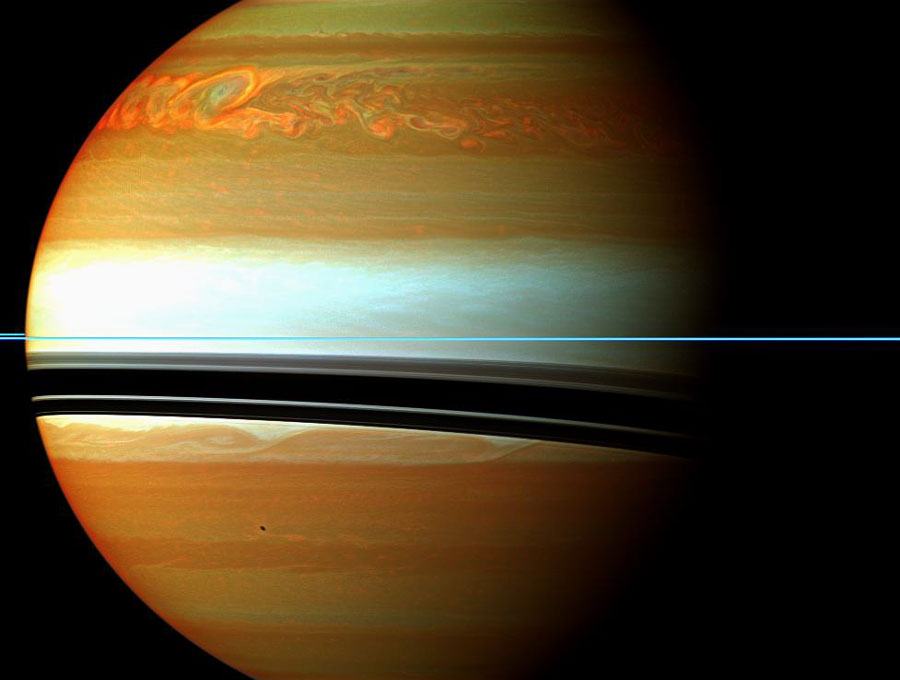
This was Astronomy Picture of the Day on Monday (26/12/11.)
The storm apparently has 18 times the surface area of the Earth. It’s one of the longest lasting storms ever recorded. (It can’t match Jupiter’s Great Red Spot, though.)
I like the way Saturn’s rings show up here as a thin blue line right across the middle of the photo. Their shadows are impressive too. There also seems to be the shadow of a moon on the lower left.
No Comments »
Posted in Astronomy at 13:01 on 24 May 2011
This is beautiful.

It was Astronomy Picture of the Day on Sunday (22/5/11.) Go to the site to see it in its full glory.
It’s a composite view of Jupiter’s moon, Io, taken by the Galileo spacecraft. You can see a blue coloured volcanic plume at the top of the scene. There is another plume – known by the name Prometheus – right in the centre. It’s ring shaped and is rising directly towards the camera. The striking yellow and red patches on Io’s surface are due to the sulphur spewed out by the volcanoes. Because of that Io looks like a semi-precious stone.
No Comments »
