The Ladies of Grace Adieu and other stories by Susanna Clarke
Posted in Fantasy, Reading Reviewed at 12:00 on 13 November 2014
Bloomsbury, 2007, 242 p.
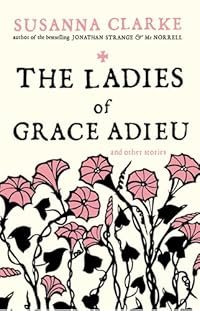
This is not my natural habitat. A book of short stories about Faery – in cod early nineteenth century English complete with “antique” spellings? The same author’s novel, Jonathan Strange and Mr Norrell, covered much the same ground and was interesting as a one-off, presenting fairies as less fey creatures than their normal portrayal (and also an everyday part of history) but this collection doesn’t really take us any more beyond that. There are introductions and footnotes by “Professor James Sutherland, Director of Sidhe Studies, University of Aberdeen,” as if the whole thing was to be taken as more than a jeu d’esprit. I can recognise the artifice of it all, the craft, but it doesn’t quite hit the spot for me.
The Ladies of Grace Adieu
Three ladies in the town of Grace Adieu practice magic. A tale “full of all kinds of nonsense that Mr Norrell will not like – Raven Kings and the magic of wild creatures and the magic of women.” In it Mr Strange reads a book which “contained a spell for turning Members of Parliament into useful members of society.” If only.
On Lickerish Hill
Before the marriage Miranda Sowerson’s mother had told her daughter’s prospective husband she could spin five skeins of flax in a day for a month. One year after the wedding he expects Miranda to accomplish this feat and shuts her up in a room. She contrives to conjure up a fairy to help her. A more or less straightforward retelling of a familiar fairy tale.
Mrs Mabb
Miss Venetia Moore’s intended, Captain Fox, has been enticed away from her by the mysterious Mrs Mabb (who never appears directly in the tale.) Strange things happen to Venetia when she tries to find Mabb’s house. She is determined, though.
The Duke of Wellington Misplaces his Horse
The Duke’s horse goes into fairyland. He follows, and discovers his fate embroidered onto tapestry. Luckily he has been provided with a pair of scissors.
Mr Simonelli or The Fair Widow
Mr Simonelli tries to prevent any of the five Gathercole sisters from being induced to marry John Hollyshoes, the fairy widower. (This employs the plural “Miss Gathercoles” rather than “Misses Gathercole” – though I accept this may be 19th century usage. However, the possessive of John Hollyshoes continually shifts from s’s to s’ and back again.)
Tom Brightwind or How the Fairy Bridge Was Built at Thoresby
How Tom Brightwind came to build the fairy bridge at Thoresby. Contains the immortal sentence, “There was, after all, nothing in the world so natural as people wishing to be English.”
Antickes and Frets
In her captivity in England, Mary Queen of Scots embroiders all sorts of garments to try to kill Queen Elizabeth and gain the English throne.
John Uskglass and the Cumbrian Charcoal Burner
While out hunting, John Uskglass, the Raven King, damages the livelihood of a Cumbrian charcoal burner, who then petitions various Saints to gain him revenge. They demur but take the king down a peg.
One of “Professor Sutherland”’s introductions contains the observation that the story following “suffers from all the usual defects of second-rate nineteenth-century writing,” – something of a hostage to fortune in a book such as this.
