Archives » Spurs

World Football Club Crests by Leonard Jägerskiöld Nilsson

The Design, Meaning and Symbolism of World Football’s Most Famous Club Badges, Bloomsbury Sport, 2018, 255 p. First published by Pintxo Förlag, Sweden, 2016.
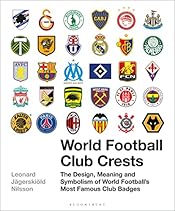
This book does exactly what its subtitle suggests, exploring the history of football club crests (that is what are called badges in the UK) or club emblems used on shirts, programs and stationery.

The contents are divided by country. There are 27 English club emblems discussed in detail, 12 each from Spain, Italy and Germany, 9 from France, 20 from the rest of Europe, 6 US clubs, 3 Australian and 5 South American. The entries give a potted history of the badge and (some of) its variations – many clubs have not kept a history of the changes – that club’s date of founding, its present stadium and capacity, its nicknames plus names of selected historic players, along with illustrations and descriptions of the relevant badge’s evolution.

As an addendum 126 “notable crests” are illustrated with the relevant badge, founding date, stadium and capacity, nicknames and country.

Sadly, despite its historical importance as the first outright winner of the Scottish League* and its badge depicting an elephant with a castle on its back Dumbarton FC’s striking emblem is not included. I note that Coventry City’s badge also has an elephant and castle and is given as one of the notable crests.

Manchester United’s historic players’ list contains Bobby Charlton and George Best but does not include Denis Law (though he appears with Derek Dougan in a photo on the Wolverhampton Wanderers pages) Sunderland’s list misses out Len Shackleton (I know a Mackem whose favourite, oft-repeated, football tale relates to him.)  Tottenham’s omits Danny Blanchflower. I first supposed the author is perhaps too young to be aware of these illustrious forebears but Charlie Buchan is in Sunderland’s list and he predates Shackleton by twenty plus years.

One of Aberdeen’s nicknames – along with ‘the Dons’ and ‘the Reds’ – is said to be ‘the Dandies’. I must confess that I had never heard of this though it does appear on the club’s Wikipedia page.

This is an agreeably idiosyncratic way of discovering something of the histories of the various clubs discussed.

*Neither is that of the first winners of the (English) Football League, Preston North End, though that too is fairly distinctive.

Pedant’s corner:- The author is Swedish and the book’s first publication was in Sweden so it is perfectly understandable that some infelicities should occur. No translator is listed so the author may have performed that function himself.  I noted a misplaced comma, “the claret and blue colours was the main motive” (the claret and blue colours were the main motif,) “the 1997 Champions’ League sinal” (final,) “forceably relegated” (forcibly,) “(1963/640” (1963/64,) “the Ukraine” (just ‘Ukraine’.) Arguabaly (Arguably,) “one star resembles ten titles” (one star represents ten titles.)

Alan Gilzean

So Alan Gilzean, whom Jimmy Greaves said was the greatest foootballer he had ever played with, has gone.

I never saw him play in the flesh, his time in Scotland being before I started watching football regularly and he was in any case in a different division to Dumbarton but he was a byword for accomplishment.

Before his move down south to Tottenham Hotspur Gilzean played for a great Dundee team, so great it won the championship of Scotland in 1962 and a year later reached the semi-finals of the European Cup. That was, of course, in the time when other Scottish clubs could compete almost on a level playing field with the two Glasgow giants. That success came in a remarkable 17 years when Hibernian (1948, 1951, 1952,) Aberdeen (1955,) (Hearts 1958, 1960,) Dundee (1962) and Kilmarnock (1965) became Scottish Champions. An incredible sequence: between the wars only Motherwell, in 1932, had broken the monopoly of Rangers and Celtic on the League Championship and subsequently only Aberdeen (1984, 1985) and Dundee United (1983) have performed the feat.

The power of money and the lucrative nature of European competition for the big two brought all that to an end. We’re unlikely to see anything like it again.

I’ve strayed somewhat from the point.

Gilzean was a great player, one whose movement on the pitch (from televisual evidence) was deceptively effortless looking, he seemed to glide over the ground in that way that only accomplished players manage to achieve. His scoring record isn’t too mean either; 169 in 190 games for Dundee, 93 in 343 for Spurs, 1 in 3 for the Scottish League and 12 in 22 for Scotland.

Alan John Gilzean: 22/10/1938 – 8/7/2018. So it goes.

The Death Of Scottish Football 5? (Woe, Woe, And Thrice, Woe)

There has been much wailing and gnashing of teeth in the realm of Scottish football over the results of the qualifiers for the Europa Laegue.

After the first leg comprehensive horsing of Hearts by Spurs and the draw and defeat for the ugly sisters (Rangers and Celtic for those who don’t share the disregard in which they are held by Scotland’s real football fans in the lower divisions) the BBC Scotland Saturday football airwaves were full of doom and gloom.

Since this Thursday and the – extremely predictable – elimination of all three Scottish clubs this rose to a cacophony on Radio Scotland this afternoon as I was making my way to New Bayview.

Most contributors seemed to be under the illusion that somehow or other the natural order of things had been upset and that Scottish clubs owed it to the country (or the fans, or something or other not entirely clear) always to survive these early rounds.

Well, ask yourselves. When was the last time a Scottish club outwith the Old Firm won a two-legged qualification tie? Motherwell was it, against Llanelli? And did they survive the next round? While I do remember Aberdeen doing well when Jimmy Calderwood was their manager, that was a good few years ago now. Most others have been deposited on their backsides very quickly indeed. And that is where Scottish football is and has been for a long time. This is the competition the Old Firm has to beat (and finds it ridiculously easy to do so by and large.)

This set of results has been coming down the pipe for a long time.

And they are perhaps to be expected from a small, poor country on the north-west periphery of Europe.

The riches pouring down on those clubs – and the leagues where they play – which habitually inhabit the knock-out stages of the so-called Champions League from television rights make this a circumstance not easy to alter.

That is where a lot of the disfunction lies. The Champions League is a monstrous carbuncle on the body of football ensuring (with only a few exceptions) the same old teams divi up the rewards between themselves. Only a Russian oligarch or oil-rich sheikh can have any hope of upsetting the apple cart.

Had the Champions League never been invented the world of football would be a purer, more innocent place. But Scottish football at the highest level would still be a self-serving, myopic miasma.

free hit counter script