Archives » Sunset Song

The Guardian Readers’ 100 Best Novels List

In response to its 100 best novels list I posted about here, on Saturday last the Guardian published its readers’ list of their 100 best novels.

I must admit I did not send in my contribution so have no grounds for complaint but again I note the absence of Sunset Song.

I did better with these, 44 (47 if the Neapolitan Quartet counts as 4; or 43⅓ if the Tolkien is taken as a whole.)

Since I copied and pasted from the Guardian website the links are theirs.

93=  Animal Farm by George Orwell

Love in the Time of Cholera  by Gabriel García Márquez

Mrs Dalloway by Virginia Woolf

80= Dune by Frank Herbert

Jonathan Strange & Mr Norrell by Susanna Clarke

The Name of the Rose by Umberto Eco

75= Brave New World by Aldous Huxley

Brideshead Revisited  by Evelyn Waugh

Tinker Tailor Soldier Spy  by John le Carré

73= The Unbearable Lightness of Being  by Milan Kundera

70= Piranesi by Susanna Clarke

The Dispossessed by Ursula K Le Guin

To the Lighthouse  by Virginia Woolf

63= Neapolitan Quartet by Elena Ferrante  (Isn’t this actually four books?)

Rebecca by Daphne du Maurier

The Tin Drum by Günter Grass

62 Midnight’s Children by Salman Rushdie

60 Possession by AS Byatt

57 Cloud Atlas by David Mitchell

52= Birdsong by Sebastian Faulks

Emma  by Jane Austen

49 David Copperfield by Charles Dickens

46  Watership Down  by Richard Adams

41 Heart of Darkness by Joseph Conrad

The Handmaid’s Tale by Margaret Atwood

39= Frankenstein by Mary Shelley

Stoner by John Williams

37 The Catcher in the Rye by JD Salinger

31 The Master and Margarita by Mikhail Bulgakov

29 Great Expectations by Charles Dickens  (Also at 29 was Huckleberry Finn which I may have read when very young but can’t actually remember doing so.)

26 Jane Eyre by Charlotte Brontë

21 Slaughterhouse-Five by Kurt Vonnegut

20 Beloved by Toni Morrison

19 Gravity’s Rainbow by Thomas Pynchon

16 Persuasion by Jane Austen

14= Wolf Hall by Hilary Mantel

Wuthering Heights by Emily Brontë

8= Catch-22 by Joseph Heller (I’ve now started this.)

One Hundred Years of Solitude by Gabriel García Márquez

7 Nineteen Eighty-Four by George Orwell

6 War and Peace by Leo Tolstoy

5 To Kill a Mockingbird by Harper Lee

3 Pride and Prejudice by Jane Austen

1 The Lord of the Rings by JRR Tolkien (I’ve only read The Fellowship of the Ring, the first in the trilogy.)

Another List

The Guardian has published a list of the 100 best novels of all time.

I was particuarly delighted to see Ursula Le Guin’s The Left Hand of Darkness appear there but no 89 is really too low. Some of the others are on my tbr pile.

Shockingly – to me at least – Lewis Grassic Gibbon’s Sunset Song is not there though I note Maggie O’Farrell did include James Hogg’s Private Memoirs and Confessions of a Justified Sinner (the quintessential Scottish novel) in her top ten.

The others I have read are:-

80 Rebecca

79 Go Tell It on the Mountain

75 The Bluest Eye

71 Kindred

66 The Master and Margarita

63 White Teeth

62 Half of a Yellow Sun

56 Mansfield Park

51 My Brilliant Friend

50 Wide Sargasso Sea

46 The Leopard

41 Heart of Darkness

36 The Handmaid’s Tale

35 Great Expectations

34 Wolf Hall

33 David Copperfield

31 The Prime of Miss Jean Brodie

30 Frankenstein

29 Pale Fire

23 Midnight’s Children

22 Things Fall Apart

20  Wuthering Heights

18 Persuasion

17 One Hundred Years of Solitude

16 Nineteen Eighty-Four

14 Mrs Dalloway

13 Emma

09 Pride and Prejudice

08 Jane Eyre

07 War and Peace

04 To the Lighthouse

02 Beloved

Project Completed (Almost)

Two posts ago I listed my review of Robert Alan Jamieson’s A Day at the Office, one of the 100 Best Scottish books.

That makes it just about all of the fiction on that list that I have now read, plus the non-fiction The Golden Bough

The only exceptions are The Wind in the Willows (which I believe I did read as a child but can’t remember actually doing so,) the J K Rowling Harry Potter book (which I won’t be reading) and Trainspotting, which along with Lewis Grassic Gibbon’s Sunset Song has appeared on all the lists of Scottish books* which I have covered over the past few years.

Since it was written in Gaelic I’ve also not read An Oidhche Mus Do Sheòl Sinn (The Night Before We Sailed) by Aonghas Pàdraig Caimbeul (Angus Peter Campbell.)

I feel a sense of satisfaction at not only having tracked down these books but finally reading them.

I have seen the film of Trainspotting, which did not encourage me to read the book. I suppose that is a bullet I must bite sometime though.

*As well as the 100 Best there were:-
The Scotsman’s 20 Scottish Books Everyone Should Read (from 2005.)
The Herald’s 100 Best Scottish Fiction Books
Scotland’s Favourite Book

Bookshelf Travelling for Insane Times – Lewis Grassic Gibbon

This will be my final entry for Judith’s meme now collated by Katrina.

This one concentrates on Scotland’s best writer of the twentieth century; J Leslie Mitchell, better known as Lewis Grassic Gibbon.

Boks by Lewis Grassic Gibbon

Here you’ll find his classic A Scots Quair, whose first instalment, Sunset Song, is the best Scottish novel of the past 150 years plus.

Also present are his two Science Fiction novels Three Go Back and Gay Hunter, his historical novel Spartacus, two other novels, two collections of shorter stories and a history book, Nine Against the Unknown, recounting the voyages of various explorers.

Another collection of his shorter fiction Smeddum is on my tbr pile as is A Scots Hairst, which contains non-fiction pieces.

Bookshelf Travelling For Insane Times

The good lady is taking part in a meme, which originated with Reader in the Wilderness in the USA.

It’s not quite in the spirit of the meme but I thought I would give you a glimpse of some of my bookshelves over the next few weekends. (Monday counts for this.)

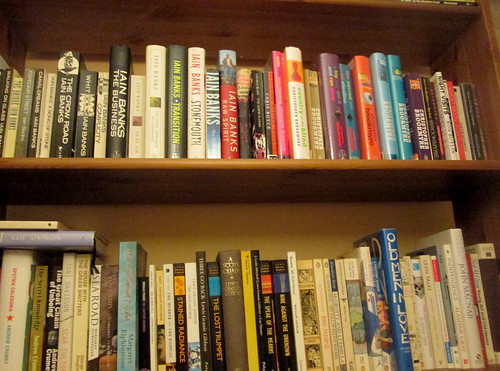
So these are the top four shelves of the bookcase where I keep those works of Scottish Fiction I have already read. (Unread books are kept elsewhere.) The bookcase was bought from IKEA and fitted well in our old house which had high ceilings. When we moved to Son of the Rock Acres we wondered where it could go. Not downstairs, not enough clearance. Upstairs though, the ceilings are three inches higher! The removal men were great at manœuvring it into place with so little margin for error. It now sits on the top corridor just outside my study. (You can’t always see the books so clearly, there’s usually more stuff placed in front of them. A few history books are still perched above some in the bottom row.)

Scottish Books 1

Scottish Books 2

Edited to add:- The meme was set up to include recommendations for reading. Well, on that note Lewis Grassic Gibbon is always worth it, most especially Sunset Song in the A Scots Quair trilogy. So too are Alasdair Gray, Iain Banks, Anne Donovan, Margaret Elphinstone, Andrew Crumey, Andrew Greig, James Robertson.

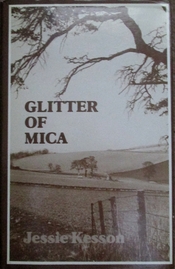
Glitter of Mica by Jessie Kesson

Paul Harris, 1982, 159 p, including 6 p Introduction by William Donaldson. First published 1963.

Glitter of Mica cover

Glitter of Mica is another tale of life in rural Scotland, in the parish of Caldwell, somewhere north and east of Aberdeen. This short novel is similar in some respects to Lewis Grassic Gibbon’s Sunset Song in that the shadow of change hangs over the town and it begins with a recitation of the area’s history. The pre-Second World War past of protagonist Hugh Riddel is gone into as the son of an itinerant fee’d farm hand who could never settle and was never retained until he came to Darklands and cemented his place as a Dairyman. The main thrust of the book is, though, set in the post war period.

The narrative structure is not linear, Kesson adopts a variety of viewpoints to tell her tale delineating life and attitudes in Caldwell through the eyes of Hugh, his wife Isa, his daughter Helen, Sue Tatt (the local woman of easy virtue) and the upstart Charlie Anson. Moreover in its first few pages the book’s defining moment is referred to as being in the very recent past with most of the narrative then circling round and leading up to that point.

The sense of social hierarchy being breached is never far away, the awareness that an increase in equality had come with the war but was still thought unseemly highlighted by the reactions to Hugh’s recent “Address to the Ladies” at a Burns Supper. Yet class differences still prevail. ‘If you’re poor you’re plain mad. If you’re rich they’ve got an easier name for you. A Nervous Breakdown.’

As an exemplar of a certain kind of Scottish fiction this would be hard to beat. It is worth reading for itself though.

Pedant’s corner:- In the Introduction; Endinbro’ (Edinbro’.) “None of the characters are complex people.” (None is a complex person.) Otherwise; God Knows’ (God Knows’s,) “a sun ranging from half a crown to ten shillings” (a sum,) Robbie Burns’ (Burns’s,) a missing end quote mark, Darklands’ (Darklands’s,) calender (calendar,) “before if shocked” (it.) “He had even less illusions” (fewer,) sime wind (some wind,) “loathe to let them go” (loath, or loth.)

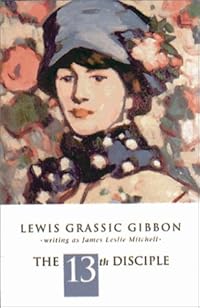
The Thirteenth Disciple by J Leslie Mitchell (Lewis Grassic Gibbon)

Black and White, 1995, 262 p, plus ix p Introduction by Jack Webster.

 The Thirteenth Disciple cover

Malcom Maudslay (yes that is the spelling of Malcom used) is a child of that north-east of Scotland which Mitchell/Gibbon wrote about so well, distilling the experiences he gained while growing up there. In this novel the life of a young child in rural Scotland in the early part of the twentieth century is evoked admirably. Like J Leslie Mitchell was himself, Malcom is of a scholastic bent, encouraged to stay on at school by both the local minister and the dominie at Leekan, whose half-French neice, Domina Riddoch, is something of a free spirit, apt to scandalise the neighbourhood with her relaxed attitude to clothing in hot weather.

Malcom more or less self-educates by reading voraciously, though his father would have been keener to see him fee’d at a neighbouring farm. Through the minister he develops an interest in archaeology (which has significance much later) but Malcom soon outgrows his teachers and secures a job in journalism in Glasgow where he meets his first lover, Rita Johnson, and takes up with socialists. He progresses quickly at the newspaper but Rita’s accidental death (there is a hint that it may not actually have been an accident) and a misuse of the paper’s funds mean he has to leave Glasgow. Not quite his usual self, he joins the Army and endures the brutal rigours of training, but his relationship with the greatest influence on his life, Sergeant Major John Metaxa, a man as educated as himself, is in itself an education. A subsequent spell in the trenches in the Great War is described in harrowing terms. There is an occasional narrative conceit whereby we are given quotes from a journal of reflections Malcom supposedly kept in adulthood.

While The Thirteenth Disciple does not reach the heights of Sunset Song (but not even its two sequels quite did that) it signals the direction in which Mitchell/Gibbon would travel and in one delicious passage the Leekan village gossip is described as passing on from Leekan “and its scandalous days and nights – no doubt to that particular hell where all folk live discreetly and unscandalously, where no juicy stories ever circulate, where all girls marry their lovers before they bed with them.” Later, in his role as editor of Malcom’s journals, our narrator tells us, “To us of the early twentieth century the detailed sex-act is still impossible in all literature but the pseudo-scientific. We are, all of us, still, too young and nasty-minded.” It has been said that Andrew Greig was Scotland’s first post-Calvinist writer. On this evidence Gibbon has a good claim to that title.

Pedant’s corner:- In the Introduction; “the age if” (of.) Otherwise; some now obsolete spellings such as Gomorrahn (Gomorran,) tabu (taboo,) juldi (jildi,) Knut Hammsen (Hamsen,) unescapable (inescapable,) Cainozoic (Cenozoic,) Thibet (Tibet,) bye-election (by-election,) unauthentic (inauthentic.) Also there were; Scottish Quarternary (Quaternary,) Jock Edwards’ (Edwards’s,) Kark Liebknecht (Karl,) Epsoms salts (Epsom’s salts,) archeology/archeologist (archaeology/archaeologist; annoyingly the spelling varies from place to place in the book,) “he could fell her breast-nipples against his chest” (breast-nipples? Is there any other kind of nipple on a human?) “Morituiri te salutant!” (Morituri,) a missing end quote mark, “whiskey advertisements” (whisky surely?) a missing start quote mark at the beginning of a quoted paragraph, “Pio Perez’ grammar” (Perez’s,) an extraneous single quote mark, pifistac (???)

Scotland’s Favourite Book Update

You may have noticed from my sidebar I am currently reading Val McDermid’s The Wire in the Blood.

This is my latest from the list of Scotland’s Favourite Books I posted about here.

Of the thirty books shown there that will be 27 I will have read, the only exceptions being:
An Oidhche Mus Do Sheol Sinn (The Night Before We Sailed) by Angus Peter Campbell which being written in Gaelic I could not attempt except in translation,
Harry Potter & the Philosopher’s Stone by J.K. Rowling, which simply does not appeal to me, and
Trainspotting by Irvine Welsh.

That last is, along with Lewis Grassic Gibbon’s Sunset Song, one of only two books to appear on all four lists of Scottish books I have slowly been working my way through.
(The other lists are:- the 100 best Scottish Books; the Herald’s “100” best Scottish Fiction Books; the Scotsman’s 20 Scottish Books Everyone Should Read.)

I have long doubted that Trainspotting could be as good as Sunset Song and have so far resisted its charms. One day I suppose I’ll bite that bullet but for now The Wire in the Blood is the last from this particular list.

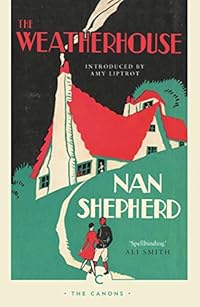
The Weatherhouse by Nan Shepherd

Canongate, 2017, 211 p, including 3 p Glossary: plus ii p Dramatis Personae and vi p Introduction. First published 1930.

 The Weatherhouse cover

I don’t normally pick up a book according to its cover but I did in this case. It helped that the novel was by Nan Shepherd whose The Quarry Wood I enjoyed a year or so ago. Yet I was also attracted by the illustration which is almost in the style of a 1930s railway poster – a very Art Deco form – even down to the lettering. The house shown is actually wrong though; in two ways. It is much more of an English type of building rather than Scottish and it bears no relation at all to the hexagonal construction described in the text. Pretty, just the same.

That titular Weatherhouse is the home in Fetter-Rothnie of the Craigmyle family, which consists of matriarch Lang Leeb plus her daughters Annie, Theresa and the widowed Ellen. The story though, is more to do with how Garry Forbes, the intended of Lindsay Lorimer, in turn the daughter of Andrew, Lang Leeb’s cousin, came to become a proverb in Fetter-Rothnie.

The former Minister’s daughter, Louie Morgan, claimed after Forbes’s friend David Grey had died in the Great War that she and Grey had been secretly betrothed and carries Grey’s mother’s ring about her neck as proof. Forbes, home from the war as a convalescent, is convinced that can not be the case. He attempts, first to bring the falseness of Louie’s claim to the attention of the Kirk Session (which upsets Lindsay) and then to prevent his knowledge of Louie’s theft of the ring becoming more widely apprehended.

Despite what appears to be a focus on small matters The Weatherhouse nevertheless has a wider resonance, and has some humorous observations. The incidental mention of the man who, because of his brother, waited twenty years to wed his fiancée (who nevertheless brought him children “as a wedding gift”) shows life in those times was not entirely as straight-laced as might perhaps be thought.

Human dilemmas and emotions occur in all places and at all times. Shepherd shows us the humanity of her characters, in all their complexity. This is a fine companion piece to The Quarry Wood. Both these novels bear some similarities to Lewis Grassic Gibbon’s Sunset Song and Cloud Howe but don’t quite have the sweep of the first of those.

Pedant’s corner:- Amy Liptrot’s introduction says Shepherd’s writing is very localised to the foothills of the Grampian mountains and quotes two of the words she uses, stravaigin and collieshangie as being specific to that area. Stravaigin certainly has no such specificity.
In the glossary: keeing (keeking,) snored (smored.) Otherwise: “you’re as light ’s a feather” (light’s,) knit (knitted,) chose (choose,) “a moment before made up on her sister on the road” (before she made up,) a missing comma before a start quote mark.

Progress in Scottish Reading

A suitable post for St Andrew’s Day.

You may have noticed on my sidebar that I am reading Neil M Gunn’s Young Art and Old Hector.

This is one of The Herald’s “100” best Scottish Fiction Books.

Of the thirty books that were actually listed on that now defunct web page this means I will now have read twenty-nine (having made that my Scottish reading project for the year.)

The only one from that Herald list I have so far missed is Trainspotting by Irvine Welsh, which has appeared on all four lists I’ve been working from* – a distinction it shares only with the otherwise incomparable Sunset Song by Lewis Grassic Gibbon.

For some reason I have a reluctance to tackle Welsh’s book. I have seen the film that was made from it and wasn’t overly enthused. I’ll get round to it sometime.

*Those four lists:-
100 best Scottish Books;
The Herald’s “100” best Scottish Fiction Books;
Scotland’s favourite books;
and The Scotsman’s 20 Scottish Books Everyone Should Read (from 2005.)
This last is the one I shall be working from next year. I’ll post the list in the new year.

free hit counter script