The Flea Palace by Elif Shafak
Posted in Other fiction, Reading Reviewed at 12:00 on 15 April 2025
Penguin, 2015, 446 p. Translated from the Turkish Bit Palas (Meris Yayinlari, 2002) by Müge Göçek.
 This, Shafak’s debut novel, has similarities with Aala Al Aswany’s The Yacoubian Building – both are concerned with the inhabitants of a block of flats – but was originally published in the same year so these will be coincidental.
From the outset it is clear that things will not be entirely straightforward: the narrator – accused of having a fanciful mind; ie talking nonsense – riffs on the differences between truth (conceived of as a horizontal line,) deception (a vertical one,) and nonsense (a circle.) This is as a way to approaching story, a circle can be entered anywhere; but it isn’t a beginning, nor is it an end.
We are then given the history of the building, Bonbon Palace, from ‘Before’ and even ‘Before Before,’ it was built on the site of an old Christian (Armenian) cemetery.
The inhabitants of the various flats within the building are Musa, Meryem and Muhammet; Sidar and Gaba; hairdresser Cemal and Celal, twins who were not actually brought up together; The Firenaturedsons family; Hadji adji Hadji, his Son, Daughter and Grandchildren; Metin Chetinceviz and HisWifeNadia; Me; The Blue Mistress; Hygiene Tijen and Su; Madam Auntie.
Already that running together of words in Firenaturedsons and HisWifeNadia signal the otherness of the narration, that heightened sense which comes from a slightly surreal take on fiction and can be a signature of non-Anglophone literature. The whole thing would seem to be narrated by the ‘Me’ occupying Flat 7 as his are the only sections written in the first person. Chapters of the book focus on and return to the flat-dwellers’ various lives in no particular order. The circumstances under which he wrote this account are not revealed until the end.
Another surreal touch is that Bonbon Palace has an accumulation of rubbish around it which keeps being added to despite the attentions of bug fumigator Injustice Pureturk. This forms the core of the plot as, in an attempt to prevent people adding to the rubbish piles, ‘Me’ paints on the enclosing wall a sentence declaring a saint is buried inside the premises.
All serious novels are attempts to sum up the world in microcosm. Limiting the story to such a small part of the world highlights this. Not all of human life is here but a good portion of it certainly is.
An initial surprise to me was the use in the translation of the word wee in the Scottish sense (‘a wee bit of clarification,’ ‘one wee bit,’ ‘a wee bit of sadness’) – and the fine British term nutter (‘a good-for-nothing nutter’.)
Peppered throughout are some adages such as, “Men committing adultery find quality significant: they enjoy receiving from another woman love that is in essence different from what they receive from their wives. Yet women committing adultery find quantity significant: they enjoy receiving from another man love that is more than that which they receive from their husbands.”
The narrator’s assertion that “Life is absurd, at its core lies nonsense” is as good a justification for the deployment of magic realism – or exaggerated reality – in a novel as you could get.
Then again he says, “Deception turns truth inside out. As for nonsense, it solders deception and truth to each other so much so as to make them indistinguishable.”
So does fiction.
The Flea Palace is as accomplished a debut novel as anyone could wish to write – or read.
Pedant’s corner:- the print looks as if was photocopied and on some pages is slanted, quantative (quantitative,) “raise to the ground” (raze to the ground,) sprung (several times, sprang,) “café chantants” (cafés chantants,) “she had suddenly ran screaming” (she had suddenly run screaming,) sunk (sank,) “the gage of their nature” (gauge. ‘Gage’ for ‘gauge’ appeared once more,) a missing full stop, “you might may well start to believe” (has a ‘might’ or a ‘may’ too many?) “where he had laid down” (lain down,) “in spite of our eating in hoards” (in hordes,) “as they silently drunk” (drank,) “of the ‘The Oleander of Passion’” (that first ‘the’ is not needed,) “had all ended up in flop” (ended up as flops,) “a unfussy end” (an unfussy end,) “raised to the ground” (razed to the ground,) shrunk (x 2, shrank,) tealeaf (tea leaf,) dopey (dopy,) “he would lay in the corner” (he would lie in ….,) “as if hadn’t been him” (as if it hadn’t been him,) “they always go through their houses as if they had never gone through it before” (‘houses’ therefore ‘them’ not ‘it’,) “chaise long” (chaise longue,) “and before you it, know” (before you know it,) gamma-amino-butiric-acid (it’s not spelled butiric, it’s gamma-amino-butyric acid,) “no sooner had they given their consent that an objection was voiced” (than an objection,) “the saints existence” (the saint’s existence,) “he fished from the thrash” (from the trash,) “the end of last the century” (end of the last century,) “I laid next to her” (I lay next to her.) “All though this period” (All through.)
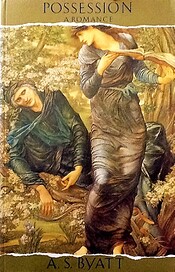 Insecure academic Roland Michell finds in a pile of unsifted-through papers relating to Victorian poet Randolph Henry Ash unfinished drafts of a letter from Ash to a hitherto unknown possible female lover, a relationship which would overturn the prevailing view of Ash’s life. For reasons obscure even to himself Michell removes the drafts from the pile and resolves to investigate further. He begins to suspect the intended recipient was the female poet Christabel LaMotte and enlists the help of LaMotte expert Dr Maud Bailey to delve into the mystery. With her help he comes across a complete set of letters between the two poets which reveal the extent of their affair.
 This is the first book of Barker’s trilogy about alumni of the Slade Art School in the run-up to the Great War. I read the second one,

 I noted when Byatt died that I had only read one book by her and perhaps ought to remedy that so when I saw this in a second-hand bookshop (in Ulverston as it happens) I snapped it up. However only after I started reading it did I check her back catalogue and found this is the third novel in a sequence featuring Frederica Potter as the main character. Not that it matters because the book stands alone.
 124, the house where Sethe lives with her daughter Denver, is haunted, by her unnamed baby and by the slavery which caused the child’s death. That other daughter, who was unnamed but whose gravestone bears the description ‘Beloved’ – Sethe could not afford the extra money to have ‘Dearly’ inscribed as well – was killed by Sethe herself to prevent her being taken back to Sweet Home, the plantation from where she had escaped enslavement. Perhaps an extreme reaction but also an expression of the horrors of slavery. Sethe has the image of a tree on her back from the whippings she received in that part of her life.
 The setting is Northern Ireland during the troubles. Cal spends his days lazing about as he is unemployed, having not been able to stand the job he had in the slaughterhouse where his father works. They are the only remaining Catholics in an otherwise Protestant street and subject to threats as a result. He is plagued by Crilly and Skeffington, Provisional IRA members wanting him to go on more jobs but is haunted by the memory of his part in the killing of a police officer where he drove the car they used. A new woman assistant at the local library begins to consume his attention. She is Marcella, and happens to be the wife of the man that was killed.
 Allan’s writing has always been idiosyncratic, never straightforward. While skirting the borders of Science Fiction, though absolutely acknowledging the genre’s existence, often tipping over into Fantasy, there has usually been something that sets it apart. It has never quite been full-on SF. Perhaps this is as it should be. Her writing has all the qualities the reader of literary fiction would expect and any writer would want to broaden her possible readership. So much the better then from that point of view if any Science-Fictional allusion can be taken as just that, or a manifestation of a character’s state of mind.
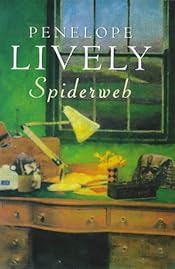 Stella Brentwood has retired to Somerset after her career as a social anthropologist which took her all around the world – Cardiff’s Tiger Bay interviewing Lascar seamen, the Nile Delta, Malta, Orkney.
