Archives » Janice Galloway

Another List

I recently came across this list of ten of the best Scottish fiction books. (A bit late I must admit. It was produced five years ago by the Irish Times on the eve of the Scottish Independence Referendum.)

The ones in bold I have read.

The Prime of Miss Jean Brodie by Muriel Spark (1961)
The Girls of Slender Means by Muriel Spark (1963)
Lanark by Alasdair Gray (1981)
The Wasp Factory by Iain Banks (1984)
The Trick is to Keep Breathing by Janice Galloway (1989)
Swing Hammer Swing! by Jeff Torrington (1992)
Trainspotting by Irvine Welsh (1993)
Morvern Callar by Alan Warner (1995)
Black and Blue by Ian Rankin (1997)
Day by A L Kennedy (2007)

Most of the usual suspects appear here. Trainspotting is the only one I haven’t read.

The list seems to be biased towards more modern novels. Remarkable for its absence is Lewis Grassic Gibbon’s Sunset Song (now nearly 100 years old, however.) I doubt that’s an omission any such list produced in Scotland would make, though.

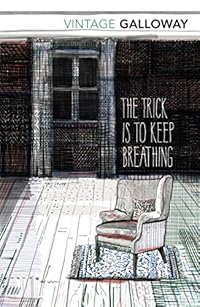
The Trick is to Keep Breathing by Janice Galloway

Vintage, 2010?* 236 p. First published 1989.

 The Trick is to Keep Breathing cover

Janice Galloway’s much lauded first novel, The Trick is to Keep Breathing, relates the adult experiences of a woman who is/was a teacher but also worked in a bookmaker’s and whose life started to unravel when the man she was living with (another woman’s husband) drowned. In the main body of the novel the narrator is an anorexic and self-harmer unable to talk about her situation. “We are veering into the difficult territory of how things are.” She is recommended by a psychiatrist to enter hospital. The doctors she meets are so indistinguishable she thinks of them as numbers; Drs One, Two and Three. In the hospital, “Most of (the rules) work on the landmine principle: they just let you loose till you trip on one of them.”

Partly to suggest her skittish mental state the text is non-linear, full of lists, repeated phrases, unconventional typography (one whole page has nothing but the word “oops” just over halfway down,) dialogue that is not indicated by quotation marks – but in interviews with health workers is rendered as in the text of a play – and has sentences that break off somewhere in

In addition wide margins allow the occasional insertion of (repeated) words or phrase fragments. This is almost in the style of Alasdair Gray’s marginal notes but here really add nothing to the novel but I suppose are again indicative of mental state.

Prior to the – unnamed; at least, I can’t recall one – narrator’s hospital admission (the doctor) “gave me pills to tide me over when I got anxious. I got anxious when they didn’t tide me over into anything different. He gave me more pills.” Later; “Maybe the pills know the answer. I doubt it but I have no proof.” Some time later she looks in a mirror. “But what looks back is never what I want. Someone melting. And too much like me.” She also avers, “Persistence gets me every time. I haven’t got any.”

She is prone to noting things like,
“This the Way Things Are.
This is What Passes For Now.”

She realises, “There’s no fucking point is there?” and eventually that the difference between her and other people is minding. They don’t mind they don’t know what the point is.

In sum The Trick is to Keep Breathing is neither a comfortable nor an easy read. As an examination of a fragmenting psyche and the incomprehension and indignities it suffers it’s illuminating, though.

Pedants corner: The text refers to a fifth form romance – in Scotland we say fifth year. We had a “sunk” count of one, “‘What are supposed to come here for?’ I said,” “He sat me down and said looked serious,” an “is” for “if,” attracive, an “it’s” for “its,” and “too neat and know” which no matter how I tried I just could not parse.

*The book states “published by Vintage 1999” but at the back has an advert for the same author’s 2003 novel Clara so must be a later reprint.
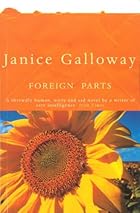
Foreign Parts by Janice Galloway

Vintage, 1995, 262 p.

Foreign Parts cover

The thing that struck me most about this book was its typography. Passages a paragraph long – sometimes smaller, rarely longer, though the paragraphs obviously vary in size – are separated by a double line break. The names of the two main characters

Rona and Cassie
Cassie and Rona

are frequently represented as above in succeeding lines between two double line breaks before the sentence continues. The main narrative, which has paragraph indentation, follows them on a trip through Northern France, has no markers for speech beyond context or an embedded said and can be interrupted by sections blocked off in a rectangle containing extracts from guidebooks to the local areas.

This is supplemented by sections (each with a uniform margin the size of the paragraph indentation above) describing the contents of photographs of Cassie’s life up to this point.

Nothing much happens in the story as the relationship between Cassie and Rona does not evolve significantly over the novel’s span. The main incidents of Cassie’s life were at the times represented by the photographs so we get, em, snapshots of her previous life. There is a passage about how men are more or less uniformly useless – apart from being able to provide sex – which Rona says she doesn’t miss anyway. Do we not take this as read? In any case not enough is made of this notion to allow us to ascribe the book’s title to being descriptive of the male even if Cassie says, “Heterosexuality is a complete farce…… Because what men really are in love with is men.”

Certain details niggled. Cassie and Rona visit a War Cemetery to find and photograph the name of Rona’s grandfather on a wall and much note is made of the crosses. While it is true that French and US War Cemeteries contain crosses (or stars of David, and I vaguely remember crescents on some French Army graves) British and Commonwealth war grave markers are rectangular slabs with rounded tops. There are some crosses at Thiepval, where the names of the otherwise unmarked dead of the Battle of the Somme are inscribed on a huge memorial, but those are the resting places of French soldiers. The cemetery in the book is unnamed.

Pedants’ accounting:- There was a “shrunk” count of 1 and several misspellings. At one point we had sandle but sandal appeared subsequently several times plus a “meritricious” in one of the guide book sections and a “colandar.”

free hit counter script