Posted in Trips at 20:00 on 27 August 2017
Hoy and a boat on Scapa Flow:-

Hoy from ferry across Scapa Flow. The island in the middleground, with the lighthouse, is Cava:-

A yacht on Scapa Flow, Hoy behind:-

Yacht and SS Hamnavoe from Scapa Flow. Island of Graemsay in middle ground:-

No Comments »
Posted in Seaside Scenes, Trips, Wild Life at 12:00 on 26 August 2017
On the way back from Lyness on Hoy to Houton on the Orkney mainland the ferry took a slightly different route in order to put off and pick up at the island of Flotta.
Looking back to Hoy from ferry to Flotta :-

Miltary constructions go back a long way on Orkney. This is one of at least two Martello Towers on Hoy. These date from the Napoleonic wars:-

Defunct military building on Flotta, Orkney. Plus trees – an unusual sight on Orkney:-

At the Flotta terminal a woman suddenly cried out, “Look. A Seal!”

Three more seals were basking on the shore on the other side of the ferry:-

Structure in mid Scapa Flow. This was too far away from the ferry for me to make it out but it looks like an artificial island:-

Oil Terminal at Rinnigill, Flotta, from Flotta-Houton ferry.:-

Tanker and Rinnigill Oil Terminal, Flotta:-

No Comments »
Posted in History, Trips at 20:00 on 25 August 2017
A spit of the Orkney mainland, a ness, juts down from Stromness towards Hoy. To defend the Sound of Hoy from the 1860s onwards artillery batteries were sited on the north shore of the Sound of Hoy.
We strolled down one evening not knowing there were remains still there. I suspect these are all World War 2 vintage.
Site of Volunteers Battery, Stromness:-

Nissen Hut, Volunteers Battery, Stromness. I supose they kept ammunition and such here. I suspect it’s now used by Stromness Golf Club:-

Gun Emplacement, Links Battery, Stromness, Hoy in background:-

Closer View, Gun Emplacement, Links Battery, Stromness:-

Searchlight Emplacement, Links Battery, Stromness:-

Reverse View Links Battery, Searchlight Emplacement. Mainland Orkney in background, island of Graemsay to right:-

Sound of Hoy and Hoy from Links Battery Searchlight Emplacement:-

Remains of Gun Batteries, Stromness Golf Course, in middle ground:-

No Comments »
Posted in History, Trips at 20:44 on 14 August 2017
Orphir is on the south of mainland Orkney, near the ferry terminal at Houton. We visited it the day before Lyness as we were scoping out the possibilities of taking the car over to Hoy. It turned out you had to book that two or three days in advance. We ended up as foot passengers.
At Orphir there is a Visitor Cente devoted to the Orkneyinga Saga as it was here there was a Viking drinking hall and where a certain Sven Breastrope (Sveinn Brestrope) was murdered. There are the usual display boards and also a video dramatising the relevant bit of the saga. Unlike at many Orkney attractions we were the sole visitors.
A modern cemetery lies to the south of the site.
Plaque on cemetery wall. Bu means residence:-

Remains of Viking drinking hall from northeast:-

Remains of Viking drinking hall looking southeast:-

Remains of Viking drinking hall looking south:-

Remains of Viking drinking hall looking north from cemetery wall. Orkneyinga Saga Visitor Centre to left rear, farm buildings to right:-

No Comments »
Posted in History, Museums, War Memorials at 20:13 on 13 August 2017
Almost the first thing you notice making your way out of the ferry terminal at Lyness on Hoy, apart from the last remaining oil tank servicing what was the naval base there and the building housing the Lyness Naval Museum is two flags and two upright stone markers.
This is the Arctic Convoy Memorial. Some of the convoys’ ships sailed from Scapa Flow.
Memorial from road:-

Memorial Plaza:-

Memorial Dedication:-

Russian Inscription and Flag. (I note that the flag, strictly, should be that of the USSR):-

Russian inscription:-

British Inscription and Flag:-

British Inscription:-

No Comments »
Posted in Architecture, Art Deco, Trips at 12:00 on 13 August 2017
Ahoy-hoy was the suggestion of the inventor of the telephone Alexander Graham Bell for the greeting people should use when answering the telephone. I couldn’t avoid thinking of it as we approached the island of Hoy across Scapa Flow on the ferry crossing from the terminal at Houton to Lyness.
Hoy from ferry:-

Approaching Lyness:-

Plaque at Lyness Ferry Terminal commemorating the salvaging of ships from the scuttled German High Seas Fleet in Scapa Flow. Apparently the metal from the ships found use in the space programme as it was uncontaminated by radioactive fallout:-

Old Fortified Building on Hoy seen from Lyness Naval Cemetery. This must have been to do with either or both of the World Wars:-

The Hoy Hotel. Art Deco/Moderne style. We met an Australian photographing the building. He had come to Hoy as that was his surname:-

Photo in the Lyness Naval Museum of the Garrison Theatre, Hoy, built by the Royal Marines. Now no more except for the foyer:-

No Comments »
Posted in Trips, War Graves, War Memorials at 12:00 on 8 August 2017
On the night of 8th October, 1939, the German submarine U-47, under the command of Günther Prien, penetrated the defences of Scapa Flow, Orkney, through Holm Sound and Kirk Sound. Her first two torpedo salvos missed all but an anchor chain but her third struck HMS Royal Oak. Within fifteen minutes the ship had sunk with the loss of 833 British sailors out of the crew of 1,234 men and boys. Many of their bodies were unrecoverable and remain on the ship. A few are interred at Lyness Naval Cemetery on Hoy.
For his feat Prien was awarded the Knight’s Cross of the Iron Cross, the first sailor of a U-boat and the second member of the Kriegsmarine to receive this decoration.
To prevent any further such attacks a series of barriers known as the Churchill barriers was built between four of the southern Orkney islands to connect them to each other and the mainland. The one shown below (picture from the Royal Oak’s Wikipedia page) crosses what was Kirk Sound.

For decades afterwards the Royal Oak, a designated war grave on which diving is therefore prohibited, leaked oil into Scapa Flow before the leak was sealed off.
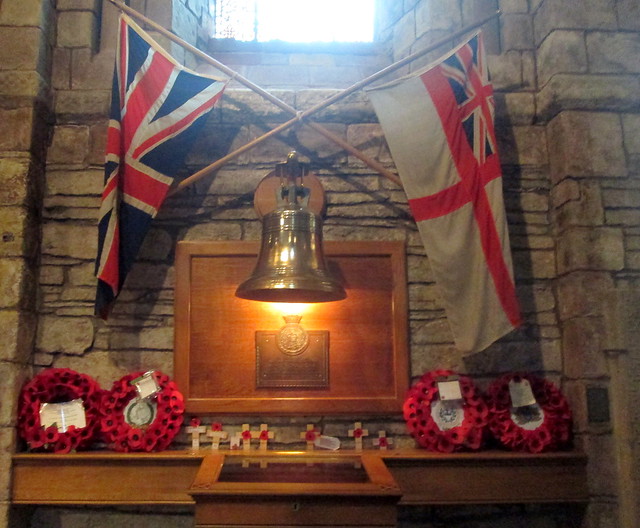
A memorial to HMS Royal Oak is set into the north wall of Kirkwall’s St Magnus Cathedral. There is a dedication plaque, a book of remembrance listing the names, with a page turned every day, surmounted by the ship’s bell.
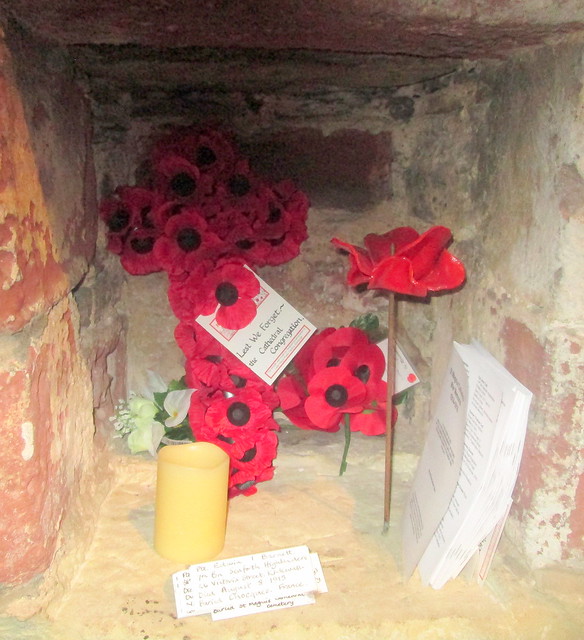
Further along the same wall lies another site of more general remembrance, a niche containing poppies and candles.
No Comments »
Posted in Trips, War Graves at 12:00 on 1 August 2017
An unknown sailor of the Great War, HMS Narborough, 12/1/1918:-

An unknown sailor from the Royal Oak, sunk by a German submarine, 14/10/1939:-

There are civilian burials in the cemetery at Lyness. Whether these deaths were due to enemy action or not is not made clear on the gravestones.
A Merchant Navy Seaman, Ham Fat, fireman, SS Pass of Leny, 14/6/1943:-

T H Coleman, First Radio Officer, S S Vasna, 17/9/1941, aged 46:-

“A Parsee” and “A Musalman” Sailor:-

K Ullah, fireman and trimmer, K Ullah, SS Mostyn, 30/1/1941, aged 32:-

No Comments »
Posted in Trips, War Graves, War Memorials at 20:00 on 29 July 2017
Unusually for a Commonwealth War Graves Cemetery, in Lyness Royal Naval Cemetery, Hoy, Orkney, there are memorials other than the Cross of Sacrifice and the individual graves.
I posted about the HMS Vanguard Memorial on the anniversary of its sinking.
There is also a memorial to HMS Hampshire on which Lord Kitchener and many others died.

HMS Malaya went down in the Battle of Jutland:-

This cross commemorates Roman Catholics:-

The following memorial is to “Henry Dixon Dixon-Wright, Chaplain to HMS Barham, died 1/6/1916 of wounds received in the Battle of Jutland and in memory of officers of HMS Barham who fell that day and lie at sea.” (I note the absence of “and men” in the dedication):-

Gravestone of Zu Sing Kang RFA (Royal Fleet Auxiliary) who died at Scapa Flow, 2/5/1916. “Erected in memory of a kind act done by a Chinaman in nursing a blinded working man afterwards Senator McGregor of the Australian Commonwealth”:-

A Boy Telegraphist, C Rogerson, HMS Pembroke I, 5/1/1918:-

A Boy 1st Class, J T Porter, HMS Malaya, 31/5/1916:-

German graves:-

7 Comments »
Posted in Trips, War Memorials at 12:00 on 20 July 2017
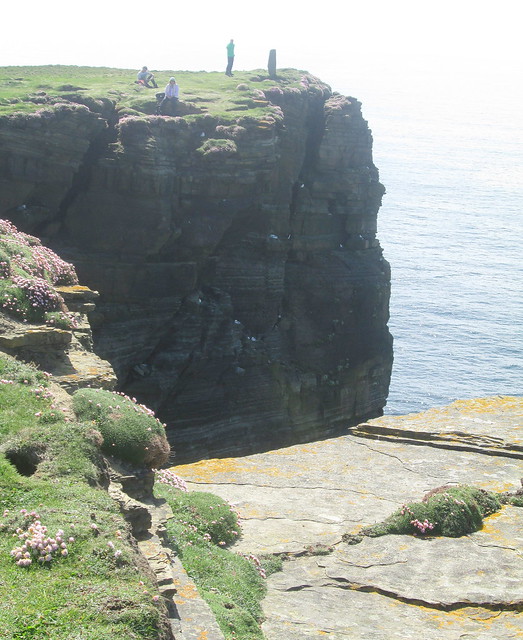
The cliffs at Marwick Head, the westernmost point of mainland Orkney, are stunning – at least on a sunny day.
The sea was a fantastic blue colour:-
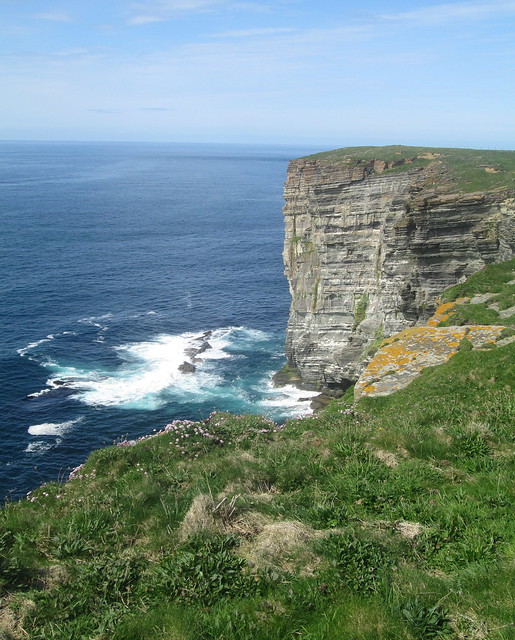
Another cliff:-
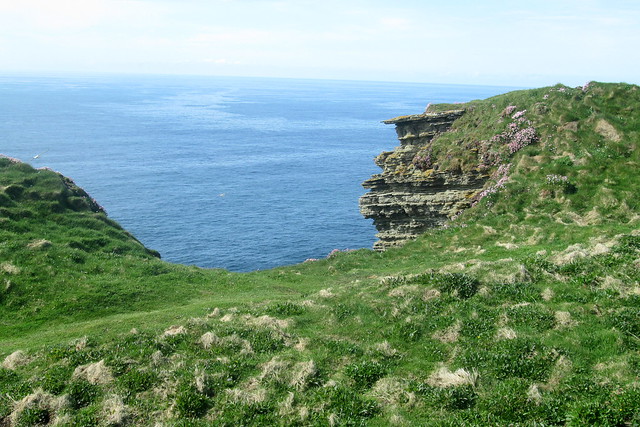
The southernmost headland had a standing stone on it. Seabirds circling:-
View South from Marwick Head, Orkney. Hoy in distance:-

Looking north from the vantage point above. Marwick Head, Orkney, and Kitchener Memorial, standing stone in right foreground. The island off to the left is the Brough of Birsay:-

No Comments »
